Keeping you informed about Palestinian cultural heritage research, and our work here at the Archive

Keeping you informed about Palestinian cultural heritage research, and our work here at the Archive
Showing posts with label Palestinian culture. Show all posts

Monday, October 26, 2015

Palestinian Film Festival Australia 2015


Time for our favorite film festival :)

Cultural Media have announced the 2015 Palestinian Film Festival program in Australia. The Festival is visiting Sydney, Melbourne, Canberra and for the first time, Perth.

It's a terrific program, full of gems like (Paradise Now and Omar director) Hany-Abu Assad's The Idol, which tells the true story of Palestine’s first pop celebrity, Mohammed Assaf who rose to fame after his victory in Arab Idol, and Palestinian cartoonist Amer Shomali and Paul Cowan's The Wanted 18, a documentary animation that  "seamlessly combines the comic and the tragically absurd ... mapping the story of non-violent resistance during the first intifada and how 18 cows came to be declared “dangerous for the security of the state of Israel”."


We are also looking forward very much to seeing Leila Sansour's Open Bethlehem.  We think the Open Bethlehem campaign is wonderful - we especially love their Bethlehem Passports :) - and we've been looking forward to an Australian screening of the film for a while.

Here's dates and details:

Sydney - Palace Norton Street:
Melbourne - The Kino Cinemas
Canberra - Palace Electric Cinema
  • Friday, 27th of November, 2015: 7pm The Idol
and for the first time:

Perth - Cinema Paradiso
For more on each film, head here to to by tickets, here.

If any Archive volunteers or Education Officers are attending sessions drop us a line over on the Archive's Facebook page so we can meet up.

Finally: We know we say this every year but it's worth repeating:

Thank you again to Cultural Media :) 

We know how much time, effort, money and love goes into organizing this event, and we want them to know we appreciate it more than we can say.

More Info:

Friday, October 17, 2014

Librarians and Archivists with Palestine's “One Book, Many Communities: Mornings in Jenin”

LAP - "One book" campaign
source

Most Archive Education Officers and volunteers are familiar with Librarians and Archivists with Palestine ("a network of self-defined librarians, archivists, and information workers in solidarity with the Palestinian struggle for self-determination") because we've sung their praises quite a lot.

We rather like their latest project - a new reading campaign called  “One Book, Many Communities" which is similar in concept to our own real time (wherever Archive staff are based) and cyber (when we meet online as a group) book club meetings and morning teas. So we thought we might take part :)

source

The  “One Book, Many Communities: Mornings in Jenin” project:
"draws inspiration from the “one book, one town” idea—wherein people in local communities come together to read and discuss a common book. Librarians and Archivists with Palestine invites readers, librarians, and others to organize gatherings in January 2015 to discuss Mornings in Jenin, the acclaimed novel by Palestinian-American author and activist Susan Abulhawa. 
"Mornings in Jenin is a sweeping, heart-wrenching historical saga about four generations of the Abulheja family. From Jenin to Jerusalem to Beirut to Philadelphia, the novel follows the family from its displacement from Ein Hod village in 1948 through love and loss over decades of life in Palestine and the diaspora. 
“Every now and again a literary work changes the way people think. Abulhawa…has crafted a brilliant first novel about Palestine… [This] intensely beautiful fictionalized history… should be read by both politicians and those interested in contemporary politics.” –  Library Journal 
"LAP’s “One Book, Many Communities” campaign will introduce readers to the richness of Palestinian literature, and create a broader awareness and understanding of Palestinian history and the struggle for self-determination. 
"Please join us! If you’re interested in organizing a reading group in your community, let us know and check back here soon for more information and resources. Book groups can be held at a library, university or school, at a local non-profit organization or community center, in your living room, or at a bookstore. If you schedule your event for sometime during the month of January 2015, you’ll be connected to readers across the globe who will be reading and discussing the book at the same time. Use your imagination! And let us know what you’re planning! "
We thought we'd hold one in Canberra, but also wanted to suggest some of you - scattered around the world as Archive Education Officers and volunteer staff are - might like to hold one in your own town / country / city.  Check out LAP's very useful "One book "reading group toolkit page on their website for how to plan an event / what type of format / date / venue / reading resources etc and don't forget to tell LAP. And us as well - like LAP we'll list on this blog and link to it on our Facebook page.

You might prefer just to attend one of the events LAP are co-ordinating.  Keep an eye on LAP's events page as they'll be listing new events all the time over the next few months.

source

Those of you near New York might like to attend the official launch of LAP’s “One Book, Many Communities” campaign and meet Susan Abulhawa who wrote Mornings in Jenin, at the Bluestockings Bookstore, Café + Activist Center on Saturday, November 8 at 7:00pm.

We are sure most of you are familiar with Susan Abulhawa - we first became aware of her via her Playgrounds for Palestine project and more recently always look out for her Electronic Intifada articles and book reviews - but if not you might like to check out her Wiki page which says of Mornings in Jenin:
"Abulhawa, who at the time was working for a drug company, visited Jenin as an international observer in the aftermath of the 2002 Israeli attack on a refugee camp there. 
"The visit “transformed” Abulhawa, she later said. “You grow up as a Palestinian knowing about these massacres and the wars and the injustice but it was completely different to be there." "What I saw in Jenin was shocking at so many levels,” she later said, “but it was also quite humbling to watch how the people came together and shared what little they had. So when I left there, I really wanted to tell their story because I knew nobody was going to talk about it.” 
"Returning to the U.S., she had trouble reconciling the concerns of her coworkers at the drug company with the travails of the people of Jenin. “They were two parts of my life and it was suffocating. A few months later I was laid off and it was probably the best thing that happened to me.” The result was a novel, Mornings in Jenin, which was published in 2010. 
"It has been described as “a poignant, lyrical tale tracing four generations of the Abulheja family as they suffer loss after loss - first, with the kidnapping of their son Ismael in the 1948 Naqba by an Israeli soldier and then through their violent expulsion from their village near Haifa.” The novel follows the family through “successive horrors inflicted during the 1967 war, the siege of Lebanon and slaughters in Jenin, Sabra and Shatila, the devastation and agonies wreaked on ordinary Palestinians are depicted through the struggles of the book's protagonist Amal, whose brother Ismael is raised as the Arab-hating David.” 
"The novel, published by Bloomsbury, has been translated into Arabic by Bloomsbury Qatar Foundation Publishing. It has also been translated into at least two dozen other languages and has become an international bestseller. 
“In the Palestinian narrative,” she has said apropos of the book's story, “there are no two sides. There are no two sides to this conflict in the same way that there were no two sides to the Holocaust. There were no two sides to apartheid. There are no two sides to slavery. You have a nuclear power that is pitted against principally an unarmed civilian population. This is not a matter of sides.”
source

We've got two copies of Mornings in Jenin in the Archive's Research Library, one in English and one in Arabic, which we can lend to anyone who wants to read it, but let us know quickly as there will probably be a bit of queue of people wanting it.  Also you could buy a copy yourself - links below.

We thought we might hold our Canberra book reading at Zar Bakery and Cafe (Canberra's only Palestinian food outlet) as that way no one has to worry about catering and exact numbers re attendees. If you've not tried Zar's yet have a read of our earlier post.

For those interested in attending a Canberra event, get in touch via our Facebook page. We'll also be discussing the Canberra event idea further when we meet up for our next cyber morning tea and also when we meet up for the Sydney and Canberra parts of the Palestinian Film Festival which is in the first half on November.

More Info:

Saturday, October 11, 2014

Palestinian Film Festival Australia

source

Yes, it's that time of year again - our friends at Cultural Media have announced the 2014 Palestinian Film Festival program in Australia:
"Cultural Media is pleased to present the 2014 Palestinian Film Festival. As with previous Palestinian film festivals, this year’s festival guarantees to surprise and delight as well as inform and challenge. 
"Showcasing the very best of Palestinian cinema from around the globe, the festival presents an exciting opportunity to see and feel the energy, diversity and creativity of Palestine through film. Visit Palestine in Reel Time and join the growing Australian community discovering and enjoying Palestinian cinema."
The Festival is visiting Sydney, Melbourne - and for the first time, Canberra this year :). Here's the program:

Sydney - Palace Norton Street
  • Thursday, 6th of November, 2014 8:00pm: Condom Lead, Giraffada 
  • Friday, 7th of November, 2014 7:00pm: Though I Know The River Is Dry, Where Should The Birds Fly? Saturday, 8th of November, 2014 4:00pm: Beyond Blue and Gray, Mars at Sunrise 6:30pm: Palestine Stereo, Apartment 10/14
  • Sunday, 9th of November, 2014 4:00pm: The Red Stone, The Village Under The Forest 6:30pm: Xenos, Omar
Canberra - Palace Electric Cinema
  • Friday, 7th of November, 2014 7:00pm: Condom Lead, Giraffada
  • Saturday, 8th of November, 2014 4:00pm: Beyond Blue and Gray, Mars at Sunrise 7:00pm: Though I Know The River Is Dry, Where Should The Birds Fly?
  • Sunday, 9th of November, 2014 4:00pm: The Red Stone, The Village Under The Forest 6:30pm: Palestine Stereo, Apartment 10/14
Melbourne - The Kino Cinemas
  • Friday, 14th of November, 2014 7:00pm: Condom Lead, Giraffada
  • Saturday, 15th of November, 2014 4:00pm: Beyond Blue and Gray, Mars at Sunrise 6:30pm: Though I Know The River Is Dry, Where Should The Birds Fly? 
  • Sunday, 16th of November, 2014 4:00pm: The Red Stone, The Village Under The Forest 6:30pm: Palestine Stereo, Apartment 10/14
For more on each film, head here to to by tickets, here. We're especially delighted that Omar Robert Hamilton's "Though the river runs dry" will have it's Australian premiere at this festival  - just goes to show Cultural Media has excellent taste in selecting it!

Thank you again to Cultural Media - we know how much time, effort, money and love goes into organizing this event, and we want them to know we appreciate it more than we can say :)

More Info:


Sunday, July 13, 2014

katayef: "a dessert worthy of a fairy-tale"

SBS - source

What a week.  "I am in my mother and father's house now, my friends" posts one of our favorite Palestinian food bloggers, Jessica from Bint Rhoda's Kitchen:
"We are in Western Michigan, enjoying the sweet, cool breezes. Our days are filled with summery bliss, with sailing and swimming, with late morning cups of coffee and mounds of my mother's incredible food... But our nights are spent in Palestine. 
"After the children are finally asleep ... we go home. We scroll through the headlines, the news feeds. We jump from news sources to first-hand accounts from our friends, posting updates from our old neighborhoods. It's a strange thing, you know, when your old hometown becomes a war zone. Your friends from home, from your old neighborhood, start posting on their social media pages things that you wish you had never seen. But we cannot look away...."
We feel much the same here in Australia, totally overwhelmed by recent events, no way to help, so worried for friends.  All we can do is pray and remember that we are not without a voice, however small, and that we are not without a role - our job here is to keep Palestinian culture alive. Which we are doing in this post - we need something totally frivolous to take our minds of things.

This post came about because some Archive friends and staff wrote to us about katayef.  In our recent review of Zar Bakery and Cafe in Canberra we wrote:
"one of the reasons we'd come to Zar Cafe that particular day was that Sam had posted on Facebook on June 25 about making katayef for Ramadan. Katayef is a favorite sweet of ours. It's totally over the top. Wiki observes on their Palestinian cuisine page:
"A common Palestinian dessert reserved only for Ramadan is qatayef, which could be provided by the numerous street vendors in several major Palestinian cities or towns as well as typical Palestinian households.  
"Qatayef is the general name of the dessert as a whole, but more specifically, the name of the batter that acts as a base. The result of the batter being poured into a round hot plate appears similar to pancakes, except only one side is cooked, then folded. The pastry is filled with either unsalted goat cheese or ground walnuts and cinnamon. It is then baked and served with a hot sugar-water syrup or sometimes honey"
"We especially love the version made with a crushed walnut, cinnamon rose water and ashta cream filling, either fried or baked, then served drenched in hot orange water scented sugar syrup (Claudia Roden's recipe here).  See why we say it's over the top?  
We'd not had it for a long time.  It's really only served at Ramadan and we'd not been in the right place or the right time for it.  But today we were lucky. While Sam didn't have any ready to eat, as it was a few days still to Ramadan, he very very generously gave us a few pancakes and some advice for how to put everything together - thank you Sam :) 
We assembled Sam's pancakes with our favorite crushed walnut, cinnamon rose water and ashta cream filling, baked them as Sam suggested, then served them with orange water scented sugar syrup to Archive volunteers and visitors for afternoon tea or to take some home for Iftar.  We didn't take any photos - we're sorry about that, but they proved too delicious to stay on a plate long.

Word then got around to other staff and volunteers not here that day. We ended up promising to make some more very soon, and to post some recipes of the staff blog.  Which we are doing now - you'll find several good recipes in the links at the end of this post. We also highly recommend Archive staff and friends in Canberra head over to Zar Bakery and Cafe to try Sam's version.

Completely by chance, another favorite food blogger, Dubai based Arva from I Live In A Frying Pan posted about katayef this week.  Not only that, we think Arva came up with the best ever description of katayef.  Arva was writing about experiencing Ramadan in Dubai in this post, which was titled "Stepping into a Palestinian-Jordanian home for Iftar":
"Ramadan is that holy time when we take a small step closer to the lives of those who are less fortunate. We experience their hunger, their fatigue, their daily struggle for the things we take for granted. And in turn, we channel that empathy into prayers, zakat (alms) and acts of feeding the poor. 
"Dubai has monetized Ramadan. We – ‘we’ as businesses and ‘we’ as consumers – have reduced Ramadan to a series of shopping deals and buffet extravaganzas that are a far cry from the humble, restrained spirit of the month. I laugh every time a radio ad for a five-star restaurant 'Iftar tent' closes with the profound words: Embrace the spirit of Ramadan, likely written by someone whose only experience of the holy month was behind a ludicrously over-stocked buffet table. 
"Just when I’d given up all hope of having an authentic Iftar experience in the city, I receive an invite from Maysa Meqdadi, the Palestinian-Jordanian mother of two living in Mirdiff and running home-based cooking lessons under a brand that shows she means business: Let's Talk Food Dubai ..."
Arva had a wonderful evening at Maysa Meqdadi's home, both preparing and sharing the meal.  Towards the end of the post Arva gives this glorious description:
"Our evening draws to a close with cups of cardamom-infused Arabic coffee, digestive sage tea and a dessert worthy of a fairy-tale – baby pancakes (ataif asafoori) pinched into cones, ladled with our ethereally light, homemade clotted cream, rolled in pistachios, garnished with orange blossom petals or dotted with Damascus rose buds. And drizzled with our homemade sugar syrup."
Ms Meqdadi also creates her family's preferred versions:
"Not averse to a few fun departures from tradition, Maysa creates the Nutella-stuffed ataif that her sons love. And two ataifs down, I end up becoming a Nutella slave as well."
 "A dessert worthy of a fairy-tale". Really, we can't top that description. It's absolutely perfect.

To continue our theme of Palestinian food we're going to publish another post soon about diaspora / contemporary versions of traditional Palestinian dishes.  Until then, why not head to Arva's blog to have a read and check out her stunning photos of Maysa Meqdadi's katayef.  We can only hope Archive friends and staff are lucky enough to be enjoying similar evenings during Ramadan wherever you all are in the world :)

More Info:
(we're adding katayef posts as we find them :)
Recipes:
For more Palestinian / Middle East bloggers see the list in the far right column on our blog's home page.

Thank you to you all for giving us lovely posts this week to take our mind off things.

Wednesday, June 11, 2014

Tatreez Cafe, London


When the Palestine Costume Archive first started, in the early 1980s, if you wanted a Palestinian meal anywhere in the Palestinian diaspora you went to family or friends' homes.  But wonderfully these days Palestinian cafes and restaurants are springing up all over the diaspora. Archive friends and volunteers regularly ask about them, so we thought we might review some of our favorites.

Let's start with the UK:

Archive staff have several favorites including Habibi Restaurant in Coventry and two in London: Maramia Cafe and Tatreez Cafe.  We're going to talk about Tatreez Cafe today.  We chose to review it for two reasons. First, it's name :)  The word tatreez describes traditional Palestinian embroidery. We loved that the cafe uses this "cross stitched" logo:


Second, because Tatreez Cafe is a designed space, specifically created to evoke Palestinian culture and landscape within a 21st century urban environment.  Does it succeed?

It certainly does :) It mixes the modern industrial world (brick walls, burnished metal panels, metal air ducts, etc)

Source: courtesy Relic Interior London

with echoes of older traditions (wooden tables and chairs, handwritten blackboard menu,


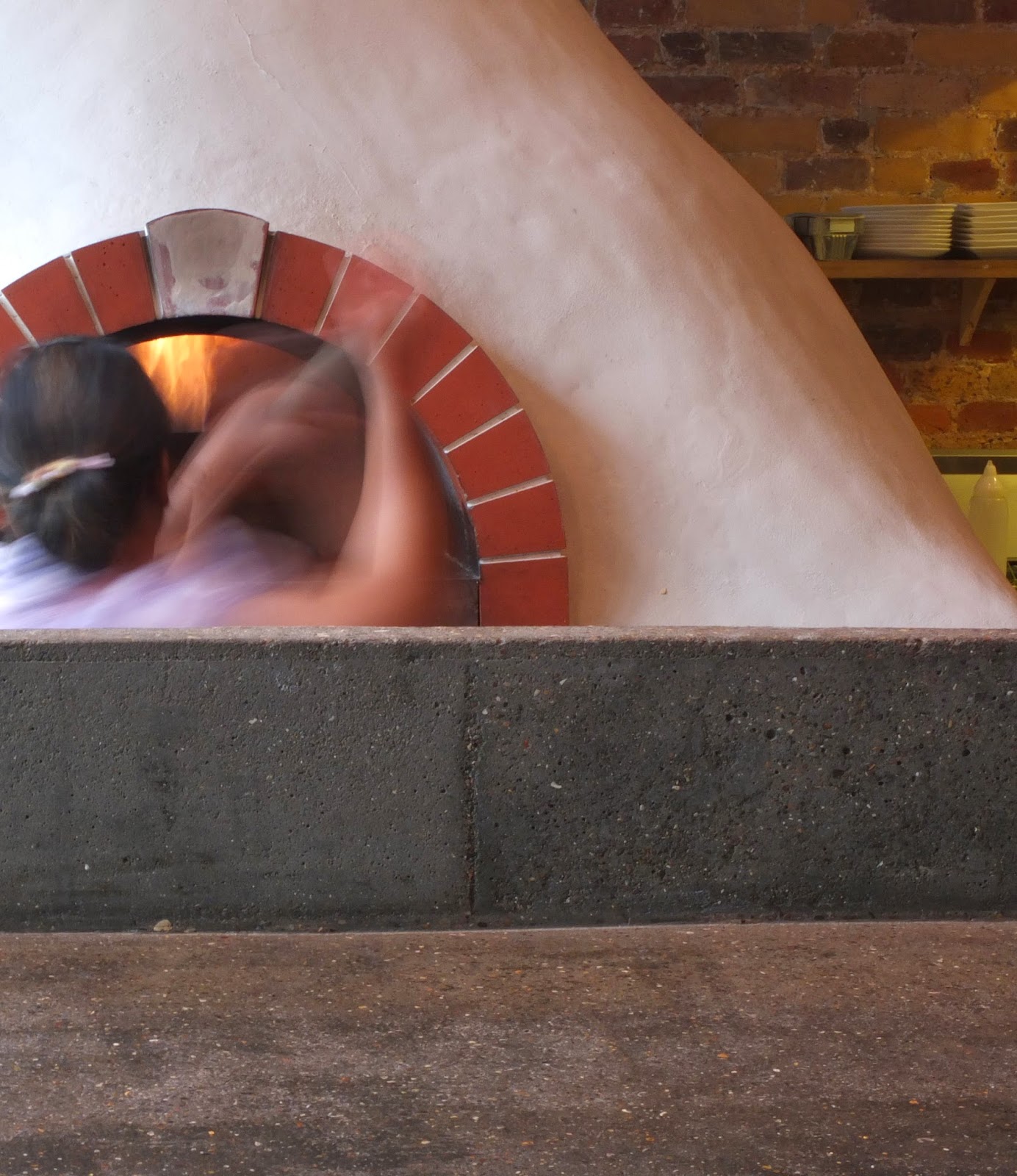
while components like the form and colour of the huge pizza oven

Source: courtesy Relic Interior London

the shape of the vertical decorative wooden panels and the earth coloured tiled floor

Source: courtesy Relic Interior London

as well as these cotton table decorations


 evokes the Palestinian village landscape. Tatreez Cafe was designed by Relic Interiors London.


Interestingly Relic Interiors posted one of their mood boards for the project on their website:

Source: courtesy Relic Interiors London

We really enjoyed going through this and checking off inspiration points against the final cafe design. We think Relic Interiors interpreted their client's ideas really well.

Hang on a moment, you say, one of the embroidery panels in that mood board looks rather familiar. It is indeed. The blue piece at the top towards the centre is a detail of a jumbo cushion embroidered by the Palestine Red Crescent Society in Gaza. Dr Fathi Arafat donated it to our museum. The image has probably been swiped from Flikr, even though we have copyright / all rights reserved stated on those images. Ah well, we don't mind. Perhaps as a return favor Relic Interiors won't mind us using their photographs of Tatreez in this post :) (with source info / links of course)

Anyway, back to our review. We think Relic Interiors did a great job. The Palestinian village feel is enhanced by the use of free hanging black and white poster size photos printed on to fabric of pre 1948 Palestinian village and bedu life.

Source: courtesy voyagingknave on TripAdvisor

In his TripAdvisor review voyagingknave identifies these "massive photos on tapestry" as the work of "Palestine's first female photographer".  Some look like they are from the Matson Collection / American Colony Photographers to us, but they may well be Karimeh Abbud's (the "Lady Photographer" who was the first female professional photographer in Palestine) as much new information has just been uncovered about her. We'll put up a separate post sometime.  

Hopefully the tapestry photo panels at Tatreez Cafe have labels somewhere providing details of the photographer / date / which aspect of Palestinian society they reveal (the bedu desert lifestyle being very different from those of villagers, whose world Tareez Cafe has tried so hard to evoke).

Source: courtesy Relic Interior London

A private room provides a further exhibition space:

Source: courtesy voyagingknave on TripAdvisor

Tatreez Cafe is quite new - it opened last year, with a soft opening mid year followed by a great party on 27 September 2013:


Owner Hana Haj Ahmad posted this invitation:
"It has been quite a journey full of strong determination & hard work from the start of the visualisation of Tatreez Café up till our opening in June this year. And with the help of our lovely family + talented friends, Tatreez was put together, in style! 
"Whilst we were in soft opening mode, we have been working harder and harder to add our unique finishing touch to our beautiful space. Now the time has come to officially celebrate all this hard work, therefore, we invite you to celebrate with us our official opening with a bang! We will be opening our back mezzanine room, outdoor balcony + launching our full brand. We are presenting a photographic celebration of Palestinian embroidery 'tatreez', people + culture.  Thanks to our dear friend Daniel Junsei who has helped us immensely to put this together. 
"We will also be hosting + highlighting Gilgamesh Publishing house’s recent book ‘Jerusalem, Palestine + Jordan’ by Hisham Khatib who has presented a unique collection of art and printed works, covering the 400-year period of ottoman rule in the region.
The evening will host unique performances that will put you right in the mood to compliment our lovely setting: 
8:00
A Middle Eastern band, lead by the amazing ABDEL SALAM KHEIR, that will take you on an authentic 'tarab' journey, performing and singing the most beautiful Arab classics by the likes of giants Umm Kalthoum, Abdel Halim Hafez & Asmahan. Experience enchanting 'tarab', a music that was at its pinnacle in the 50's and 60's, a style of music that is rare nowadays though can still be revived by the likes of Abdel Salam Kheir. 
9:30
YAZ FENTAZI TRIO:
YAZ FENTAZI: The Guardian has described Yaz his compositions as having “breadth and atmosphere, and his oud soloing, which recalls the drive and dynamism of world Oud star Anouar Brahem, is often stunning." He was invited to perform record and tour with the Master Drummers of Africa, Robert Plant (of Led Zeppelin), Natacha Atlas, Transglobal Underground,Peter Ind, and the main composer of Fantazia Band and more. 
ERIC FORD: Drummer Eric Ford has played a huge variety of music including fusion with Hadrien Feraud (of John McLaughlin's band), Latin jazz with Irvin Acao (of Irakere), soul with Ruby Turner, contemporary jazz with Duncan Eagles' Partikel, Nicolas Meier and many others, as well as theatre shows, pop, rock, blues and much else! 
ZAD ADDA: Zad Adda is a virtuoso bass player who grew up with a mix of cultures including North African music, jazz and flamenco. He studied jazz at the Academy of Marseille and he’s the leader and composer of the Beessap Band, based in London. 
You can only imagine the result when these masters combine! Book your diaries and come join our celebrations!
We've quoted this in full because it gives a great idea of what Tatreez Cafe is all about - which is Palestinian culture in all it's forms. Music continues to be a highlight of the cafe, both in terms of special events and "just happens to be playing while you're eating" events.

Source: courtesy voyagingknave on TripAdvisor

But the cafe offers so much more than that.  Rana B. Baker got it absolutely write when she reviewed the cafe on Facebook a few months back:
"There's something about this place which really draws me into it; the atmosphere, staff, food, and music all converge to deliver a unique culinary experience, and, with a book in hand, one can add an intellectual flavour to it..."
Another Facebook reviewer Merce Benet described the cafe as:
"a really special and unique place in the World. Palestinian pure roots in a radically contemporany soul. Genuine fresh mediterranean food in a jazzy and artistic atmosphere."
We were not at all surprised when PalFest began hosting events there.


And then there's the food and drink.

Source: courtesy Yeah Hackney

The cafe serves a small vegetarian menu which is also turning out to be a hit with patrons with food allergies (Simonetta on November 11th, 2013: "Lovely restaurant with very friendly and helpful staff. The food was gorgeous!!! First class ingredients, everything fresh… I am a coeliac, and they made every effort to provide me with gluten free food").  Sarah Lewis and Josh Loeb explain more about the menu in their 14 October 2013 post about the cafe:
"North West London may be the traditional destination for Middle Eastern eats in our city, but last month saw the official opening in Stoke Newington of Tatreez, a Palestinian eatery serving Levantine and vegetarian food. 
"Candlelit and with an exposed brick interior and a selection of (mostly Lebanese) wines and beers, the cafe offers a menu that evidently has an experimental local crowd in mind.
It eschews well-known staples like hummus and falafel in favour of introducing diners to other less famous but equally tasty and authentic Levantine classics such as mana’eesh, a middle eastern style pizza baked in a large white stone oven with toppings such as vegetables with labneh (sour yogurt) and spinach, onion and lemon (mostly £5). 
"And no Palestinian restaurant worth its zataar would be complete without foul (fava beans and chickpeas mashed with garlic and lemon and fresh bread, priced £6.50). The makdoos, a pickled aubergine dish, is delicate and delicious, and the food has a fresh and healthy taste.  Owner Hana Haj Ahmad says the dishes are made according to her mother’s recipes ... Most fun is the jalab, a date-syrup and rosewater drink with pine nuts."
Source: courtesy Hackney Citizen blog

 Ellen Hardy from TimeOut also enjoyed her meal:
"After a bowl of Palestinian olives and a couple of easy-drinking Lebanese beers, we had tart makdous – pickled baby aubergines stuffed with walnuts and chilli – fluffy, creamy and warm full-stewed chickpeas, and crisp manaeesh flatbread baked with a cheese and za’atar thyme mix"
Martina O writes in her review on yelp:
"Animated owner Hana Haj Ahmad served us mana'eesh, a middle eastern style pizza baked in the afformentioned massive stone oven with  labneh, spinach, onion and lemon toppings, we also had the makdoos, a pickled aubergine dish, which is delicious and fried cauliflower,  a uniquely distinctive dish which was a favourite of ours."
Rana B. Baker  found "the thyme and cheese manakeesh are particularly delicious." while Nick Saltmarsh found the fava beans "Some of the best-cooked fava beans I've tasted. And I've tried a few!". Finally Merce Benet suggests patrons "Try the palestinian Za'atar with bread and olive oil...it is just unforgetable! Loved it!"

Source: courtesy Tatreez Cafe Facebook page

The Middle Eastern alcohol selection has also provided popular. Ellen Hardy tried "a honeyed Palestinian white wine, but there are also some excellent Lebanese wines", while one yelp reviewer notes: "Top tip, (if you like wine) try the Lebanese wine, as it's one of the most delectable wines that has ever made the journey down my oesophagus."

Reviewer stuart round also notes on Time Out that the cafe is dog friendly.

Tatreez Cafe comes highly recommended from us - it's a tiny, welcoming corner of Palestine and London is richer for it's existence :)


More Info:

Thursday, October 17, 2013

Palestinian Heritage Museum, Tulkarm


Murad Shishani reports for BBC News on another small museum keeping Palestinian heritage alive, this time in Tulkarm in the West Bank :)
"Bassam Badran has been collecting Palestinian heritage artifacts for most of his life - but not just for his own enjoyment. On al-Mintar hilltop in the West Bank district of Tulkarm, the 64-year-old has set up the Palestinian Heritage Museum, where his treasured possessions are carefully displayed for all to see. 
"Badran says the aim of the museum is to keep the Palestinian heritage alive. "Theodore Herzl said a very famous sentence and the Israeli policies these days are built on it. He said: 'Every Jew should got to Palestine because we are a people without a land for a land without a people'. He ignored the Palestinian people I will prove to him through Palestinian heritage that the Palestinian people have lived on this land and still live and will continue to do so, God willing," the curator said. 
"The Palestinian Heritage Museum traces the region's long history, from the Greek, Roman and Byzantine periods, to the era of the early Crusades and the British Mandate. One of the more precious items is a lamp used by the 'Orient Express', a train that used to run from Istanbul to Egypt through what was known then as Palestine. 
"They used kerosene or oil to light it up and when they wanted to ask the train to stop, they would signal like so, and when they wanted to ask the train to depart it would signal like so," Badran said as he showed how the light worked. Badran said his collection of newspaper clippings showed Palestinian merchants used to export millions of boxes of oranges before the Second World War, while a gold-plated bell pays testament to another significant historical event. 
"On the Titanic, there were Palestinians. The Titanic sank into the sea and the Palestinians (who were on board) also drowned like the rest. Their family at home heard that they drowned on the Titanic, so they held a memorial service and made five bells and gave them as gifts to schools so they could be rung in remembrance of those who drowned on the Titanic," Badran explained. 
While some of the items on display have little monetary value, they offer a valuable glimpse into the past, showing the old Palestinian currency and passports dating back to the 17th and 18th centuries. 
The devoted collector said that while he received words of support for his museum from the Palestinian National Authority, he had spent over 40 years funding the project himself.
"Anyone who wants to collect heritage items needs to have these three traits: the will to collect, and secondly, the time. I have been collecting since 1972, so time is needed. Also you need money, the monetary issue is important. Imagine that I buy the Palestinian pound for 400-1000 (US) dollars, the 100 pound bill is worth 150,000 (US) dollars or more," Badran said. 
With his unique collection of artifacts, Badran says he is determined to maintain the Palestinian national heritage. And he hopes that one day, his prized museum will be even be recognized by the U.N.'s cultural body, UNESCO.

Sunday, September 22, 2013

Human Rights in Palestine conference, ANU, Canberra

Final session

Several Archive volunteers recently attended the Economic, Social and Cultural Rights in the Occupied Territories conference and related events at the Australian National University in Canberra.  We had a great time catching up with each other and old friends, and making lots of new ones.  Some of us also attended the annual National Palestine Advocacy Solidarity Gathering hosted by Australia Palestine Advocacy Network the day after the conference.

Being back at ANU reminded us of other conferences we've attended there.  I think I've presented on Palestinian issues at about seven, but my all time favorites were:
Now we were all back again at ANU for another human rights conference, but this one specifically related to Palestine. I first met it's convenor Dr Victoria Mason in 2002 at the First World Congress of Middle Eastern Studies in Mainz, Germany, where we were both presenting and where the Archive was displaying "Symbolic Defiance: Palestinian costume and embroidery since 1948".   She very kindly wrote a review  - as this was the traveling exhibition 'lost' in transit at LAX on it's way to it's next venue (at the MESA conference in 2003) Dr Mason's review is one of the few this important exhibition received and we treasure it on our website to this day.

Here's some details from the human rights conference's website:
"On the 11th and 12th September 2013 The Australian National University will host a groundbreaking conference on Palestinian human rights.

"The Israeli occupation of the Palestinian Territories has impacted both the civil and political rights (CPR) and economic, social and cultural rights (ESCR) of Palestinians. Yet in line with the broader marginalisation of ESCR within the international human rights field, very little of the literature on the human rights situation in the Palestinian territories addresses issues specifically from the ESCR framework.

"The impact of the occupation on Palestinian ESCRs has been considerable: including restrictions on movement (as a result of the ‘Security/Separation Wall’, checkpoints, curfews  and closure policies) and the resultant impact on the Rights to Education and Health; de-institutionalisation of the Palestinian economy; expropriation of Palestinian land and resources (including water); forced evictions and house demolitions; and destruction of land and property.

"This conference will be a world first by bringing leading international experts together to discuss ESCRs in the Occupied Palestinian Territories (OPT). Over the two days, panels of these experts will address the following issues within the OPT:

The Right to Health (including access to adequate medical services and treatment)
The Right to Education
The Right to Adequate Water and Food Security
The Right to Adequate Housing (including issues around house demolitions)
The Right to Work
The conference will examine these issues through focusing on:
Human rights obligations enshrined in international law
Duty-holders of these obligations (including the Israeli Government and the Palestinian Authority)
Evidence of violations
Mechanisms for complaints and other forms of remedy for violations
Practical steps for implementing and monitoring ESCRs
Professor Jeff Halper speaking
It was a very interesting couple of days.  The conference was fully subscribed, so there was a good crowd.  Lots of great presentations, you came away really feeling you'd learned something about each topic and an honour to meet the speakers.  Lots of informal discussions, in part facilitated by having attendees sit at round dinner tables.   

Here's the transcript from an SBS journalist who attended the second day and really picked up on things that mattered:
Reviewing the state of Palestinians' human rights by Thea Cowie, SBS Radio  Transcript from SBS World News Australia Radio 13 SEP 2013 
"Israeli-Palestinian peace talks have resumed and fighting has died down, but human rights experts say life for Palestinians is harder than ever.
"International academics and activists have gathered at the Australian National University in Canberra for a wide-ranging conference on the state of human rights in the Palestinian territories.  Direct peace talks between Israel and the Palestinians resumed late in July, after a three-year stalemate in the negotiations. No-one is expecting any quick breakthrough.  
Professor Jeff Halper speaking
"Israel-based Nobel Peace Prize nominee Professor Jeff Halper says life remains uncertain for the four-million Palestinians living in the Gaza Strip and the West Bank. He says Israeli occupation of the territories restricts all manner of rights - civil, political, economic, social and cultural. 
"Professor Halper says his work to defend Palestinians' rights to housing is ongoing. "I've talked to many Palestinian women who say to me 'the first thing I do when I get up in the morning is I look out the window to see if there's bulldozers and soldiers and if the coast is clear I get dressed and wake up the kids and start making breakfast.' And in fact the family lived in their home for five years and one day in the middle of the day they're having lunch and there's a knock on the door.
"Saleem answers the door, Rami says to him 'is this your house?', Saleem says 'yes it's my house', he says 'no it isn't, it's our house now. You got ten minutes to get all your belongings our we're going to demolish it'. Here's where the soldiers literally kick in. Saleem was beaten and kicked out of his home. In the commotion Arabia managed to slam the door shut and she called us. So the soldiers broke the windows of the home, threw in tear gas to flush out the family, she was carried out unconscious, the kids screaming and yelling in all directions." 
 Dr Sarah Roy in the final session
"Harvard University senior research scholar Doctor Sara Roy says the absence of violence with the Israelis does not mean the absence of difficulties for Palestinians.  She believes the new peace talks will become just the latest in a series of failed discussions which have seen Palestinian rights gradually eroded since 1993.
"They've faced growing constraints. In fact what many people don't understand about this so-called peace process is that it diminished, and weakened and contracted Palestinian life rather than the opposite." 
"Dr Roy and her colleagues argue the Israeli occupation compromises Palestinians' access to adequate medical services, water, education, food, housing and work. She says tasks like collecting groceries or going to school are exponentially complicated by more than 600 fixed and flying checkpoints dotted across the territories.  
"And she says sometimes it's what people living elsewhere would regard as simple things that highlight how restrictive life is for Palestinians. "I have friends who live in Ramallah in the West Bank. The wife is from Gaza. Now Gazans are restricted from entering the West Bank and have been for a very long time. My friend has had two children they're now 12 or 13 years old. Their grandparents who live in Gaza have never seen their grandchildren and you're talking about distances that you can measure in the tens of miles. It is easier for Palestinians to go to the United States than it is to travel between West Bank and Gaza." 
"PhD Candidate at Queens University Belfast, Lucy Royal-Dawson has conducted interviews with Palestinian students about their lives. 
 Lucy Royal-Dawson Queens University Belfast 
"She says Israeli occupation has become so normalised that Palestinians don't realise the barriers they face. "The last question I asked in a lot of the interviews was 'and so how does the occupation affect your education?' and people would say 'no, no it doesn't. It used to but not any more.' And you think 'wow, that's how deep the normalisation has become that people can no longer see it, it's only represented by acts of violence.'" 
"Despite the ongoing difficulties, academics like Sara Roy do see glimmers of hope. Like earlier this year, when a three-year-old Jewish boy fell from the fourth floor window of his home in Israel and was later declared brain-dead. His parents decided to donate his organs to a Palestinian boy.  
"Dr Roy says she's heard other similar stories - not many, but some. "In the final analysis people are human beings and I truly believe, and I've seen many examples of this in my many years over there, that when you bring people together and you allow them to see each other as human beings, as monthers, as fathers - that often, not always, but often - people can sometimes break down these terrible political barriers that have been erected for them and this is one powerful example of that." 
"Professor Jeff Halper, an American Israeli, has been arrested numerous times defending the rights of Palestinians. He's a co-founder of the Israeli Committee Against House Demolitions, which helps Palestinians to replace homes destroyed by Israeli authorities in the occupied territories. Professor Halper says the committee's work shows Israelis and Palestinians can work together. "We've built 187 homes in the last 12 or 13 years which isn't much in a humanitarian way. But if you think of it as 187 joint acts of resistance of Israelis and Palestinians then it really means much more than that." 
"The conference at the ANU has been criticised by Jewish community leaders who say speakers lacked academic credibility, and that it amounted to blatant anti-Israel advocacy."
We won't give that criticism further fuel, other than to say we totally enjoyed our time amongst "fringe conspiracy theorists and ideologues", and "scholars [with] no academic credibility" :).   But if you are interested we recommend a quick read of our favorite response: Middle East Reality Check's post Anatomy of a beat up.   It was a pleasure to be sitting next to George Browning while he drafted this response to The Australian:
"In a democratic society, debate about human rights should be the most protected of all debates. Why is the topic of rights important everywhere except the occupied territories? Surely the effect of occupation of Palestinian land and control of the lives of Palestinians is essential information to Australians who support the activities of Israel in the occupied lands. In the mix of tensions that are the reality of the Middle East, any light on factors that contribute to those tensions should be encouraged. George Browning, president, Australia Palestine Advocacy Network, Canberra"
More info:
All photos: J Allenby