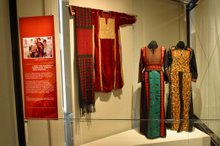
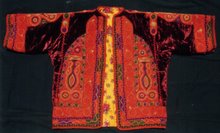
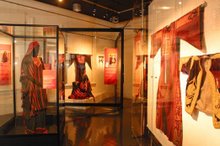
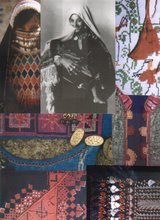
Displays of Palestinian costume are still fairly rare around the world, so here at the Archive we like to document each one as much as we can.
Quite often when we post about Palestinian heritage displays it can be a tough read, as we record stories of organizers - no matter where they are in the world - facing major problems budget wise, politics wise, content wise (when museums / exhibition venues try to control info on labels and wall text, or stop certain photos being used) etc with their display.
Sometimes the problem relates to the quality of the heritage material being displayed. Some times it's hard for exhibition organizers to know how to identify and date Palestinian material, for example how to tell pre1948 costumes and textiles from mid 20th century ones. Or what garments go together on a mannequin. Some items proposed for display may need (expensive, time consuming) conservation. Sometimes the information on the labels is wrong. Sometimes the items displayed are not even Palestinian.
It's a challenge. That's what happens when cultural knowledge has been ripped away and must be reclaimed inch by inch. But we'll let you in on a secret. Things are slowly improving on this front. In fact, the particular exhibition we are posting about today provides a good example of that. This Palestinian costume display was part of a larger exhibition that looked at Middle Eastern costume, which itself was a small but important part of
"the largest ever Arab arts festival in the U.S" which was "
widely seen as a landmark for the representation of Arab culture in the United States". Even better, there was no problem about the budget or about the quality of the Palestinian cultural material displayed or the info on the labels.
Which means, if you are out there looking at creating an exhibition of Palestinian costume, then this is an excellent example to use. It may only contain a handful of mannequins devoted to Palestine - and we find the white hands on those mannequins a bit intrusive lol - but the quality and cultural knowledge being exhibited is the best.
"Brides of the Arab World" was part of the
Arabesque Festival which ran at the Kennedy Center in Washington DC from February 23 to March 15, 2009:
"Unwrap the cultural treasures of the Arab world in this Kennedy Center international festival showcasing the varied cultures of the 22 Arab nations that represent the Arabic-speaking world. From the Arabian Gulf to the Levant to North Africa-this region of the world is the birthplace of human civilization and features extraordinary diversity in geography, traditions, landscape, religion, and contemporary aesthetics.
"In cooperation with the League of Arab States, the three-week festival brings together artists, many of whom are making their U.S. debut, in performances of music, dance, and theater, as well as exhibitions featuring art installations, fashion, a soundscape, cuisine, a marketplace, and much more. Discover the evolution of art forms born from the cradle of human civilization. Experience an amazing breadth of culture that spans both eons and continents"
Talk about an
amazing program of events! Some Archive volunteer staff
did attend, and the rest of us were very envious. It was also great to see Arab culture displayed in the US. As Piney Kesting later noted in
Art to Heart in Saudi Aramco World:
"The seeds for “Arabesque” were planted more than four years ago. “I believe the arts create peace and provide a window onto understanding people,” says Michael Kaiser, president of the Kennedy Center. He explains that since 2004, the Center has sponsored festivals focused on France, China and Japan; for 2009, he says, he wanted a larger festival focused on regions about which Americans have little cultural knowledge. “In the Arab world, we know only about politics and oil,” Kaiser comments. “We have no knowledge of Arabs as human beings. I felt it was important for us to dispel this ignorance, and also to show the immense beauty that has been created by Arab people throughout the centuries.
"For the festival’s 21 days, visitors found an open passport to the Arab world—no visas required. There were daily performances on several of the Center’s nine stages; discussions of Arab literature with more than 30 authors; Arab films; an exhibition of 40 wedding dresses from all of the 22 Arab nations; contemporary art exhibits; shopping in “The Souk” (“Marketplace”) and learning about the Islamic world’s contributions to science in the “Exploratorium.”
James Zogby
wrote in The Huffington Post:
"Negotiating the logistics and politics necessary to assemble the festival was monumental. Locating the talent, securing visas, transporting sets, costumes and works of art was, itself, a remarkable undertaking, a tribute to the foresight and vision of the Kennedy Center's Director, Michael Kaiser, and the determination and the commitment of his staff to see the project to fruition.
"Five years in the making, the Director and staff of Washington's prestigious Kennedy Center, traveled across the Arab world to assemble a wide range of artists from all 22 Arab countries. Eight hundred performers, in all, have come to the U.S., from the traditional (Berber singers from Morocco), to the more avant-garde (Marcel Khalife, or Debbie Allen's remarkable "Omani Dancers"). There were musicians, singers and dancers, poets and painters, story-tellers, artists and craftsmen represented in the group.
"Arabesque" provides Americans and Arabs alike with a profound learning experience. As Secretary General of the Arab League, Amr Moussa, noted, never before have artists from all 22 Arab countries been represented under one roof in one festival. As the festival unfolds over its three-week run, tens of thousands of Americans will see the richness and diversity of Arab culture, in all its many exquisite forms..."
The Palestinian costumes were from the collection of the
Palestinian Heritage Foundation, an amazing foundation that does excellent work and has an excellent collection. The Palestinian Heritage Foundation later wrote in their
Newsletter for March 2009:
“Brides of the Arab World” featur[ed] 48 traditional bridal outfits from all 22 member countries of the Arab League ... a fascinating display of rich textiles, embroidery and intricate jewelry.
"The Palestinian Heritage Foundation presented five costumes from Palestine representing Bethlehem, Jerusalem, Ramallah, Al-Khalil and Asduud, as well as other costumes from Jordan, Syria, Lebanon and Tunis. The costumes from Lebanon and Tunis come from the collection of the late Dr. Hala Salaam Maksoud, donated by her family to PHF."
You'll find some excellent photos of the installation
on the PHF's newsletter. Coleen T at the
Costume History is Fun blog has several posts with excellent photos of the displays,
including Palestine (10 July 2010), we've reproduced several here in fact it was finding these photos that prompted this post. Pierre Radulescu, who posted the You Tube videos above, also posted some photos of his blog
here.
The detailed labels accompanying the five Palestinian costumes were very good, combining both the past and present, which as one reviewer noted, is rare:
"The descriptions of the bridal gowns and their history reveal what is usually hidden from American audiences; that the traditions, cultural expressions and heritage of the Palestinian people mingled with adjacent Arab lands and dated back to the time of the Roman Empire. Unfortunately, many of these traditions and cultural aspects from early times have been more recently destroyed"
Brilliantly, Coleen T included label text in her Costume History is Fun posts, so we are going to
quote some below:
Asdud Dress
"With its lightweight fabric and V-cut neckline, the Asdud costume was well suited to the warm Mediterranean climate of this coastal town. This particular dress was hand-woven in the 1930s in nearby Mejdel, once famous for its narrow linen edged with red or turqoise stripes. Similar fabric has been excavated from sites dating back to the 2nd century, and the embroidery patterns (cypress trees, combs) are just as ancient. The headdress or saffeh resembles that woen in other coastal areas; decorated with coins, it is wrapped around the bride's braided hair and covered with a large embroidered headscarf.
"Since the 1948 war, the former residents of Asdud have lived in refugee camps in nearby Gaza. Asdud is now the Israeli town of Ashdod and its traditional embroidery has almost disappeared, although Palestinian workshops in Lebanon and Jordan do still re-create these classic patterns on shawls, jackets and bags. "
El Khalil Dress
"The El Khalil wedding dress is famous for its winged sleeves and heavy embroidery, with silk cross-stitch covering most of the linen. The bride may also wear a coin-covered vest called a miklab. The headdress, richly decorated with coins and precious stones, sits atop a simple cap. Reserved exclusively for weddings, it is shared by all brides from the same clan. A large embroidered linen scarf called a ghudfeh is draped over the headdress; after the bride is presented wo the wedding guests, the scarf is removed to reveal her complete costume. Embroidery motifs on this dress, made in the 1940's, include "acanthus leaves with cup" khemet-el-pasha (the tent of the pasha) and feathers."
Jerusalem Dress
"Made in the 1940s, this wedding dress from the village of Ein Karem reveals the strong influence Bethlehem exerted on the embroidery in villages around Jerusalem in the early 20th century. The primary fabric is imported European velvet, and the chest piece, side panels and sleeves are silk embroidered with couching. Called talhami or tahriri, this needlework was usually done by professional women embroiderers in the towns of Bethlehem, Beit Jala and Beit Sahur. And as in Bethlehem, a short-sleeved embroidered jacket (taqsireh) was worn over the long-sleeved dress, creating a lovely shirred effect. The scarf covering the headdress was trimmed with locally made lace, a feature unique to Jerusalem costumes.
"This is but one of the eight different Jerusalem styles; each boasts different fabrics and colors, but all feature similar embroidered panels. The former residents of Ein Karem are now refugees (the village has become a popular Israeli tourist destination). but Palestinian embroidery workshops still reproduce the Ein Karem dress as well as the taqsireh which many women now wear as an elegant jacket"
Ramallah Dress
"One of the most famous Palestinian costumes, the Ramallah bridal outfit is said to have originated in the 5th century. This one was made in the 1920s of hand woven linen embroidered with silk thread in a cross stitch pattern. It features the traditional squarechest piece adorned with age-old motifs such as flowers, palm trunks, birds and the S- shaped alak or leeches (used for medicinal purposes, they represent good health and longevity). Its wuqa headdress is decorated with Ottoman coins and cross stitch embroidery.
"Draped over the headdress is a matching scarf embroidered with crosses, a reminder that Ramallah was a predominantly Christian town in the 1920s. During the 1930s, silk scarves imported form the Far East became popular, but today the traditional costume is worn without a scarf. On special occasions, Palestinian women intent on preserving their heritage wear contemporary versions of the dress made of synthetic fabric embroidered with cotton thread. The headscarves have been re-purposed as wall hangings, tablecloths and cushions. "
Bethlehem Dress
"A woman would wear this costume for the first time on her wedding day, then on festive occasions thereafter. Distinguish by long, winged sleeves called irdan, these dresses were made from a special linen hand-woven exclusively for that purpose. The fabric was crafted in lengths of about 10 yards; silver brocade at one end was used for the lower back of the dress, a tradition that goes back at least 10 centuries. The shatweh, or headdress, resembles those seen on ivory statues dating from 1200 BC. It was presented to the bride at their wedding and could be worn only by married women. Decorated with Ottoman coins and coral, the shatweh, is covered by a large headscarf.
"Most of the embroidery on the dress and headdress is metallic and silk couching. The square chest piece features a traditional design with floral rounds in each corner and a central medallion containing a cross (this dress dates from the 1930s when Bethlehem was predominantly Christian). For Muslim brides, flowers replaced the cross. This special linen has not been woven since the 1960s, but Bethlehem dresses made with synthetic fabric and embroidery thread are available to today's brides, who often include one in their weddings along with a modern white gown. On special occasions, today's Palestinian women also wear contemporary jackets and accessories inspired by the traditional couching."
A lot of work went into getting those labels right, in discussing both pre and post 1948 styles, and in tying whole outfits together so you know what goes with what. We adore statements like "A woman would wear this costume for the first time on her wedding day, then on festive occasions thereafter". This addresses one of our pet hates - the pretty much constant misrepresentation in European and North American exhibitions of traditional Palestinian dresses as bridal gowns in the Western sense, worn once and never again. This was absolutely not the case. The majority of items in a woman's married wardrobe were sewn before her wedding as part of her trousseau, worn on specific days during her wedding celebrations and then afterwards on special occasions.
"Brides of the Arab World's design and installation would have been tricky, because the Hall of Nations / the Hall of States are not the easiest of display areas, being major through ways. You also need to tie the exhibition in to the rest of the proposed festival. As Piney Kesting notes in Saudi Aramco World:
"The difficulty with exhibits that involve 22 countries, explains “Arabesque” exhibit designer Adrien Gardère, is finding “a common thread that emphasizes the legacy and the roots that link the artists.” In the case of the Kennedy Center, which is neither a museum nor an exhibition hall, “you want the exhibits to enhance the performing arts and to capture the attention of a public that has come primarily for the performances,” he says. In less than eight months, Gardère produced exhibits that used Islamic architectural elements and proved as fascinating and provocative as the artworks themselves
"Visitors entering the Kennedy Center were captivated by a row of traditional wedding dresses in the “Brides of the Arab World” exhibit. Upstairs, Egyptian sound engineer Alaa El Kashef ’s “Soundscape: Souk” evoked a busy Cairo street. Nearby, the exhibit of Azza Fahmy’s jewelry, a blend of traditional and modern design, was displayed nestled in stacks of unglazed clay pots. Women’s art from throughout the Middle East appeared in a room constructed of mashrabiyyah windows—the traditional turned-wood screens that allow in exterior light while preserving interior privacy. In the Exploratorium, visitors lay back and watched a 3-D film on the golden age of Islam, projected onto the ceiling."
It was certainly an effective installation. The entire Arabesque festival was widely praised. "Arabesque: More Significant than Apparent" headlined
one review, while James Zogby
concluded:
"The experience of "Arabesque" will shatter stereotypes, and put new definition to the meaning of being Arab. For too many Americans, Arabs exist only as one-dimensional political beings, lacking hearts or souls ... During the next three weeks, this caricature of Arabs will be destroyed ...
"There are lessons to be learned from "Arabesque." It should be repeated. The seeds that have been planted by this festival will grow on their own - but how much better if they are nurtured and cultivated? The lesson here is that, not only is the Arab past glorious, but that the present and future are, as well. All of us owe thanks to the Kennedy Center for reminding us of that, and challenging us to do better at remembering it."
More info about the exhibition:
- Arabesque Festival
- Arabesque Festival schedule
- The Costume History is Fun blog has excellent photos of the Palestinian displays here 10 July 2010
- Costume History is Fun blog - other countries: Jordan, Syria, Algeria, Kuwait and Qatar, Iraq and Saudi, UAE and Bahrain, Morocco and North Africa, Yemen, Egypt,
- The Fashion Museum blog has a post here
- Palestine Heritage Newsletter March 2009
- Piney Kesting Art to Heart Saudi Aramco World. Volume 60, Number 3May/June 2009
- James Zogby Arabesque The Huffington Post 27 Feb 2009
- Washington Post - Immersed in Arab culture
- Washington Times - Dance "Arabesque" immersion
- Washington Times - Kennedy Festival expores Arab culture
- Dan Lieberman Arabesque: More Significant than Apparent Palestine Chronicle 03/29/2009
- Will Youmans Arab American News
- You Tube videos posted by Pierre Radulescu