Keeping you informed about Palestinian cultural heritage research, and our work here at the Archive

Keeping you informed about Palestinian cultural heritage research, and our work here at the Archive
Showing posts with label Contemporary Muslim fashions. Show all posts

Wednesday, May 28, 2014

"Beyond the Veil: Dress, Identity, and Tradition through the Eyes of the Muslim and Arab Women of Greater Milwaukee"

Enaya Othman holds one of the handmade
 items featured in “Beyond the Veil”
Michael Sears
source

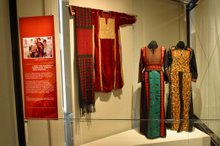
A very interesting exhibition is currently on display at the Milwaukee Public Museum, which shares curatorial goals with our museum's own traveling exhibitions "Portraits without names: Palestinian costume" ("featuring 200 years of Palestinian design and examining how traditional costume and embroidery has long reflected the culture and identity of the Palestinian people", which is curated to include garments and stories of the nearest Palestinian diaspora community to wherever it being displayed) and "Secret Splendours: women's costume in the Arab world" ("curated to examine and redress Western misconceptions regarding Arab and Muslim life, and featuring urban, tribal, village and oases traditional costumes from Morocco to Yemen").

 "Beyond the Veil: Dress, Identity, and Tradition through the Eyes of the Muslim and Arab Women of Greater Milwaukee":
"is a special exhibition created as a joint project between MPM and the Arab and Muslim Women's Research and Resource Institute (AMWRRI), showcasing the dress of Muslim women from the Milwaukee area and exploring some enduring traditions in Muslim clothing. This exhibit aims to expand public knowledge concerning the significance of cultural clothing beyond stereotypes, and to give women from the Milwaukee community an opportunity to speak about their experiences both here, and in the diverse societies of their ethnic descent. 
"This exhibit, supported by a grant from the Wisconsin Humanities Council, features 30 traditional outfits, as well as various special occasion and day-to-day use items like table sets and jewelry, owned by local women with strong ethnic ties to countries ranging from Jordan, Palestine, and Kuwait, to Morocco, India, and Pakistan. 
"Beyond the Veil caps a four-year-long project led by AMWRRI dedicated to the study of the attitudes toward cultural clothing among the Muslim and Arab women of the Milwaukee area. Testimonies gathered here highlight the importance of cultural clothing and its meanings to Arab and Muslim women who migrated from various Muslim countries, and illustrate how women from different generations continue to recreate and adapt elements of their cultural dress to meet modern tastes."
 Annysa Johnson published the following article "Milwaukee Public Museum show explores relationship between Muslim clothing, identity" in the Journal Sentinel on May 25, 2014:
"In December, on the eve of her niece's wedding, Enaya Othman gathered with the women of her family for the traditional painting of the henna on the bride and her attendants. 
"Like the others, Othman donned a traditional gown, a colorful Roomi thob of her native Palestinian territories. But this was not just any dress. Handmade in her homeland, it was fashioned from pieces of a linen garment worn by her late mother. The cross-stitching of its silk embroidery tells the tale of its origins in her family's home region of Ramallah al-Bireh. 
"Othman's thob is now on display at the Milwaukee Public Museum as part of a dazzling new exhibit that exploresthe complex and evolving relationship between traditional dress and identity for Muslim women whose families immigrated to Wisconsin from around the world. "This dress is connected to my heart, my traditions, my mother's traditions," said Othman, an assistant visiting professor of Arabic language, culture and history at Marquette University and the driving force behind the exhibit, "Beyond the Veil." "It tells my mother's story, and I will one day hand it to my daughter, so she can tell her story." 
"Beyond the Veil," which opened to the public this month, grew out of an oral history project launched in 2010 by the nonprofit Arab and Muslim Women's Research and Resource Institute co-founded by Othman through her work at Marquette.  
"That project transcribed the narratives of dozens of Arab men and women, both Muslim and Christian, whose families have settled here over the past century. Recurring themes, especially among the Muslim women, centered on appearance and identity and how the clothes they wore opened them to stereotyping and discrimination and affected their adjustment to life in the United States, according to Othman.
"What researchers found were varied and complex relationships to traditional dress: women who wore it exclusively, and others just for special occasions. There were women who embraced it, yet fought against being stereotyped by it; and younger women who were rediscovering and modernizing it. Depending on the woman, the clothes reflect a sense of modesty or pride; a connection to history, to faith, culture or regional identity.
Visitors milled through the exhibit at its opening, many of them first-generation immigrants who had donated items for the show. 
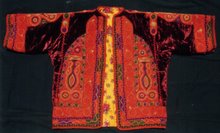
"My daughter-in-law wore this for her henna night; we had it specially made," said Ibtisam Ahmad, pointing to an elaborate velvet mallaka embroidered with leaves and flowers in brilliant jeweled tones, the gold coins of the bride's dowry sewn into a velvet sash around the neck. 
"Museum President Dennis Kois called it "one of the most beautiful" textile exhibits that he had seen. Middle Eastern scholar Iman Saca, whose mother founded the Center for Palestinian Heritage and Embroidery Preservation in Bethlehem, spoke on the history and symbolism of the art, and the importance of such exhibits in keeping that history alive.
"Every stitch, every color, every design had meaning," said Saca, director of the Middle Eastern studies program at Saint Xavier University in Chicago. "And hopefully, we can preserve that meaning." 
"The exhibit is a collaboration between the Arab and Muslim Women's Research and Resource Institute and the Milwaukee Public Museum. It was financed in part with a $10,000 grant from the Wisconsin Humanities Council. 
"The show is a glimpse at the diversity of Wisconsin's Muslim community, through the lens of fashion. It features 30 traditional garments, jewelry, accessories and other artifacts from a wide swath of the Muslim world, divided into five regions: Bilad al-Sham, which encompasses modern-day Syria, Lebanon, Jordan and the Palestinian territories; the Gulf States; North Africa; South Asia; and Turkey. It's a visual feast of color and texture, from the velvet and embroidered Palestinian mallakas to the flowing abayas of Saudi Arabia and the silk sari and gauzy shalwar kameezes of India and Pakistan. 
"All of the items were donated by members of the local Muslim community. Many have been passed down from mother to daughter or were specially made by seamstresses in their countries of origin. Some feature designs unchanged for centuries; others reflect a kind of globalization of design with the melding of motifs across cultures. "It shows how all these regions are being mingled together by immigrant women to make their own cultural clothing," Othman said. "It's not anymore just traditional — something in the past — but it is something alive for today."
If you can't make it to the exhibition, why not take a moment to view this You Tube video of  a Henna Night event the Arab and Muslim Women's Research and Resource Institute was involved with :)


More Info:

Wednesday, May 8, 2013

Traditional Day, Bethlehem University


Wow.  We are so impressed.

The You Tube video at the top by RoyaTV captures Bethlehem University's Traditional /  "Be Proud With Your Palestinian Dress" Day.  Even if you don't speak Arabic it's well worth watching to see the lovely traditional garments being worn.

Photo: Yahya Hbaibb
Source

Traditional Day took place on April 16 2013. Prior to the day, the event was promoted on Facebook by students Hind Abu-Shkhadim and Shoroq M. Thawabta. We hope they and photographers Ghassan Shosha and Yahya Hbaibb won't mind us sharing some of the photos they've all shared on Facebook.

Photo: Gassan Shosha
Source
Traditional Day is a wonderful idea. It encouraged students to be proud of their folklore and heritage, as well as seeing it as a symbol of resistance: "you can wear anything related to Palestinian traditional textiles, "tatreez" like clothes, handbags, scarves… etc.".  As you can see from the photos it worked very well.  It's also lovely to see people walking around the university's campus in traditional dress, in the You Tube video.

Photo: Gassan Shosha
Source

We often get contacted by people wanting to put on a Palestinian fashion parade.  We can now direct them to the video above and say:
"look, these students did this perfectly. No-one is wearing anything from before 1948, there's not a single outfit styled in historical Bethlehem costume. They don't need it. They've showing what Palestinian costume is now.  It's a riotous mix of red and black embroidery on "shawal" and "6 Branch" style dresses and triangular shawls (first designed in Palestinian refugee embroidery projects to go with the "shawal"), with flashes of bright colour from Muslim headdresses. Older married women are even wearing the traditional white cotton scarf - see May Jaber, Assistant to the Dean of Students? And everything is worn with love and pride and passion.""

Later after the fashion parade May Jaber (who has some nice dresses - also here) wore the cotton headscarf like a shawl. Also check out Hind Abu-Shkhadim's unusual thob - a shawal style qabbeh and dense embroidery in the skirt sections similar to Sinai bedu styles, with an unusual mix of blue, red and white cross stitch.

Photo: Gassan Shosha
Source

While we can see some traditional patterns like the saru, other patterns like the blue ones look like new interpretions. We also like her sneakers :)

Photo: ?
Source

Anyway, enjoy the photos. There are a few more here.

Photo: Gassan Shosha
Source

A modern blue shawal and on the right, a 6 branch with a shawal style V shaped qabbeh.


Another interesting very heavily decorated thob in unusual colours.


Lovely thob inspired by the pre1948 heremezy technique.


On the left, an embroidered waistcoat, in the middle a shawal style tunic , on the right an embroidered triangular scarf worn as a shawl.

Photo: Gassan Shosha
Source

On the right - Black top worn with embroidered belt.


How's this for stylish - an embroidered triangular shawl worn as a headscarf over jeans and boots (more here)
Source

Saturday, March 2, 2013

The most beautiful lady at the Oscars

Source: Huff Post
As we wrote on Facebook:
"The most beautiful lady at the Oscars this year was definitely Soraya Burnat (wife of Oscar-nominated filmmaker Emad Burnat) in her Palestinian embroidered dress. Such a lovely outfit to see on Hollywood's red carpet! :)"
  
We spent a lot of time delightedly checking out Mrs Burnat's outfit.  It comes across as a white and pink ensemble in the photos taken that day, but from closer examination we think the cross stitch embroidery is more red than pink. Which would make this thob quite traditional in style, but with some lovely contemporary features - you can see similar designs currently in fashion in stores like Al Jriri in Ramallah.  There's an awful lot of embroidery in this dress, which means an awful lot of love and hard work went into creating it!

If anyone has a photo of the back of the dress, please please share it with us? The way you "read" a Palestinian dress, it's impossible to have the complete story without seeing the embroidery on the back!

Meanwhile we all agree you can see the most handsome man on the red carpet that night in the centre of the photo below!

Wednesday, October 24, 2012

First Lady Al Sheikha Mozah Visits Atfaluna, Gaza - October 23, 2012

All photos courtesy Atfaluna
 Atfaluna in Gaza being dear to our heart (it seems ages since we visited) we were delighted to read about Qatar's First Lady Al Sheikha Mozah's visit there on October 23, 2012.


We were also delighted to see these photos posted on Atfaluna's Facebook page and hope they don't mind our reproducing them, because we were very intrigued by the First Lady's outfit.


A quick google search turned up no information on who might have designed the garment. Some news reports mistakenly identified it as traditionally Palestinian.  We think it was best described on france24.com:
"Sheikha Moza bint Nasser ... wore an elegant black turban and robe of the same colour with trimmings made of traditional Palestinian cross stitch."
We'd probably have described it as "contemporary Palestinian cross stitch" rather than traditional, but that's because we are pedantic museum curators :)


We also found ourselves discussing whether it was a single robe or an coat with embroidered arm bands and front panels over a black dress with a cross stitched belt. We've seen similar lovely garments styled by Anat in Damascus.


This outfit (like it's wearer) was certainly very elegant. It's always interesting to see Palestinian cross stitched amalgamated successfully with modern Islamic design. We like to document those kind of garments - thus, this post.


If anyone out there can identify this garment further for us, please drop us a line :)


Friday, February 17, 2012

Faith Fashion Fusion exhibition at The Powerhouse Museum

Photo: Sotha Bourn
Courtesy: Powerhouse Museum 


Archive friends may recall our traveling exhibition "Portraits without names: Palestinian costume" was displayed at The Powerhouse Museum in Sydney for more than a year. Now we are all looking forward to a new, inhouse curated exhibition "Faith, Fashion, Fusion: Muslim women’s style in Australia" which is due to open in early May 2012.

Curator Glynis Jones recently posted about the exhibition on the museum's "Photo of the day" blog:
"Over the past year staff at the Museum have been developing content for the exhibition Faith, Fashion, Fusion: Muslim women’s style in Australia opening in May this year. From streetstyle to red carpet dresses, the exhibition will explore the emerging modest fashion market and the work of a new generation of Australian clothing brands offering stylish clothing for Muslim and non-Muslim women. 
"Through filmed interviews and photo shoots we have been capturing the stories and creative process behind some of these fashion labels. Our first photography session documented Hijab House’ fashion shoot for its mid summer 2010 campaign..."
You can read the rest here. We are hearing good things about the exhibition and look forward to seeing it when it opens in Sydney in May.

Friday, July 13, 2007

SBS audio interview with Archive director Jeni Allenby

(Jeni presenting her paper in 2005)

Our director has presented papers at both "Transformations: culture and the environment in human development" conferences at the Australian National University. In 2005 her paper was titled "Traditional Cultural Heritage in the Australian Palestinian community: a case study in (multi) cultural isolation". At the most recent "Transformations" (27-29 Nov 2006), she presented paper based on another area of Archive research: "Religion is Not the Only Label they Wear": Cultural Responses to Wearing Hijab in Post 9/11 Australia".

Her abstract on the "Transformations" website reads:

"Life has become increasingly difficult for Muslim women in Western countries, who must face post 9/11 hostility to Islam as well as discrimination derived from the West's confusion of religion with cultural practices. 
"With Islamic dress codes constantly misunderstood, frustrated Western hijab wearers find themselves stressing that they are NOT in need of rescue, nor wearing "traditional costume" and that their right to wear hijab should be recognised and respected. The dangers inherent in this misunderstanding can be seen in increasing European / Asian government interventions banning hijab in schools, and closer to home, amongst other examples, in the 2002 call to ban hijab in Australian public places "because it could be used by terrorists to conceal weapons and explosives" (The Age 4 Dec 02).

"This paper explores how hijab wearers have responded to post 9/11 issues, with a particular focus on cultural / educational projects in Australia that encourage cross cultural discourse. These include the evocative Australians Against Racism 2004 billboard campaign "Religion is not the only label they wear", the Palestine Costume Archive's exhibition "Everything you wanted to know about hijab but were afraid to ask", Randa Abdel Fattah's young adults books set in the Arab Australian community, and Melbourne's "My dress, my image, my choice" fashion parade (which received a Living in Harmony grant for "bringing together Muslim and non Muslim women" and featured on ABC's Compass).

"These projects not only challenge Western negative stereotypes but provide a unique platform for the voices and experiences of contemporary Muslim women in Australia"
During the conference Jeni caught up with Peggy Giakoumelos from Australia's multicultural broadcaster SBS' program "World View" who asked her for a few words about the Archive and the state of Palestinian heritage, which was broadcast on 8 December 2006. SBS' website now contains that audio interview:
"When the media refers to life in the Palestinian territories, it's usually about conflicts occurring in the region. The culture of the Palestinian people is often ignored by the media. Jeni Allenby is the director of the Palestine Costume Archive, a museum that not only showcases traditional Palestinian dress, but costumes from across the Middle East. She spoke to Peggy Giakoumelos at the 2006 Transformations Conference in Canberra"

High Speed MP3

(if you have problems accessing this try via the SBS website)

Monday, July 9, 2007

Secret splendours of the Archive


The detail above is from a Yemeni wedding dress in the Archive's traveling exhibition "Secret Splendours: women's costume in the Arab world". Let's see if we can find a nice installation photo of the exhibition as well, to finish our post.

The website is still offline and we are receiving no mail so today we are doing internal museum things. Like finishing up cleaning up, LOL, but also working on storing collection items from other areas of the Arab and Islamic world. We have quite a good collection, but unfortunately after we lost our funding after 9/11 and then one of our traveling exhibitions went missing during a tour of America, our museum's acquisition budget was reassigned to help cover these things. So we are lucky we still receive wonderful costumes and textiles as gifts.

Having such a wide collections means we can curate and tour exhibitions like "Secret Splendours: women's costume in the Arab world", which has a checklist of over 150 items. The exhibition includes both historic and contemporary costumes from North Africa, Egypt, Jordan, Palestine, Syria and the Gulf, including Yemen and Oman. There is also a contemporary section on Islamic modesty dress, which was added after 9/11 when it became very important to educate Western audiences about hijab.

To further redress this issue the Archive is currently curating an exhibition just about the latter. It's a wonderful project to be working on, for several reasons. Firstly, it's essential to have a good educational tool available for people wanting information on this topic, and secondly the exhibition provides a platform for Muslim women to share their experiences of wearing hijab. Those of us who wear hijab really look forward to having a voice. So we guess we'd better get back to work!

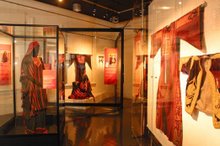
Below is a photo of "Secret Splendours" installed at the Museum of Victoria in 2002. This is the Egyptian section of the exhibition - you can see traditional costumes from Siwa Oasis and the Sinai Desert.