Keeping you informed about Palestinian cultural heritage research, and our work here at the Archive

Keeping you informed about Palestinian cultural heritage research, and our work here at the Archive
Showing posts with label Traditional costume - Syria. Show all posts

Wednesday, August 20, 2014

Practicing costume / textile identification skills


A lot of the work we do here at the Palestine Costume Archive is identifying costumes and textiles. We do this for lots of reasons. We might be asked by a diaspora Palestinian family about garments or cultural material in their family. We might be asked by a museum to confirm details of an item they are hoping to acquire or items on a checklist for a forthcoming exhibition, or an auction house wanting to list an item for auction.  We might be asked to help people organizing Palestinian cultural events like fashion parades.

Whatever the reason we are always happy to help because these days a lot of cultural material that is not Palestinian - especially in countries close to Palestine (one example being Sinai bedouin garments) - is getting labeled Palestinian out in the diaspora. We're always grateful that the people contacting us have taken the time to check.

We've been using social media to help familiarize people - not only Archive friends / staff who need practice with identification tools, but others out there with less knowledge.

A couple of days ago we posted the photo at the top of this post of an item in our collection on Facebook and asked Archive staff and friends to identify it.  We chose this particular one because we wanted something light hearted. We provided a couple of clues:
"it wasn't Palestinian, it was acquired in Damascus and it always creates amusement when we display it."
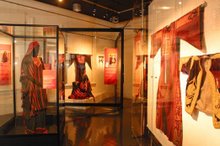
Twenty of you dropped us a line.  Ten got it right.  We're impressed. Those who didn't - don't worry about getting it wrong. This is all about practicing your skills. And you all came up with excellent suggestions, especially those of you who thought the garment might be a Sinai Desert bedouin headveil. This was a very good guess, because we have several Southern Sinai bedouin headveils with very similar sequined decoration in and on loan to our collection. You can see two of these displayed flat on the wall in the photo below of our traveling exhibition "Secret Splendours: women's costume in the Arab world":

Sinai Desert bedouin costumes on display
in the Archive's traveling exhibition
"Secret Splendours: women's costume in the Arab world"

Several even feature red sequins - here's one in storage, we've just pulled the archival paper back so you can see:

Sinai Desert bedouin headveil
in storage
Palestine Costume Archive collection

So seriously, well done :)

The clue to putting it all together was in our final clue - as one of you wrote "your "always creates amusement when we display it" gives it away lol".  Here's the entire garment:

Black and scarlet sequined Syrian lingerie
Palestine Costume Archive collection

If you are wondering at this point why on earth we are collecting underwear then you are in for a treat - it's Syrian lingerie and that's always over the top and very special :)

Black and scarlet sequined Syrian lingerie - detail
Palestine Costume Archive collection

"Forthright displays of the some world's kinkiest "leisure wear" have long been a feature of Syrian souks - though many tourists don't notice the crotchless knickers and PVC French maid outfits among the more traditional inlaid backgammon sets and textiles. 
"It stems from the Syrian tradition for brides-to-be to be given a trousseau of exotic underwear - sometimes dozens of items - usually by girlfriends, aunties and cousins, to add spice to their wedding nights, honeymoons and beyond..."
The Archive has three sets of late 20th century Syrian lingerie acquired in Suq al Hamidiya, Damascus.  

Pink heart Syrian lingerie
Palestine Costume Archive collection

As Martin Asser points out:
"There's a whole street off the historic Hamadiyeh Souk selling this genre of clothing - all outfits manufactured in Syria, some that Madonna herself might blush to wear, all showing bawdy creativity and a wicked sense of humour"
 Asser notes that according to Rana Salam and Malu Halasa who published "The Secret Life of Syrian Lingerie: Intimacy and Design" in 2008:
"there are more than 200 little tiny factories that manufacture these fast changing lingerie models, from feathers to ringing mobiles to actual candies “embedded” into the panties. Stuff like this, pretty unique in its genre, at least for Western tastes standards"
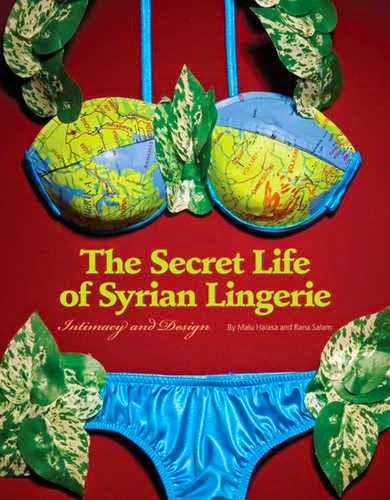
'The Secret life of Syrian Lingerie'
source

Here's an article about the book by Susannah Tarbush:
"When Malu Halasa and Rana Salam visited the souqs and shops of Damascus and Aleppo during a visit a couple of years ago, they were surprised by the apparent contradiction between the unusually audacious and playful lingerie on display there and the relatively conservative society, in which so many women are veiled. Halasa and Salam soon decided to co-author a book, "The Secret Life of Syrian Lingerie: Intimacy and Design"...

"The colourful pages of the book are full of photographs of lingerie decorated with everything from birds, butterflies and feathers to fake scorpions, flowers and fur. Sequins, pearls, embroidery and tassels liberally adorn bra and panty sets. Some lingerie sets emit music, others vibrate or incorporate lights. Lingerie may be edible; in other cases it is hidden inside chocolates or eggs. There are crocheted one-piece body suits, and costumes influenced by belly-dancing gear. The lingerie often has a playfulness about it, with comic touches such as fake fur thongs which double as mobile phone holders.
'The Secret life of Syrian Lingerie'
source 
"​​In addition to photographs of the lingerie on display, the book has photographs of lingerie modelled by pale-skinned women, mostly East European. These pictures are from catalogues which are readily available in lingerie outlets, despite the taboo on the showing of explicit images of women in public....
'The Secret life of Syrian Lingerie'
source 
"Lingerie has become an essential part of the wedding trousseau: "If a groom doesn't buy the lingerie for his wife-to-be, the bride herself or her mother does, sometimes collecting up to thirty outfits for her wedding night." The essay is accompanied by Lebanese photographer Reine Mahfouz's photographs of lingerie factories, window displays and shops where veiled women buy lingerie from male assistants.
"Halasa asks Abdulhamid about Syria's reputation within the region for earthiness and raunchiness. He replies: "Syrian society tackles sexuality head-on and looks at it in a very direct manner, which some people might find strange because it is supposedly a conservative society." There is overt discussion of sexuality even in mixed gatherings of men and women. "Sometimes it doesn't matter whether the people are religious or not. Sexual jokes are common currency in Syrian society."
'The Secret life of Syrian Lingerie'
source 

​​"There is a double edge to his comments on the racy type of Syrian lingerie. On the one hand, "you're turning women into sex toys. They're not supposed to be sexually stimulating to other people, but at home, to the husband, they're supposed to provoke his sexuality and dress in the manner that will attract him and do whatever he says." But at the same time, "it gives women a lot of control. Women can use sexuality to manipulate men."  
"An idea stated by some of those quoted in the book is that a woman should entertain her husband at home, including dancing for him. Some claim that the Koran contains such an injunction. Abdulhamid says this is not the case, but that "thousands of prophetic traditions support these ideas about women." Certainly some Syrians consider that if a woman "entertains" her husband, this will keep him away from other women and prostitutes, and will reduce the risk that he will take a second wife...
​​"The Secret Life of Syrian Lingerie" may itself attract such criticisms. Interviews with women are interspersed with photographs of lingerie by Lebanese photographer Gilbert Hage, but many women turned down the request to be interviewed, or became angry when they saw examples of the lingerie. A woman in her sixties who declined to be interviewed declared: "Damascenes are proud of their city and culture. No one will talk to you." Another said: "Lingerie is such an embarrassing issue for Syrian women to talk about, and that's probably why it's called 'the secret life'."
"One interviewee pointed out that the type of lingerie highlighted in the book is only a small part of Syria's overall lingerie output, and is linked only to a small category of people. "There are subcultures in Syria, and subcultures everywhere else in the world that would be interested in this kind of lingerie, starting from Le Lido or Moulin Rouge." But another interviewee thought the lingerie is "almost done in a naive sweet innocent way. It's not sick or perverted."
'The Secret life of Syrian Lingerie'
source
"The interviewees often associated the "exotic" lingerie with a certain class or religion. One said: "The underwear makes me laugh so much. It is not sexy at all!" She considers it mirrors "the very old fashioned ideas about sexuality in the less educated classes of Syria." Another said that for Christians, the underwear is "nothing but embarrassing, old-fashioned fun; for Muslims it is something very normal – they not only accept it but also enjoy it. The more religious an area is, the more risqué the underwear becomes. I think that Muslim women have less freedom on the outside so to compensate they have more freedom on the inside." 
"The Secret of Life of Syrian Lingerie: Intimacy and Design" is one of the most unusual, even bizarre, books you are likely to see on the Arab world. It is surely the first book to probe an Arab culture via the medium of its female undergarments, and looks certain to arouse debate and controversy."
If you'd like to learn more or read the book if you can either purchase a copy online or borrow the copy in the Archive's Research Library if you are in Australia.

Thanks so much to everyone who took part in this costume / textile identification skills practice and congrats again to those who got it right. We learned lots and are looking forward to the next one :)

More Info:

Wednesday, May 28, 2014

"Beyond the Veil: Dress, Identity, and Tradition through the Eyes of the Muslim and Arab Women of Greater Milwaukee"

Enaya Othman holds one of the handmade
 items featured in “Beyond the Veil”
Michael Sears
source

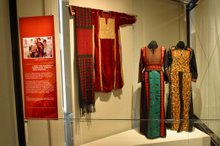
A very interesting exhibition is currently on display at the Milwaukee Public Museum, which shares curatorial goals with our museum's own traveling exhibitions "Portraits without names: Palestinian costume" ("featuring 200 years of Palestinian design and examining how traditional costume and embroidery has long reflected the culture and identity of the Palestinian people", which is curated to include garments and stories of the nearest Palestinian diaspora community to wherever it being displayed) and "Secret Splendours: women's costume in the Arab world" ("curated to examine and redress Western misconceptions regarding Arab and Muslim life, and featuring urban, tribal, village and oases traditional costumes from Morocco to Yemen").

 "Beyond the Veil: Dress, Identity, and Tradition through the Eyes of the Muslim and Arab Women of Greater Milwaukee":
"is a special exhibition created as a joint project between MPM and the Arab and Muslim Women's Research and Resource Institute (AMWRRI), showcasing the dress of Muslim women from the Milwaukee area and exploring some enduring traditions in Muslim clothing. This exhibit aims to expand public knowledge concerning the significance of cultural clothing beyond stereotypes, and to give women from the Milwaukee community an opportunity to speak about their experiences both here, and in the diverse societies of their ethnic descent. 
"This exhibit, supported by a grant from the Wisconsin Humanities Council, features 30 traditional outfits, as well as various special occasion and day-to-day use items like table sets and jewelry, owned by local women with strong ethnic ties to countries ranging from Jordan, Palestine, and Kuwait, to Morocco, India, and Pakistan. 
"Beyond the Veil caps a four-year-long project led by AMWRRI dedicated to the study of the attitudes toward cultural clothing among the Muslim and Arab women of the Milwaukee area. Testimonies gathered here highlight the importance of cultural clothing and its meanings to Arab and Muslim women who migrated from various Muslim countries, and illustrate how women from different generations continue to recreate and adapt elements of their cultural dress to meet modern tastes."
 Annysa Johnson published the following article "Milwaukee Public Museum show explores relationship between Muslim clothing, identity" in the Journal Sentinel on May 25, 2014:
"In December, on the eve of her niece's wedding, Enaya Othman gathered with the women of her family for the traditional painting of the henna on the bride and her attendants. 
"Like the others, Othman donned a traditional gown, a colorful Roomi thob of her native Palestinian territories. But this was not just any dress. Handmade in her homeland, it was fashioned from pieces of a linen garment worn by her late mother. The cross-stitching of its silk embroidery tells the tale of its origins in her family's home region of Ramallah al-Bireh. 
"Othman's thob is now on display at the Milwaukee Public Museum as part of a dazzling new exhibit that exploresthe complex and evolving relationship between traditional dress and identity for Muslim women whose families immigrated to Wisconsin from around the world. "This dress is connected to my heart, my traditions, my mother's traditions," said Othman, an assistant visiting professor of Arabic language, culture and history at Marquette University and the driving force behind the exhibit, "Beyond the Veil." "It tells my mother's story, and I will one day hand it to my daughter, so she can tell her story." 
"Beyond the Veil," which opened to the public this month, grew out of an oral history project launched in 2010 by the nonprofit Arab and Muslim Women's Research and Resource Institute co-founded by Othman through her work at Marquette.  
"That project transcribed the narratives of dozens of Arab men and women, both Muslim and Christian, whose families have settled here over the past century. Recurring themes, especially among the Muslim women, centered on appearance and identity and how the clothes they wore opened them to stereotyping and discrimination and affected their adjustment to life in the United States, according to Othman.
"What researchers found were varied and complex relationships to traditional dress: women who wore it exclusively, and others just for special occasions. There were women who embraced it, yet fought against being stereotyped by it; and younger women who were rediscovering and modernizing it. Depending on the woman, the clothes reflect a sense of modesty or pride; a connection to history, to faith, culture or regional identity.
Visitors milled through the exhibit at its opening, many of them first-generation immigrants who had donated items for the show. 
"My daughter-in-law wore this for her henna night; we had it specially made," said Ibtisam Ahmad, pointing to an elaborate velvet mallaka embroidered with leaves and flowers in brilliant jeweled tones, the gold coins of the bride's dowry sewn into a velvet sash around the neck. 
"Museum President Dennis Kois called it "one of the most beautiful" textile exhibits that he had seen. Middle Eastern scholar Iman Saca, whose mother founded the Center for Palestinian Heritage and Embroidery Preservation in Bethlehem, spoke on the history and symbolism of the art, and the importance of such exhibits in keeping that history alive.
"Every stitch, every color, every design had meaning," said Saca, director of the Middle Eastern studies program at Saint Xavier University in Chicago. "And hopefully, we can preserve that meaning." 
"The exhibit is a collaboration between the Arab and Muslim Women's Research and Resource Institute and the Milwaukee Public Museum. It was financed in part with a $10,000 grant from the Wisconsin Humanities Council. 
"The show is a glimpse at the diversity of Wisconsin's Muslim community, through the lens of fashion. It features 30 traditional garments, jewelry, accessories and other artifacts from a wide swath of the Muslim world, divided into five regions: Bilad al-Sham, which encompasses modern-day Syria, Lebanon, Jordan and the Palestinian territories; the Gulf States; North Africa; South Asia; and Turkey. It's a visual feast of color and texture, from the velvet and embroidered Palestinian mallakas to the flowing abayas of Saudi Arabia and the silk sari and gauzy shalwar kameezes of India and Pakistan. 
"All of the items were donated by members of the local Muslim community. Many have been passed down from mother to daughter or were specially made by seamstresses in their countries of origin. Some feature designs unchanged for centuries; others reflect a kind of globalization of design with the melding of motifs across cultures. "It shows how all these regions are being mingled together by immigrant women to make their own cultural clothing," Othman said. "It's not anymore just traditional — something in the past — but it is something alive for today."
If you can't make it to the exhibition, why not take a moment to view this You Tube video of  a Henna Night event the Arab and Muslim Women's Research and Resource Institute was involved with :)


More Info:

Thursday, February 13, 2014

From the Archive's Research Library - Evelyne Bustros and Georges Cyr's "Lebanese and Syrian costumes" 1939

Kurd Street Sweeper, Beyrouth
Evelyne Bustros and Georges Cyr 
"Lebanese and Syrian costumes" 1939 
Publisher: Beirut, Lebanon: Impimerie Catholique

A recent acquisition of an indigo Syrian coat (which we'll post about in a day or so) provided a welcome opportunity to spend some time looking through Evelyne Bustros and Georges Cyr's portfolio "Lebanese and Syrian costumes" which was published in 1939 by Impimerie Catholique in Beirut.  

The copy in our library is bound but it usually comes unbound as portfolio. This is useful if you are planning an exhibition of Syrian or Lebanese costume. The little water colours look beautiful displayed, especially if you match them up with correctly attired mannequins.  We've displayed them in two of our exhibitions. 

The portfolio contains twenty-five water colours by Cyr of Syrian and Lebanese folk costumes. 

Alaouite women
Evelyne Bustros and Georges Cyr
"Lebanese and Syrian costumes" 1939
Publisher: Beirut, Lebanon: Impimerie Catholique

A poem by Evelyne Bustros appears at the beginning of the portfolio.  Evelyne Bustros was an interesting woman.  Samar Kanafani provides some background in her The Daily Star, Lebanon article "Evelyne Bustros is honored once again" (October 10, 2001):
"Already one of the first women in the 20th century to claim recognition in literary and political circles, Evelyne Bustros garnered another honor Tuesday when the Francophone Summit’s cultural committee dedicated a conference in her name. 
"Held Tuesday at the Rencontre des Cultures pavilion at Riad Solh Square, the conference was conducted by Ghassan Tueni, the publisher of Beirut daily newspaper An-Nahar, with Culture Minister Ghassan Salameh in attendance. 
"Bustros, who was born in 1878, emerged on the literary scene with the 1926 publication of her first novel, The Hand of Allah. This effort, the first French novel published by a Lebanese woman, thrilled reviewers as a genuine exploration into the meaning of Arab identity in a French colonial world. Only after its distribution in Egypt did the novel appear on Lebanese book shelves. Girded by this triumphant debut and her increased popularity, Bustros became active in the Lebanese feminist movement, organizing powerful demonstrations to promote women’s rights, according to Tueni. “The emotion was so great when one of these demonstrations happened to coincide with a march, which we organized to demand independence (from the French mandate),” Tueni recalled. 
"Bustros’ political concerns and nationalist sympathies extended her enthusiasm well beyond women’s issues and literature. Among the few women to claim a prominent political role in the struggle for independence against the French, Bustros was the only female signatory of the National Pact’s preliminary draft in 1937, Tueni said admiringly.
Until her death in 1971, she wrote novels, chronicles, essays, and poems whose force continues, even today, to resonate artistically and politically. Ever founding literary and political clubs, Bustros helped, in the 1930s, to establish the first club to include both Muslim and Christian authors. “Evelyne left behind a great heritage of which we are very proud,” Tueni exclaimed. Bustros’ complete  works are available in a single anthology, published by Dar an-Nahar."
Hauranese Bride
Evelyne Bustros and Georges Cyr 
"Lebanese and Syrian costumes" 1939 
Publisher: Beirut, Lebanon: Impimerie Catholique

Georges Cyr is also interesting - a French artist who dedicated his life to Lebanon.  In his  reviews an exhibition of the artist's work in Lebanon (The Daily Star Friday, 22 June, 2007) James Farha discusses Cyr's Lebanese ouvre:
"Businessman Raymond Audi, one of Lebanon's most active arts patrons, has gathered together the privately held works of French modernist painter Georges Cyr for a two-month exhibition entitled "Georges Cyr dans les collections libanaises."  
"The exhibition includes examples of Cyr's work from many stages in his artistic life, but it focuses on the art he produced after he moved to Beirut from Normandy in 1934. "Cyr represents two important traditions in the history of art in Lebanon," says Sarah Rogers, an art historian and PhD candidate in the history, theory and criticism of art and architecture program at the Massachusetts Institute of Technology. Rogers is particularly knowledgeable on Lebanese art history and has taught in the department of visual art at Notre Dame University in Zouk Mosbeh.  
"First is the cultural crossroads that have long given form to art in Lebanon; the French Mandate opened the country more to all things French, and because of the legacy of the laissez-faire economy put into place by the mandate, Beirut's role as a locus for the trafficking of goods and services, and artists, only further developed post-1943," adds Rogers. "Secondly, his atelier served as an artistic meeting place and studio for training others interested in art which is part of a longer history of art in Beirut. For instance, before the Lebanese Academy of Fine Art [ALBA] established its art department in 1943, followed by the American University of Beirut's 10 years later in 1953, artists in Lebanon learned their craft in the studios of the previous generation such as [Charles] Corm and [Habib] Srour." 
"The Cyr collection on view now is made up of 96 privately owned paintings organized in six rooms. The exhibition includes works in pencil, ink, watercolor, oil and gouache. The paintings chart his career through the first half of the 20th century and encompass a broad range of modernist styles ... Cyr's works are arranged in roughly chronologically order, and it is striking that even shortly before his death in 1964, he was still producing a great range of styles - from light, playful watercolors of people at a picnic to heavy cubist oils and landscapes"
"Light, playful watercolours" is a good description of the art works in "Lebanese and Syrian costumes".

Village Woman of the Homs Plain
Evelyne Bustros and Georges Cyr 
"Lebanese and Syrian costumes" 1939 
Publisher: Beirut, Lebanon: Impimerie Catholique

The contents page lists each print with regional and social identification: "a Homs midwife", "a Kurd street-sweeper", "Merchant from Damascus" etc.  An eclectic range of religions / geographic areas / communities are represented.  However the watercolours are detailed enough to be extremely useful, in terms of traditional costume identification.
Bedouin woman of Akkar Plain, Lebanon
Evelyne Bustros and Georges Cyr 
"Lebanese and Syrian costumes" 1939 
Publisher: Beirut, Lebanon: Impimerie Catholique

The contents list sometimes contains a little more information about the costumes.

Peasant woman of the Hama Plain
Evelyne Bustros and Georges Cyr 
"Lebanese and Syrian costumes" 1939 
Publisher: Beirut, Lebanon: Impimerie Catholique

For example, for plate 19 "Village women of Ferouz and Zaidal in the Syrian Plain" 

Village Women of Ferouz and Zaidal in the Syrian Plain
Evelyne Bustros and George Cyr 
"Lebanese and Syrian costumes" 1939 
Publisher: Beirut, Lebanon: Impimerie Catholique

the additional text reads "petit point tapestry stitch on cotton or velvet materials coin studded headdress worn only after marriage".  While for plate 3,  "A Homs midwife"

Homs midwife
Evelyne Bustros and Georges Cyr 
"Lebanese and Syrian costumes" 1939 
Publisher: Beirut, Lebanon: Impimerie Catholique

the additional text reveals "the tcharchaff" (striped material covering the clothing) worn in all Syria before the Great War, is only to be found in the interior nowadays"

Woman of the Djebel Druze
Evelyne Bustros and Georges Cyr 
"Lebanese and Syrian costumes" 1939 
Publisher: Beirut, Lebanon: Impimerie Catholique

You can still acquire copies of the portfolio via Ebay, both as a portfolio and sold separately. Sometimes other prints come up for sale that are not in the portfolio - like the sheik here.  It's always worth keeping an eye out for these :)

Syrian Bedouin Woman 
Evelyne Bustros and Georges Cyr 
"Lebanese and Syrian costumes" 1939 
Publisher: Beirut, Lebanon: Impimerie Catholique 

Wednesday, August 18, 2010

Arabesque Festival - Brides of the Arab World, Kennedy Center, Washington D.C


Displays of Palestinian costume are still fairly rare around the world, so here at the Archive we like to document each one as much as we can.

Quite often when we post about Palestinian heritage displays it can be a tough read, as we record stories of organizers - no matter where they are in the world - facing major problems budget wise, politics wise, content wise (when museums / exhibition venues try to control info on labels and wall text, or stop certain photos being used) etc with their display.

Sometimes the problem relates to the quality of the heritage material being displayed. Some times it's hard for exhibition organizers to know how to identify and date Palestinian material, for example how to tell pre1948 costumes and textiles from mid 20th century ones.  Or what garments go together on a mannequin.  Some items proposed for display may need (expensive, time consuming) conservation. Sometimes the information on the labels is wrong. Sometimes the items displayed are not even Palestinian.

It's a challenge. That's what happens when cultural knowledge has been ripped away and must be reclaimed inch by inch. But we'll let you in on a secret. Things are slowly improving on this front.  In fact, the particular exhibition we are posting about today provides a good example of that. This Palestinian costume display was part of a larger exhibition that looked at Middle Eastern costume, which itself was a small but important part of "the largest ever Arab arts festival in the U.S" which was "widely seen as a landmark for the representation of Arab culture in the United States".  Even better, there was no problem about the budget or about the quality of the Palestinian cultural material displayed or the info on the labels.

Which means, if you are out there looking at creating an exhibition of Palestinian costume, then this is an excellent example to use. It may only contain a handful of mannequins devoted to Palestine - and we find the white hands on those mannequins a bit intrusive lol -  but the quality and cultural knowledge being exhibited is the best.


"Brides of the Arab World" was part of the Arabesque Festival  which ran at the Kennedy Center in Washington DC from February 23 to March 15, 2009:
"Unwrap the cultural treasures of the Arab world in this Kennedy Center international festival showcasing the varied cultures of the 22 Arab nations that represent the Arabic-speaking world. From the Arabian Gulf to the Levant to North Africa-this region of the world is the birthplace of human civilization and features extraordinary diversity in geography, traditions, landscape, religion, and contemporary aesthetics. 
"In cooperation with the League of Arab States, the three-week festival brings together artists, many of whom are making their U.S. debut, in performances of music, dance, and theater, as well as exhibitions featuring art installations, fashion, a soundscape, cuisine, a marketplace, and much more. Discover the evolution of art forms born from the cradle of human civilization. Experience an amazing breadth of culture that spans both eons and continents"
Talk about an amazing program of events! Some Archive volunteer staff did attend, and the rest of us were very envious. It was also great to see Arab culture displayed in the US. As Piney Kesting later noted in Art to Heart in Saudi Aramco World:
"The seeds for “Arabesque” were planted more than four years ago. “I believe the arts create peace and provide a window onto understanding people,” says Michael Kaiser, president of the Kennedy Center. He explains that since 2004, the Center has sponsored festivals focused on France, China and Japan; for 2009, he says, he wanted a larger festival focused on regions about which Americans have little cultural knowledge. “In the Arab world, we know only about politics and oil,” Kaiser comments. “We have no knowledge of Arabs as human beings. I felt it was important for us to dispel this ignorance, and also to show the immense beauty that has been created by Arab people throughout the centuries.
"For the festival’s 21 days, visitors found an open passport to the Arab world—no visas required. There were daily performances on several of the Center’s nine stages; discussions of Arab literature with more than 30 authors; Arab films; an exhibition of 40 wedding dresses from all of the 22 Arab nations; contemporary art exhibits; shopping in “The Souk” (“Marketplace”) and learning about the Islamic world’s contributions to science in the “Exploratorium.” 
Bedouin costume, Egypt
Costume History is Fun

James Zogby wrote in The Huffington Post:
"Negotiating the logistics and politics necessary to assemble the festival was monumental. Locating the talent, securing visas, transporting sets, costumes and works of art was, itself, a remarkable undertaking, a tribute to the foresight and vision of the Kennedy Center's Director, Michael Kaiser, and the determination and the commitment of his staff to see the project to fruition. 
"Five years in the making, the Director and staff of Washington's prestigious Kennedy Center, traveled across the Arab world to assemble a wide range of artists from all 22 Arab countries. Eight hundred performers, in all, have come to the U.S., from the traditional (Berber singers from Morocco), to the more avant-garde (Marcel Khalife, or Debbie Allen's remarkable "Omani Dancers"). There were musicians, singers and dancers, poets and painters, story-tellers, artists and craftsmen represented in the group. 
"Arabesque" provides Americans and Arabs alike with a profound learning experience. As Secretary General of the Arab League, Amr Moussa, noted, never before have artists from all 22 Arab countries been represented under one roof in one festival. As the festival unfolds over its three-week run, tens of thousands of Americans will see the richness and diversity of Arab culture, in all its many exquisite forms..."
The Palestinian costumes were from the collection of the Palestinian Heritage Foundation, an amazing foundation that does excellent work and has an excellent collection.  The Palestinian Heritage Foundation later wrote in their Newsletter for March 2009:
 “Brides of the Arab World” featur[ed] 48 traditional bridal outfits from all 22 member countries of the Arab League ... a fascinating display of rich textiles, embroidery and intricate jewelry. 
"The Palestinian Heritage Foundation presented five costumes from Palestine representing Bethlehem, Jerusalem, Ramallah, Al-Khalil and Asduud, as well as other costumes from Jordan, Syria, Lebanon and Tunis. The costumes from Lebanon and Tunis come from the collection of the late Dr. Hala Salaam Maksoud, donated by her family to PHF."


You'll find some excellent photos of the installation on the PHF's newsletter.  Coleen T at the Costume History is Fun blog has several posts with excellent photos of the displays, including Palestine (10 July 2010), we've reproduced several here in fact it was finding these photos that prompted this post. Pierre Radulescu, who posted the You Tube videos above, also posted some photos of his blog here.

The detailed labels accompanying the five Palestinian costumes were very good, combining both the past and present, which as one reviewer noted, is rare:
"The descriptions of the bridal gowns and their history reveal what is usually hidden from American audiences; that the traditions, cultural expressions and heritage of the Palestinian people mingled with adjacent Arab lands and dated back to the time of the Roman Empire. Unfortunately, many of these traditions and cultural aspects from early times have been more recently destroyed"
Brilliantly, Coleen T included label text in her Costume History is Fun posts, so we are going to quote some below:

Source: Courtesy Costume History is Fun
Asdud Dress 
"With its lightweight fabric and V-cut neckline, the Asdud costume was well suited to the warm Mediterranean climate of this coastal town. This particular dress was hand-woven in the 1930s in nearby Mejdel, once famous for its narrow linen edged with red or turqoise stripes. Similar fabric has been excavated from sites dating back to the 2nd century, and the embroidery patterns (cypress trees, combs) are just as ancient. The headdress or saffeh resembles that woen in other coastal areas; decorated with coins, it is wrapped around the bride's braided hair and covered with a large embroidered headscarf.
Source: Courtesy Costume History is Fun
"Since the 1948 war, the former residents of Asdud have lived in refugee camps in nearby Gaza. Asdud is now the Israeli town of Ashdod and its traditional embroidery has almost disappeared, although Palestinian workshops in Lebanon and Jordan do still re-create these classic patterns on shawls, jackets and bags. "
Source: Courtesy Costume History is Fun
El Khalil Dress 
"The El Khalil wedding dress is famous for its winged sleeves and heavy embroidery, with silk cross-stitch covering most of the linen. The bride may also wear a coin-covered vest called a miklab. The headdress, richly decorated with coins and precious stones, sits atop a simple cap. Reserved exclusively for weddings, it is shared by all brides from the same clan. A large embroidered linen scarf called a ghudfeh is draped over the headdress; after the bride is presented wo the wedding guests, the scarf is removed to reveal her complete costume. Embroidery motifs on this dress, made in the 1940's, include "acanthus leaves with cup" khemet-el-pasha (the tent of the pasha) and feathers."
Source: Courtesy Costume History is Fun
Jerusalem Dress
"Made in the 1940s, this wedding dress from the village of Ein Karem reveals the strong influence Bethlehem exerted on the embroidery in villages around Jerusalem in the early 20th century. The primary fabric is imported European velvet, and the chest piece, side panels and sleeves are silk embroidered with couching. Called talhami or tahriri, this needlework was usually done by professional women embroiderers in the towns of Bethlehem, Beit Jala and Beit Sahur. And as in Bethlehem, a short-sleeved embroidered jacket (taqsireh) was worn over the long-sleeved dress, creating a lovely shirred effect. The scarf covering the headdress was trimmed with locally made lace, a feature unique to Jerusalem costumes. 
"This is but one of the eight different Jerusalem styles; each boasts different fabrics and colors, but all feature similar embroidered panels. The former residents of Ein Karem are now refugees (the village has become a popular Israeli tourist destination). but Palestinian embroidery workshops still reproduce the Ein Karem dress as well as the taqsireh which many women now wear as an elegant jacket"
Source: Courtesy Costume History is Fun
Ramallah Dress 
"One of the most famous Palestinian costumes, the Ramallah bridal outfit is said to have originated in the 5th century. This one was made in the 1920s of hand woven linen embroidered with silk thread in a cross stitch pattern. It features the traditional squarechest piece adorned with age-old motifs such as flowers, palm trunks, birds and the S- shaped alak or leeches (used for medicinal purposes, they represent good health and longevity). Its wuqa headdress is decorated with Ottoman coins and cross stitch embroidery. 
"Draped over the headdress is a matching scarf embroidered with crosses, a reminder that Ramallah was a predominantly Christian town in the 1920s. During the 1930s, silk scarves imported form the Far East became popular, but today the traditional costume is worn without a scarf. On special occasions, Palestinian women intent on preserving their heritage wear contemporary versions of the dress made of synthetic fabric embroidered with cotton thread. The headscarves have been re-purposed as wall hangings, tablecloths and cushions. "
Bethlehem Dress 
"A woman would wear this costume for the first time on her wedding day, then on festive occasions thereafter. Distinguish by long, winged sleeves called irdan, these dresses were made from a special linen hand-woven exclusively for that purpose. The fabric was crafted in lengths of about 10 yards; silver brocade at one end was used for the lower back of the dress, a tradition that goes back at least 10 centuries. The shatweh, or headdress, resembles those seen on ivory statues dating from 1200 BC. It was presented to the bride at their wedding and could be worn only by married women. Decorated with Ottoman coins and coral, the shatweh, is covered by a large headscarf. 
"Most of the embroidery on the dress and headdress is metallic and silk couching. The square chest piece features a traditional design with floral rounds in each corner and a central medallion containing a cross (this dress dates from the 1930s when Bethlehem was predominantly Christian). For Muslim brides, flowers replaced the cross. This special linen has not been woven since the 1960s, but Bethlehem dresses made with synthetic fabric and embroidery thread are available to today's brides, who often include one in their weddings along with a modern white gown. On special occasions, today's Palestinian women also wear contemporary jackets and accessories inspired by the traditional couching."
A lot of work went into getting those labels right, in discussing both pre and post 1948 styles, and in tying whole outfits together so you know what goes with what.  We adore statements like "A woman would wear this costume for the first time on her wedding day, then on festive occasions thereafter". This addresses one of our pet hates - the pretty much constant misrepresentation in European and North American exhibitions of traditional Palestinian dresses as bridal gowns in the Western sense, worn once and never again. This was absolutely not the case. The majority of items in a woman's married wardrobe were sewn before her wedding as part of her trousseau, worn on specific days during her wedding celebrations and then afterwards on special occasions.

"Brides of the Arab World's design and installation would have been tricky, because the Hall of Nations / the Hall of States are not the easiest of display areas, being major through ways.  You also need to tie the exhibition in to the rest of the proposed festival.  As Piney Kesting notes in Saudi Aramco World:
"The difficulty with exhibits that involve 22 countries, explains “Arabesque” exhibit designer Adrien Gardère, is finding “a common thread that emphasizes the legacy and the roots that link the artists.” In the case of the Kennedy Center, which is neither a museum nor an exhibition hall, “you want the exhibits to enhance the performing arts and to capture the attention of a public that has come primarily for the performances,” he says. In less than eight months, Gardère produced exhibits that used Islamic architectural elements and proved as fascinating and provocative as the artworks themselves 
"Visitors entering the Kennedy Center were captivated by a row of traditional wedding dresses in the “Brides of the Arab World” exhibit. Upstairs, Egyptian sound engineer Alaa El Kashef ’s “Soundscape: Souk” evoked a busy Cairo street. Nearby, the exhibit of Azza Fahmy’s jewelry, a blend of traditional and modern design, was displayed nestled in stacks of unglazed clay pots. Women’s art from throughout the Middle East appeared in a room constructed of mashrabiyyah windows—the traditional turned-wood screens that allow in exterior light while preserving interior privacy. In the Exploratorium, visitors lay back and watched a 3-D film on the golden age of Islam, projected onto the ceiling."

It was certainly an effective installation. The entire Arabesque festival was widely praised.  "Arabesque: More Significant than Apparent" headlined one review, while James Zogby concluded:
"The experience of "Arabesque" will shatter stereotypes, and put new definition to the meaning of being Arab. For too many Americans, Arabs exist only as one-dimensional political beings, lacking hearts or souls ... During the next three weeks, this caricature of Arabs will be destroyed ...
"There are lessons to be learned from "Arabesque." It should be repeated. The seeds that have been planted by this festival will grow on their own - but how much better if they are nurtured and cultivated? The lesson here is that, not only is the Arab past glorious, but that the present and future are, as well. All of us owe thanks to the Kennedy Center for reminding us of that, and challenging us to do better at remembering it."
More info about the exhibition: