Keeping you informed about Palestinian cultural heritage research, and our work here at the Archive

Keeping you informed about Palestinian cultural heritage research, and our work here at the Archive
Showing posts with label Palestinian women. Show all posts

Monday, October 26, 2015

Palestinian Film Festival Australia 2015


Time for our favorite film festival :)

Cultural Media have announced the 2015 Palestinian Film Festival program in Australia. The Festival is visiting Sydney, Melbourne, Canberra and for the first time, Perth.

It's a terrific program, full of gems like (Paradise Now and Omar director) Hany-Abu Assad's The Idol, which tells the true story of Palestine’s first pop celebrity, Mohammed Assaf who rose to fame after his victory in Arab Idol, and Palestinian cartoonist Amer Shomali and Paul Cowan's The Wanted 18, a documentary animation that  "seamlessly combines the comic and the tragically absurd ... mapping the story of non-violent resistance during the first intifada and how 18 cows came to be declared “dangerous for the security of the state of Israel”."


We are also looking forward very much to seeing Leila Sansour's Open Bethlehem.  We think the Open Bethlehem campaign is wonderful - we especially love their Bethlehem Passports :) - and we've been looking forward to an Australian screening of the film for a while.

Here's dates and details:

Sydney - Palace Norton Street:
Melbourne - The Kino Cinemas
Canberra - Palace Electric Cinema
  • Friday, 27th of November, 2015: 7pm The Idol
and for the first time:

Perth - Cinema Paradiso
For more on each film, head here to to by tickets, here.

If any Archive volunteers or Education Officers are attending sessions drop us a line over on the Archive's Facebook page so we can meet up.

Finally: We know we say this every year but it's worth repeating:

Thank you again to Cultural Media :) 

We know how much time, effort, money and love goes into organizing this event, and we want them to know we appreciate it more than we can say.

More Info:

Friday, October 17, 2014

Librarians and Archivists with Palestine's “One Book, Many Communities: Mornings in Jenin”

LAP - "One book" campaign
source

Most Archive Education Officers and volunteers are familiar with Librarians and Archivists with Palestine ("a network of self-defined librarians, archivists, and information workers in solidarity with the Palestinian struggle for self-determination") because we've sung their praises quite a lot.

We rather like their latest project - a new reading campaign called  “One Book, Many Communities" which is similar in concept to our own real time (wherever Archive staff are based) and cyber (when we meet online as a group) book club meetings and morning teas. So we thought we might take part :)

source

The  “One Book, Many Communities: Mornings in Jenin” project:
"draws inspiration from the “one book, one town” idea—wherein people in local communities come together to read and discuss a common book. Librarians and Archivists with Palestine invites readers, librarians, and others to organize gatherings in January 2015 to discuss Mornings in Jenin, the acclaimed novel by Palestinian-American author and activist Susan Abulhawa. 
"Mornings in Jenin is a sweeping, heart-wrenching historical saga about four generations of the Abulheja family. From Jenin to Jerusalem to Beirut to Philadelphia, the novel follows the family from its displacement from Ein Hod village in 1948 through love and loss over decades of life in Palestine and the diaspora. 
“Every now and again a literary work changes the way people think. Abulhawa…has crafted a brilliant first novel about Palestine… [This] intensely beautiful fictionalized history… should be read by both politicians and those interested in contemporary politics.” –  Library Journal 
"LAP’s “One Book, Many Communities” campaign will introduce readers to the richness of Palestinian literature, and create a broader awareness and understanding of Palestinian history and the struggle for self-determination. 
"Please join us! If you’re interested in organizing a reading group in your community, let us know and check back here soon for more information and resources. Book groups can be held at a library, university or school, at a local non-profit organization or community center, in your living room, or at a bookstore. If you schedule your event for sometime during the month of January 2015, you’ll be connected to readers across the globe who will be reading and discussing the book at the same time. Use your imagination! And let us know what you’re planning! "
We thought we'd hold one in Canberra, but also wanted to suggest some of you - scattered around the world as Archive Education Officers and volunteer staff are - might like to hold one in your own town / country / city.  Check out LAP's very useful "One book "reading group toolkit page on their website for how to plan an event / what type of format / date / venue / reading resources etc and don't forget to tell LAP. And us as well - like LAP we'll list on this blog and link to it on our Facebook page.

You might prefer just to attend one of the events LAP are co-ordinating.  Keep an eye on LAP's events page as they'll be listing new events all the time over the next few months.

source

Those of you near New York might like to attend the official launch of LAP’s “One Book, Many Communities” campaign and meet Susan Abulhawa who wrote Mornings in Jenin, at the Bluestockings Bookstore, Café + Activist Center on Saturday, November 8 at 7:00pm.

We are sure most of you are familiar with Susan Abulhawa - we first became aware of her via her Playgrounds for Palestine project and more recently always look out for her Electronic Intifada articles and book reviews - but if not you might like to check out her Wiki page which says of Mornings in Jenin:
"Abulhawa, who at the time was working for a drug company, visited Jenin as an international observer in the aftermath of the 2002 Israeli attack on a refugee camp there. 
"The visit “transformed” Abulhawa, she later said. “You grow up as a Palestinian knowing about these massacres and the wars and the injustice but it was completely different to be there." "What I saw in Jenin was shocking at so many levels,” she later said, “but it was also quite humbling to watch how the people came together and shared what little they had. So when I left there, I really wanted to tell their story because I knew nobody was going to talk about it.” 
"Returning to the U.S., she had trouble reconciling the concerns of her coworkers at the drug company with the travails of the people of Jenin. “They were two parts of my life and it was suffocating. A few months later I was laid off and it was probably the best thing that happened to me.” The result was a novel, Mornings in Jenin, which was published in 2010. 
"It has been described as “a poignant, lyrical tale tracing four generations of the Abulheja family as they suffer loss after loss - first, with the kidnapping of their son Ismael in the 1948 Naqba by an Israeli soldier and then through their violent expulsion from their village near Haifa.” The novel follows the family through “successive horrors inflicted during the 1967 war, the siege of Lebanon and slaughters in Jenin, Sabra and Shatila, the devastation and agonies wreaked on ordinary Palestinians are depicted through the struggles of the book's protagonist Amal, whose brother Ismael is raised as the Arab-hating David.” 
"The novel, published by Bloomsbury, has been translated into Arabic by Bloomsbury Qatar Foundation Publishing. It has also been translated into at least two dozen other languages and has become an international bestseller. 
“In the Palestinian narrative,” she has said apropos of the book's story, “there are no two sides. There are no two sides to this conflict in the same way that there were no two sides to the Holocaust. There were no two sides to apartheid. There are no two sides to slavery. You have a nuclear power that is pitted against principally an unarmed civilian population. This is not a matter of sides.”
source

We've got two copies of Mornings in Jenin in the Archive's Research Library, one in English and one in Arabic, which we can lend to anyone who wants to read it, but let us know quickly as there will probably be a bit of queue of people wanting it.  Also you could buy a copy yourself - links below.

We thought we might hold our Canberra book reading at Zar Bakery and Cafe (Canberra's only Palestinian food outlet) as that way no one has to worry about catering and exact numbers re attendees. If you've not tried Zar's yet have a read of our earlier post.

For those interested in attending a Canberra event, get in touch via our Facebook page. We'll also be discussing the Canberra event idea further when we meet up for our next cyber morning tea and also when we meet up for the Sydney and Canberra parts of the Palestinian Film Festival which is in the first half on November.

More Info:

Wednesday, December 4, 2013

Palestinian embroidery in Australian Gourmet Traveller


You would think that - considering it's beauty - Palestinian embroidery would turn up in modern magazines more often.  Stylists are always looking for lovely materials to use in photographs in home style and travel magazines, etc.  And the fact that many good quality older Palestinian embroideries are on linen and worked in silk cross stitch gives them a lovely texture.

But it's actually quite rare.  Which is why we were delighted to spot a piece of Palestinian embroidery in this month's Australian Gourmet Traveller (page 94 of the Dec 2013 edition).


And such a lovely piece it was, too, with it's classical leech and comb designs in red and black cross stitch embroidery. It looks similar to pieces in our collection from the early 1950s, when the women in the refugee camp embroidery projects began using a more Westernized form of the saru / cypress tree to make their embroideries more attractive to the Western market.


The Gourmet Traveller section features recipes for Christmas / festive ham glazing and is impecibly styled by Geraldine Munoz, a stylist who's work we've admired for some years now.


We were interested to find out where Ms Munoz sourced the piece of embroidery, but rather than a store the provenance was listed as "all props stylist's own".  Like all good stylists Ms Munoz has built up a collection of interesting items - fabrics / decorative pieces etc -


which she can draw upon when the time is right. She may not even be aware this piece of embroidery is Palestinian, as she might have acquired it from a local op shop or vintage textile store either in Australia or abroad. She may have selected it for this styling assignment because of it's Christmas tree like motifs, it's linen texture or it's white, red and black colour scheme.   


Whatever her reasons, we think it's perfect Ms Munoz has used this piece in a Christmas feature - after all it could hardly have closer ties to the Holy Land :)

Sunday, November 17, 2013

Time for a five minute break

Wherever you are in the world, when you stop for morning tea this morning, why not take 5 minutes to enjoy both the music and artist Paula Cox's magical expressive line in her video:


That's what we'll be doing during our tea break :)

Sunday, September 22, 2013

Human Rights in Palestine conference, ANU, Canberra

Final session

Several Archive volunteers recently attended the Economic, Social and Cultural Rights in the Occupied Territories conference and related events at the Australian National University in Canberra.  We had a great time catching up with each other and old friends, and making lots of new ones.  Some of us also attended the annual National Palestine Advocacy Solidarity Gathering hosted by Australia Palestine Advocacy Network the day after the conference.

Being back at ANU reminded us of other conferences we've attended there.  I think I've presented on Palestinian issues at about seven, but my all time favorites were:
Now we were all back again at ANU for another human rights conference, but this one specifically related to Palestine. I first met it's convenor Dr Victoria Mason in 2002 at the First World Congress of Middle Eastern Studies in Mainz, Germany, where we were both presenting and where the Archive was displaying "Symbolic Defiance: Palestinian costume and embroidery since 1948".   She very kindly wrote a review  - as this was the traveling exhibition 'lost' in transit at LAX on it's way to it's next venue (at the MESA conference in 2003) Dr Mason's review is one of the few this important exhibition received and we treasure it on our website to this day.

Here's some details from the human rights conference's website:
"On the 11th and 12th September 2013 The Australian National University will host a groundbreaking conference on Palestinian human rights.

"The Israeli occupation of the Palestinian Territories has impacted both the civil and political rights (CPR) and economic, social and cultural rights (ESCR) of Palestinians. Yet in line with the broader marginalisation of ESCR within the international human rights field, very little of the literature on the human rights situation in the Palestinian territories addresses issues specifically from the ESCR framework.

"The impact of the occupation on Palestinian ESCRs has been considerable: including restrictions on movement (as a result of the ‘Security/Separation Wall’, checkpoints, curfews  and closure policies) and the resultant impact on the Rights to Education and Health; de-institutionalisation of the Palestinian economy; expropriation of Palestinian land and resources (including water); forced evictions and house demolitions; and destruction of land and property.

"This conference will be a world first by bringing leading international experts together to discuss ESCRs in the Occupied Palestinian Territories (OPT). Over the two days, panels of these experts will address the following issues within the OPT:

The Right to Health (including access to adequate medical services and treatment)
The Right to Education
The Right to Adequate Water and Food Security
The Right to Adequate Housing (including issues around house demolitions)
The Right to Work
The conference will examine these issues through focusing on:
Human rights obligations enshrined in international law
Duty-holders of these obligations (including the Israeli Government and the Palestinian Authority)
Evidence of violations
Mechanisms for complaints and other forms of remedy for violations
Practical steps for implementing and monitoring ESCRs
Professor Jeff Halper speaking
It was a very interesting couple of days.  The conference was fully subscribed, so there was a good crowd.  Lots of great presentations, you came away really feeling you'd learned something about each topic and an honour to meet the speakers.  Lots of informal discussions, in part facilitated by having attendees sit at round dinner tables.   

Here's the transcript from an SBS journalist who attended the second day and really picked up on things that mattered:
Reviewing the state of Palestinians' human rights by Thea Cowie, SBS Radio  Transcript from SBS World News Australia Radio 13 SEP 2013 
"Israeli-Palestinian peace talks have resumed and fighting has died down, but human rights experts say life for Palestinians is harder than ever.
"International academics and activists have gathered at the Australian National University in Canberra for a wide-ranging conference on the state of human rights in the Palestinian territories.  Direct peace talks between Israel and the Palestinians resumed late in July, after a three-year stalemate in the negotiations. No-one is expecting any quick breakthrough.  
Professor Jeff Halper speaking
"Israel-based Nobel Peace Prize nominee Professor Jeff Halper says life remains uncertain for the four-million Palestinians living in the Gaza Strip and the West Bank. He says Israeli occupation of the territories restricts all manner of rights - civil, political, economic, social and cultural. 
"Professor Halper says his work to defend Palestinians' rights to housing is ongoing. "I've talked to many Palestinian women who say to me 'the first thing I do when I get up in the morning is I look out the window to see if there's bulldozers and soldiers and if the coast is clear I get dressed and wake up the kids and start making breakfast.' And in fact the family lived in their home for five years and one day in the middle of the day they're having lunch and there's a knock on the door.
"Saleem answers the door, Rami says to him 'is this your house?', Saleem says 'yes it's my house', he says 'no it isn't, it's our house now. You got ten minutes to get all your belongings our we're going to demolish it'. Here's where the soldiers literally kick in. Saleem was beaten and kicked out of his home. In the commotion Arabia managed to slam the door shut and she called us. So the soldiers broke the windows of the home, threw in tear gas to flush out the family, she was carried out unconscious, the kids screaming and yelling in all directions." 
 Dr Sarah Roy in the final session
"Harvard University senior research scholar Doctor Sara Roy says the absence of violence with the Israelis does not mean the absence of difficulties for Palestinians.  She believes the new peace talks will become just the latest in a series of failed discussions which have seen Palestinian rights gradually eroded since 1993.
"They've faced growing constraints. In fact what many people don't understand about this so-called peace process is that it diminished, and weakened and contracted Palestinian life rather than the opposite." 
"Dr Roy and her colleagues argue the Israeli occupation compromises Palestinians' access to adequate medical services, water, education, food, housing and work. She says tasks like collecting groceries or going to school are exponentially complicated by more than 600 fixed and flying checkpoints dotted across the territories.  
"And she says sometimes it's what people living elsewhere would regard as simple things that highlight how restrictive life is for Palestinians. "I have friends who live in Ramallah in the West Bank. The wife is from Gaza. Now Gazans are restricted from entering the West Bank and have been for a very long time. My friend has had two children they're now 12 or 13 years old. Their grandparents who live in Gaza have never seen their grandchildren and you're talking about distances that you can measure in the tens of miles. It is easier for Palestinians to go to the United States than it is to travel between West Bank and Gaza." 
"PhD Candidate at Queens University Belfast, Lucy Royal-Dawson has conducted interviews with Palestinian students about their lives. 
 Lucy Royal-Dawson Queens University Belfast 
"She says Israeli occupation has become so normalised that Palestinians don't realise the barriers they face. "The last question I asked in a lot of the interviews was 'and so how does the occupation affect your education?' and people would say 'no, no it doesn't. It used to but not any more.' And you think 'wow, that's how deep the normalisation has become that people can no longer see it, it's only represented by acts of violence.'" 
"Despite the ongoing difficulties, academics like Sara Roy do see glimmers of hope. Like earlier this year, when a three-year-old Jewish boy fell from the fourth floor window of his home in Israel and was later declared brain-dead. His parents decided to donate his organs to a Palestinian boy.  
"Dr Roy says she's heard other similar stories - not many, but some. "In the final analysis people are human beings and I truly believe, and I've seen many examples of this in my many years over there, that when you bring people together and you allow them to see each other as human beings, as monthers, as fathers - that often, not always, but often - people can sometimes break down these terrible political barriers that have been erected for them and this is one powerful example of that." 
"Professor Jeff Halper, an American Israeli, has been arrested numerous times defending the rights of Palestinians. He's a co-founder of the Israeli Committee Against House Demolitions, which helps Palestinians to replace homes destroyed by Israeli authorities in the occupied territories. Professor Halper says the committee's work shows Israelis and Palestinians can work together. "We've built 187 homes in the last 12 or 13 years which isn't much in a humanitarian way. But if you think of it as 187 joint acts of resistance of Israelis and Palestinians then it really means much more than that." 
"The conference at the ANU has been criticised by Jewish community leaders who say speakers lacked academic credibility, and that it amounted to blatant anti-Israel advocacy."
We won't give that criticism further fuel, other than to say we totally enjoyed our time amongst "fringe conspiracy theorists and ideologues", and "scholars [with] no academic credibility" :).   But if you are interested we recommend a quick read of our favorite response: Middle East Reality Check's post Anatomy of a beat up.   It was a pleasure to be sitting next to George Browning while he drafted this response to The Australian:
"In a democratic society, debate about human rights should be the most protected of all debates. Why is the topic of rights important everywhere except the occupied territories? Surely the effect of occupation of Palestinian land and control of the lives of Palestinians is essential information to Australians who support the activities of Israel in the occupied lands. In the mix of tensions that are the reality of the Middle East, any light on factors that contribute to those tensions should be encouraged. George Browning, president, Australia Palestine Advocacy Network, Canberra"
More info:
All photos: J Allenby

Wednesday, July 3, 2013

The Deir Ballout Women's Cooperative needs a little bit of help, but not much :)

Source


Source

Bee keeper. Baker.  Independent farmer.  Wearer of stunning contemporary Palestinian dresses. Palestine Fair Trade Association board member. Canaan Fair Trade Deir Ballout women’s Cooperative member.  Um Hikmat is a woman who gets things done.

Source

Um Hikmat lives in Deir Ballout / Ballut (Arabic: دير بلّوط‎), a Palestinian village located in the Salfit Governorate in the northern West Bank, forty five kms south west of Nablus. According to POICA, this location:
"makes it one of the frontline villages in the governorate as it is situated on the Green Line. The population of the villages is about 3,500 according to 2005 estimates. There are a number of clans in the village including the clans of AbduIlah, Odeh, Musa, Qasem, Mustafa and Sabra, in addition to a number of smaller refugee clans (constituting about 12% of the village’s population.)

"The total area of the village is about 13.941 dunums, 10.000 dunums of which are located in the plains and is used to grow winter and summer crops. The built up area of the village is about 809 dumus and the remaining lands are used as range land and are located in the west of the village close to the Green Line, while the remaining area is planted with olive orchards mostly separated behind the Wall. The available data indicates that the village has lost more than 17,000 dunums of its fertile agricultural lands during the 1948 war."
"Out of a population of 4200 people, 80% depend on agriculture with over 15000 dunums dedicated to olive trees and stone fruits, and 3000 dunums used to plant winter crops such as wheat, lentils, barley, and rain-fed  vegetables" 
Palestinian farmers face a lot of unique problems as well as the usual every day ones every farmer faces. The result has been that many now work with organizations like the Palestine Fair Trade Association (PFTA):
"the largest fair trade producers' union in Palestine, with over 1700 small Palestinian farmers joined in fair trade collectives and cooperatives across the country.  Collectively our farmers produce the traditional olive oil and food delicacies from Palestine, and sell them internationally to buyers and markets not available to an individual farmer. 
"Fair trade means social and economic empowerment – a dignified living for farmers who have not had access to the outside world for over 40 years.  We revitalize farming traditions and a culture of sustainability by linking the  traditionally organic farming methods of Palestine to modern organic/ecological movements and markets."
Deir Ballout is one of the villages that works with Canaan Free Trade, who's mission is "to benefit the farming communities of Palestine": 
"Before we began, farmers here were selling their olive oil for 23% less than it costs them to harvest it (8 sheckels per kilo). Now, that we're able to sell our oil around the world, our growers are earning 22 sheckels per kilo, enabling us to earn a living from the farm crafts our families have practiced for generations. Our motto is "Insisting On Life". 
"Canaan is rare among Fair Trade cooperatives in that we do more than simply export raw goods for finishing and marketing by other companies.  We also manage all our processing, packaging and branding.
Source 
"We provide finished, ready-to-sell "Product of Palestine" premium food items. This of course means more economic opportunities for the people of Palestine, but it also allows us to protect the authenticity, integrity and quality of everything that we do"
Canaan Free Trade have been achieving great things for Palestinian farmers for a while now. And we can vouch that indeed their products are of the highest "authenticity, integrity and quality". We know. We've bought them and scoffed them :).  Canaan Free Trade's website states:
"Deir Ballout is also the home of Palestine Fair Tradeʼs 20-member olive cooperative that produces around 50 tons of olive oil annually, as well as the highly organized womens cooperative whose members produce about 10 tons of Canaan Fair Tradeʼs delicious Maftoul."
Which brings us back to Um Hikmat, who we met at the top of this post, who has a lot to do with those local women's cooperatives.

Source

As many Palestine Costume Archive friends know, we've worked with Palestinian women's cooperatives since the 1980s. We were able to offer use advice and some funding for some cooperatives with embroidery programs as well as assist with international markets.  It was an extraordinary experience for us because in many cases there were hardly any men left in the village. Canaan Free Trade encountered something similar in Deir Ballout:
"This village ... embodies a unique kind of beauty and hard working spirit [with] women are the primary actors in the agricultural field ... While women in Dier Ballout are proud of their leadership role in the community, most of them say that they suffer from having to carry the brunt of a conflict that has left most of the men in the village no choice but to work in difficult jobs in Israeli settlement sweatshops as carpenters and textile workers. According to Um Hikmat, “agricultural work is good but it is not enough to sustain a modern day family with all the demands in life. Men do what they can to support their families. Many even work in settlements that have taken up their own lands because factory work gives them some income. Not a good income but an income nonetheless.”
"There is, without a doubt, an unsettling feeling as you come into Deir Ballout surrounded by 3 major Israeli settlements that engulf the small village. This is why Um Hikmat says the work of the Palestine Fair Trade Association, of which she is an active member, has been very important in the village. “With fair prices for our olive oil more  people are starting to go back to the land because when Canaan Fair Trade came the revenue from olive oil got better. So many leave the textile work in the factories during the harvest season and they work in their land. It is a short month and it is tiring but it gives good yield that allows breathing space for people.” 
These cooperatives now produce a wide range of traditional Palestinian handmade products. Canaan Free Trade is trying to help establish a world market for these products:
"Fair trade women's cooperatives have introduced many traditional Palestinian handmade products to the world market – couscous, za'atar and olive oil soap among them. These products give women an opportunity to earn income and empower them as they gain experience and skills in management, problem-solving, and cooperative relationships. Economic success has led to greater self-confidence, greater civic participation, and greater influence for many women. "
"Our women's cooperatives have evolved from single item cooperatives to year round businesses.  Now village cooperatives are creating their own women's centers, where the women will own the center, making their business sustainable and viable and giving each member a share in the land and the profit.  Deir Ballout village, our most advanced women's cooperative, is building now..."
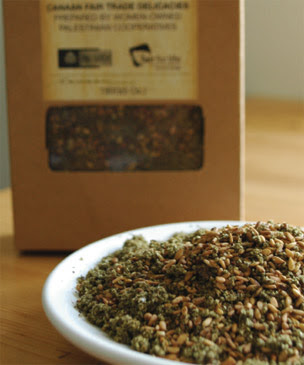
In a quote above Canaan Fair Trade mentioned their "delicious Maftoul".  If you are not familiar with Maftoul, you can see it's small, round, pasta-like granules made from semolina and wheat flour in the  Canaan Fair Trade product photo below.

Source

Maftoul provides a classic example of Israeli cultural appropriation. It's absolutely fascinating to read on Wiki's Israeli couscous page, under it's Hebrew title Ptitim, how the product was:
"invented during the austerity period in Israel (from 1949 to 1959), when rice was scarce, to provide for the needs of the Mizrahi immigrants, for whom rice was a dietary staple"
And how:
"Israel's first prime minister, David Ben-Gurion, asked Eugen Proper, one of the founders of the Osem food company, to quickly devise a wheat-based substitute to rice. The company ... developed ptitim, which is made of hard wheat flour and roasted in an oven. The product was instantly a success, after which ptitim made in the shape of small, dense balls (which the company termed "couscous") was added to the original rice-shaped ptitim"
Right down the bottom you'll read:
"Pearl-shaped ptitim are somewhat similar to the Levantine pearled couscous known as maftoul or mograbieh in Lebanon"
Amazing how one sentence can conceal so much!  At least now you can find more truthful histories of "Israeli couscous" online, like this one from CookThink.com:
"Like couscous, so-called Israeli couscous are small, round, pasta-like granules made from semolina and wheat flour. While the Israeli company Osem claims to have "invented" Israeli couscous in the 1950s, it is simply a marketing term for what was known previously as North African berkukes or Palestinian matfoul and popular in Jordan, Syria and Lebanon. 
"Unlike familiar small, yellow semolina-based North African couscous, Israeli couscous (which is sometimes called pearl couscous) is twice as big and is toasted rather than dried. This gives it a nutty flavor and a sturdy composition that gives it a chewy bite and makes it stand up to sauce. Israeli couscous can be used in salads, soups or as a base for chicken or fish. It works well when prepared like a rice pilaf" 
Maftoul has become a popular Palestinian export and one of the Deir Ballout women's cooperative's most popular products. On the Canaan Fair Trade website Um Hikmat calls her co-op's version:
"the best Maftoul in Palestine! Made from organic wheat and rolled with her own hands she says, “We may not have technological advancements in our village but we can do things with our hands that are superior to anything made by machines. No machine can make this kind of Maftoul. It does not work.”"
"Working with several women in her coop to improve their economical condition, Um Hikmat holds a bigger vision for the work that they are doing. She puts aside any personal differences to keep pressing forward with the hope that one day the work her coop does will speak to the world’s ears and break down what she refers to as cultural misunderstandings. “We want our work to communicate to people around the world that we are beautiful and strong women contrary to how we are often portrayed.” 
We'd love to meet Um Hikmat sometime.  Okay so we are biased and we want to ask her about the wonderful traditional dresses she wears. But seriously, she's achieving lots of great things, as Canaan Fair Trade point out:
"Um Hikmat has been becoming more and more involved in connecting women from different villages together in order to learn from each other ways to improve their lives. While many women find themselves in a position where their husbands cannot find work due to closures and a challenging economy, Um Hikmat says, “We have to find ways to support ourselves creatively. This is why we are now expanding our work to include more handcrafts and artwork. It is important to show young girls that they are not prisoners to their circumstances and that with hard work and determination, they may not be able to change the whole situation, but they can become more in control of their lives.” 
"But mere survival is not Um Hikmat’s goal. This is why she is excited about the role Fair Trade has played in their coop.“Since we started making Maftoul for Canaan Fair Trade we have been enjoying the company of each other more. We love life. We want to enjoy it to the fullest; this is why we don’t work alone. Maftoul is a great excuse to get together, cook together, and work together We roll, we chat, and we feel good when we are finished that we accomplished something as a group. These are the beautiful things in life.”
Canaan Fair Trade elaborates on the co-op's influence on another page of their website:
"the excellence of the work of the women in this community has also made a noteworthy contribution to Canaan Fair Trade and other women cooperatives in northern villages. 
"As one of the best Maftoul making cooperatives women in Deir Ballout have helped conduct several Maftoul rolling trainings inviting other cooperative members to come and learn their methods"
From all this we are sure you will agree it's become pretty clear that the Deir Ballout women's cooperative desperately need a base of operations for all their activities, from creating their products to holding training programs for others. 

Source


Which is where this old house comes into the picture.

Source 
It's a lovely example of traditional Palestinian architecture.

Source
Source
Source
Source

Which is why the Riwaq Center for Architectural Conservation is interested in it.  We are sure you've heard about Riwaq's work. We hold tremendous respect for them - basically our mission statement's are very similar, just replace architectural heritage with cultural heritage. But they've achieved so much, we are just in awe :)


"Riwaq’s mission is the protection of the Palestinian architectural heritage. The center’s activities started with research and documentation in 1991 and developed into more concrete conservation and planning projects. By 1998, the center operated in five main areas, these are: 
- Conservation of historic buildings
- Rehabilitation and development of historic centers
- Research and publications
- Community awareness
- Documenting and archiving information about all historic building in the West Bank and Gaza. 
"By 2006, Riwaq had become the leading organization in architectural conservation in Palestine, and has been able to achieve many of its planned objectives. A Register of 50,320 historic buildings was compiled over the course of 10 years and published, more than 50 conservation projects were implemented and more than 16 protection plans for historic villages were prepared. These achievements are just examples of what Riwaq was able to accomplish over the years, for more information please visit Riwaq’s website (www.riwaq.org). "
Source

Have a look at their incredible 50 Villages Project:
"Following the completion in 2007 of Riwaq’s comprehensive architectural survey, which resulted in the publication of ‘Riwaq’s Registry of Historic Buildings’, it was revealed that almost 50% of the historic buildings in rural areas of the West Bank and Gaza are located in around 50 villages. Hence it has become Riwaq’s vision to focus on those 50 villages for the foreseeable future, working on rehabilitation projects to target improvement of services, infrastructure and living conditions of the public, private and surrounding spaces.  
"The 50 Villages Project is not only seen as resulting in the protection of 50% of the Palestinian architectural heritage, but also as a tool for socioeconomic development, generating employment opportunities in the village, disseminating traditional building knowledge and, most importantly, revitalizing the historic center and reinstating it as part of daily life.  
"One of the most important elements is to get the inhabitants and owners of properties in the historic centers interested and involved in rehabilitation, which can only happen with the involvement of the municipal or village council, local NGOs and individuals with authority and influence in the local community..."
More here.

Source

The great thing is Riwaq has kindly agreed to renovate this house so the co-op can use it.


Here they are measuring everything. 

Source

Canaan Fair Trade has posted on the Facebook page that contained these photos that:
"Upon agreement, Riwaq will cover 90% of the conservation expenses, and the women have to cover the 10% left, which equals to around $5000US. 
"If you are interested, or know anyone who would be interested to contribute to cover the renovation expenses, please let us know! Every penny is greatly appreciated."
Source

Meanwhile - never ones to sit on their backsides - Um Hikmat and other co-op members have moved in with brooms to start cleaning the space.

Source
Source

There is just something about this co-op that really makes us want to help. Perhaps it's because of Um Hikmat's great determination and achievements. Perhaps it's because they are so close to achieving their goal here. Perhaps it's because they make amazing Maftoul. 

Anyway, here we are, letting Archive friends know via our mailing list, doing the ask around thing of all Archive volunteers, and here finally via this very long post on our staff blog. Well you know us, we're into the education thing - and think how much you've learned today reading this!

Source

In everything we've said today this is the most important part:  

If you can help drop Canaan Fair Trade a line on Facebook with your email address and they'll send donation details.  

Source

We're sure next time you're in the region Um Hikmat and her colleagues would love to show you around the co-op's new premises :)


More info: