Keeping you informed about Palestinian cultural heritage research, and our work here at the Archive

Keeping you informed about Palestinian cultural heritage research, and our work here at the Archive
Showing posts with label Refugee products for sale. Show all posts

Wednesday, November 26, 2014

a thank you from Sunbula


Sunbula sent the Archive a lovely greeting card as a thank you after a recent fundraiser. 


It took quite a while to reach us because the Australian Government decided a simple greeting card from Jerusalem required opening for inspection!


Sunbula knew we'd love this card for several reasons. Firstly, it was made by women at Atfaluna Society for Deaf Children in Gaza, a project the Archive has long ties with and has visited in Gaza.


Secondly, Sunbula knew we'd love it's design, showing a Palestinian village woman embroidering,


with a section of real cross stitch positioned within the design.


This is very well designed, and beautifully finished.  Finally, Sunbula knew we'd love the embroidery design used because it's a saru or cypress tree, which is a very important motif in Palestinian embroidery.


The Archive's logo is a saru, and Sunbula use a version of the saru too :)


You can purchase these lovely greeting cards at Sunbula's shop in Jerusalem and also on their website.

More Info:

Friday, May 2, 2014

MECA's Mother's Day Boutique

source

For friends in San Francisco, don't forget the Middle East Children's Alliance and Joining Hands are holding a Mother's Day Boutique on 4 May.
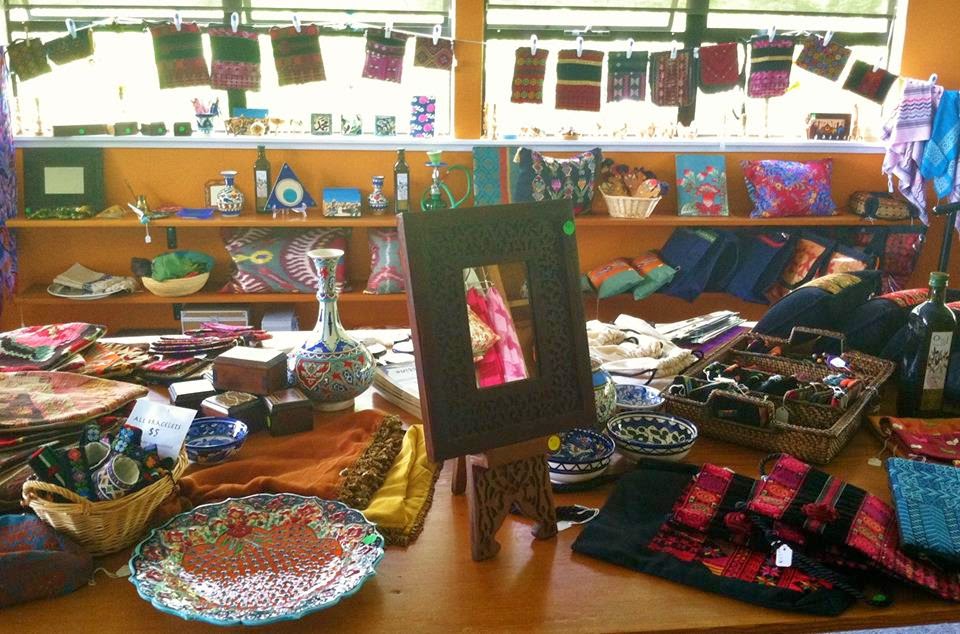
"Stop by MECA's office tomorrow to purchase crafts and edibles including pottery from Jerusalem and Hebron; embroidery from refugee camps in Gaza, West Bank and Lebanon; hand-carved olive wood by artisans and hip designers in Bethlehem; award-winning fair trade Palestinian olive oil; jewelry from women in Jerusalem and Ramallah; and much more! The sale supports artisans and cooperatives in Palestine with proceeds going to MECA's work with children and families in Palestine and Lebanon."
source

We like the poster MECA has created for the event - the embroidery at the top is obviously from a similar intifada dress to this one in our collection.

Intifada Dress
Palestine Costume Archive collection

Remember if you can't get to the Boutique you can shop online here :)

More Info:

Wednesday, October 24, 2012

First Lady Al Sheikha Mozah Visits Atfaluna, Gaza - October 23, 2012

All photos courtesy Atfaluna
 Atfaluna in Gaza being dear to our heart (it seems ages since we visited) we were delighted to read about Qatar's First Lady Al Sheikha Mozah's visit there on October 23, 2012.


We were also delighted to see these photos posted on Atfaluna's Facebook page and hope they don't mind our reproducing them, because we were very intrigued by the First Lady's outfit.


A quick google search turned up no information on who might have designed the garment. Some news reports mistakenly identified it as traditionally Palestinian.  We think it was best described on france24.com:
"Sheikha Moza bint Nasser ... wore an elegant black turban and robe of the same colour with trimmings made of traditional Palestinian cross stitch."
We'd probably have described it as "contemporary Palestinian cross stitch" rather than traditional, but that's because we are pedantic museum curators :)


We also found ourselves discussing whether it was a single robe or an coat with embroidered arm bands and front panels over a black dress with a cross stitched belt. We've seen similar lovely garments styled by Anat in Damascus.


This outfit (like it's wearer) was certainly very elegant. It's always interesting to see Palestinian cross stitched amalgamated successfully with modern Islamic design. We like to document those kind of garments - thus, this post.


If anyone out there can identify this garment further for us, please drop us a line :)


Friday, July 18, 2008

Balata Film Collective's "Palestinian embroidery under occupation"


 This video was uploaded on YouTube by the Balata Camp Film Collective:
"Film is an important means of both resistance and communication. The Balata Film Collective was initated to enable young Palestinians from Balata to break their isolation, challenge their oppression and and represent their lives to the world. 
"The Balata film production collective films, edits and produces movies in Arabic and English. Until now, the collective has focused on producing shorts which are uploaded to the internet. 
"Please visit http://www.balatacamp.net for further information about balata camp and balata film collective. Please do also visit for further video material on balata camp please visit http://a-films.blogspot.com, the webpage of the anarchist video collective a-films."
We think it's terrific, and look forward to more films :)

Sunday, July 8, 2007

People we'd like to invite to morning tea....

Child's Quilt (prototype design) 1991
Jordan River Designs
Palestine Costume Archive Collection


“Today, at a time when, too often, humanity
is clashing instead of communicating, we need to
promote [a] universal language and indivisible heritage”

Queen Rania

Much delight today when the latest issue of Vanity Fair being admired by staff at morning tea, proved to have Her Majesty Queen Rania Al-Abdullah of Jordan on the cover. Annie Leibovitz had taken the photo as part of a series commemorating activists working for Africa. Each of the twenty activists featured on the cover separately - our director had looked through all the copies in Borders to find one featuring the Queen!

Queen Rania was being praised for her work on the board of the Global Alliance for Vaccines and Immunization Fund and as Eminent Advocate for Children at UNICEF: "The world is failing millions of children, especially in Africa. Lack of access to vaccines means that the world loses over two million children every year. We can save them all. These statistics belong to the children of the developing world, the heartbreak belongs to their parents, but the responsibility belongs to us all."

Definitely. Here at the Archive we know the Queen best in her role of patron of Jordan River Foundation, which she established in 1995. The Foundation is a Jordanian NGO, working at the grassroots level to motivate low-income Jordanian families to participate in income-generating initiatives. Projects like Jordan River Designs, Wadi Al-Rayan and Bani Hamida not only assist women in creating additional sources of income to support their families, but help revive heritage crafts such as embroidery and and weaving. Bani Hamida for example currently involves 1,644 recently settled Bedouin women from 450 families, who produce traditionally made weavings and rugs, while many Palestinian women in refugee camps work for Jordan River Designs.

The photo above shows a quilt in the Archive's collection, embroidered with the Tree of Life motif by refugee Palestinian women employed by Jordan River Designs. Our director visited the project many times after Queen Noor established it in 1987 (before becoming part of Queen Rania's Foundation) and acquired this child's quilt in 1991. Originally she hoped to sell it, to raise funds for the Archive, but then decided it was so special that it should be preserved in the Archive's collection.

Archive staff love that Queen Rania shares a similar background to many Palestinian women in exile. Like many of our generation she knew the pain of a second exile when she lost her home in Kuwait after the Iraq invasion. We admire that she sincerely acknowledges the work of the International Red Cross / Red Crescent movement ("which has helped people recover from devastation and misery, rebuild their futures and carry on with their lives. And has spread compassion around the world...in the midst of tragedy and suffering, over generations of war and peace" British Red Cross fund-raiser), is willing to take on culturally difficult causes (such as her Child Abuse Prevention Project) and shows a willingness to use her celebrity to bring attention to various charities. And somehow she handles all her royal duties AND manages her own small children. We are totally in awe!

So we'd like to invite Queen Rania to come join us for morning tea. Next time she's in the country, lol. We'll promise really nice tea and some great home made munchies. We'd like to talk with her about Palestinian and Jordanian wildflowers, and about the importance of heritage for a people without a country, and share with her some of the Archive's treasures. We'd really love to discuss her views on heritage, which are so central to the Archive's cultural educational mandate ("Queen Rania has said that in order for different cultures to understand each other, they must let one and other into their homes, and see things firsthand" JBTWire) and exchange ideas about traveling exhibitions, publications and other ways to communicate the extraordinary beauty of Palestinian and Jordanian heritage to the world. And then we'd like to talk families and children....

PS: We do stock some lovely embroidered items from Jordan River Designs and it's sister projects, if anyone is looking for some really special gifts!