Wherever you are in the world, when you stop for morning tea this morning, why not take 5 minutes to enjoy both the music and artist Paula Cox's magical expressive line in her video:
That's what we'll be doing during our tea break :)
Sunday, November 17, 2013

Thursday, October 17, 2013
Palestinian Heritage Museum, Tulkarm
Murad Shishani reports for BBC News on another small museum keeping Palestinian heritage alive, this time in Tulkarm in the West Bank :)
"Bassam Badran has been collecting Palestinian heritage artifacts for most of his life - but not just for his own enjoyment. On al-Mintar hilltop in the West Bank district of Tulkarm, the 64-year-old has set up the Palestinian Heritage Museum, where his treasured possessions are carefully displayed for all to see.
"Badran says the aim of the museum is to keep the Palestinian heritage alive. "Theodore Herzl said a very famous sentence and the Israeli policies these days are built on it. He said: 'Every Jew should got to Palestine because we are a people without a land for a land without a people'. He ignored the Palestinian people I will prove to him through Palestinian heritage that the Palestinian people have lived on this land and still live and will continue to do so, God willing," the curator said.
"The Palestinian Heritage Museum traces the region's long history, from the Greek, Roman and Byzantine periods, to the era of the early Crusades and the British Mandate. One of the more precious items is a lamp used by the 'Orient Express', a train that used to run from Istanbul to Egypt through what was known then as Palestine.
"They used kerosene or oil to light it up and when they wanted to ask the train to stop, they would signal like so, and when they wanted to ask the train to depart it would signal like so," Badran said as he showed how the light worked. Badran said his collection of newspaper clippings showed Palestinian merchants used to export millions of boxes of oranges before the Second World War, while a gold-plated bell pays testament to another significant historical event.
"On the Titanic, there were Palestinians. The Titanic sank into the sea and the Palestinians (who were on board) also drowned like the rest. Their family at home heard that they drowned on the Titanic, so they held a memorial service and made five bells and gave them as gifts to schools so they could be rung in remembrance of those who drowned on the Titanic," Badran explained.
While some of the items on display have little monetary value, they offer a valuable glimpse into the past, showing the old Palestinian currency and passports dating back to the 17th and 18th centuries.
The devoted collector said that while he received words of support for his museum from the Palestinian National Authority, he had spent over 40 years funding the project himself.
"Anyone who wants to collect heritage items needs to have these three traits: the will to collect, and secondly, the time. I have been collecting since 1972, so time is needed. Also you need money, the monetary issue is important. Imagine that I buy the Palestinian pound for 400-1000 (US) dollars, the 100 pound bill is worth 150,000 (US) dollars or more," Badran said.
With his unique collection of artifacts, Badran says he is determined to maintain the Palestinian national heritage. And he hopes that one day, his prized museum will be even be recognized by the U.N.'s cultural body, UNESCO.
Sunday, September 22, 2013
Human Rights in Palestine conference, ANU, Canberra
 |
| Final session |
Several Archive volunteers recently attended the Economic, Social and Cultural Rights in the Occupied Territories conference and related events at the Australian National University in Canberra. We had a great time catching up with each other and old friends, and making lots of new ones. Some of us also attended the annual National Palestine Advocacy Solidarity Gathering hosted by Australia Palestine Advocacy Network the day after the conference.
Being back at ANU reminded us of other conferences we've attended there. I think I've presented on Palestinian issues at about seven, but my all time favorites were:
- presenting "Symbolic defiance: contemporary Palestinian issues of culture, identity and nationalism" at Carolyn Turner's extraordinary "Art & Human Rights" Conference. It was such an honour to even make the program of that event
- presenting "Commemorating Palestine: Diasporic Cultural Heritage / Identity Construction Within the Contemporary Palestinian Narrative"at the "Edward Said: Debating the Legacy of a Public Intellectual" conference convened by Debjani Ganguly and Ned Curthoys and sponsored by the Centre for Cross-Cultural Research. Really great conference.
- presenting "Thematic narratives of political protest, pain and death within contemporary Palestinian cultural expression" at ANU's Pain and Death: Politics, Aesthetics, Legalities conference. Fascinating conference, that one.
Now we were all back again at ANU for another human rights conference, but this one specifically related to Palestine. I first met it's convenor Dr Victoria Mason in 2002 at the First World Congress of Middle Eastern Studies in Mainz, Germany, where we were both presenting and where the Archive was displaying "Symbolic Defiance: Palestinian costume and embroidery since 1948". She very kindly wrote a review - as this was the traveling exhibition 'lost' in transit at LAX on it's way to it's next venue (at the MESA conference in 2003) Dr Mason's review is one of the few this important exhibition received and we treasure it on our website to this day.
Here's some details from the human rights conference's website:
Here's some details from the human rights conference's website:
"On the 11th and 12th September 2013 The Australian National University will host a groundbreaking conference on Palestinian human rights.
"The Israeli occupation of the Palestinian Territories has impacted both the civil and political rights (CPR) and economic, social and cultural rights (ESCR) of Palestinians. Yet in line with the broader marginalisation of ESCR within the international human rights field, very little of the literature on the human rights situation in the Palestinian territories addresses issues specifically from the ESCR framework.
"The impact of the occupation on Palestinian ESCRs has been considerable: including restrictions on movement (as a result of the ‘Security/Separation Wall’, checkpoints, curfews and closure policies) and the resultant impact on the Rights to Education and Health; de-institutionalisation of the Palestinian economy; expropriation of Palestinian land and resources (including water); forced evictions and house demolitions; and destruction of land and property.
"This conference will be a world first by bringing leading international experts together to discuss ESCRs in the Occupied Palestinian Territories (OPT). Over the two days, panels of these experts will address the following issues within the OPT:
The Right to Health (including access to adequate medical services and treatment)
The Right to Education
The Right to Adequate Water and Food Security
The Right to Adequate Housing (including issues around house demolitions)
The Right to Work
The conference will examine these issues through focusing on:
Human rights obligations enshrined in international law
Duty-holders of these obligations (including the Israeli Government and the Palestinian Authority)
Evidence of violations
Mechanisms for complaints and other forms of remedy for violations
Practical steps for implementing and monitoring ESCRs
 |
Professor Jeff Halper speaking
|
It was a very interesting couple of days. The conference was fully subscribed, so there was a good crowd. Lots of great presentations, you came away really feeling you'd learned something about each topic and an honour to meet the speakers. Lots of informal discussions, in part facilitated by having attendees sit at round dinner tables.
Here's the transcript from an SBS journalist who attended the second day and really picked up on things that mattered:
Reviewing the state of Palestinians' human rights by Thea Cowie, SBS Radio Transcript from SBS World News Australia Radio 13 SEP 2013
"Israeli-Palestinian peace talks have resumed and fighting has died down, but human rights experts say life for Palestinians is harder than ever.
"International academics and activists have gathered at the Australian National University in Canberra for a wide-ranging conference on the state of human rights in the Palestinian territories. Direct peace talks between Israel and the Palestinians resumed late in July, after a three-year stalemate in the negotiations. No-one is expecting any quick breakthrough.
 |
| Professor Jeff Halper speaking |
"Israel-based Nobel Peace Prize nominee Professor Jeff Halper says life remains uncertain for the four-million Palestinians living in the Gaza Strip and the West Bank. He says Israeli occupation of the territories restricts all manner of rights - civil, political, economic, social and cultural.
"Professor Halper says his work to defend Palestinians' rights to housing is ongoing. "I've talked to many Palestinian women who say to me 'the first thing I do when I get up in the morning is I look out the window to see if there's bulldozers and soldiers and if the coast is clear I get dressed and wake up the kids and start making breakfast.' And in fact the family lived in their home for five years and one day in the middle of the day they're having lunch and there's a knock on the door.
"Saleem answers the door, Rami says to him 'is this your house?', Saleem says 'yes it's my house', he says 'no it isn't, it's our house now. You got ten minutes to get all your belongings our we're going to demolish it'. Here's where the soldiers literally kick in. Saleem was beaten and kicked out of his home. In the commotion Arabia managed to slam the door shut and she called us. So the soldiers broke the windows of the home, threw in tear gas to flush out the family, she was carried out unconscious, the kids screaming and yelling in all directions."
 |
| Dr Sarah Roy in the final session |
"Harvard University senior research scholar Doctor Sara Roy says the absence of violence with the Israelis does not mean the absence of difficulties for Palestinians. She believes the new peace talks will become just the latest in a series of failed discussions which have seen Palestinian rights gradually eroded since 1993.
"They've faced growing constraints. In fact what many people don't understand about this so-called peace process is that it diminished, and weakened and contracted Palestinian life rather than the opposite."
"Dr Roy and her colleagues argue the Israeli occupation compromises Palestinians' access to adequate medical services, water, education, food, housing and work. She says tasks like collecting groceries or going to school are exponentially complicated by more than 600 fixed and flying checkpoints dotted across the territories.
"And she says sometimes it's what people living elsewhere would regard as simple things that highlight how restrictive life is for Palestinians. "I have friends who live in Ramallah in the West Bank. The wife is from Gaza. Now Gazans are restricted from entering the West Bank and have been for a very long time. My friend has had two children they're now 12 or 13 years old. Their grandparents who live in Gaza have never seen their grandchildren and you're talking about distances that you can measure in the tens of miles. It is easier for Palestinians to go to the United States than it is to travel between West Bank and Gaza."
"PhD Candidate at Queens University Belfast, Lucy Royal-Dawson has conducted interviews with Palestinian students about their lives.
 |
| Lucy Royal-Dawson Queens University Belfast |
"She says Israeli occupation has become so normalised that Palestinians don't realise the barriers they face. "The last question I asked in a lot of the interviews was 'and so how does the occupation affect your education?' and people would say 'no, no it doesn't. It used to but not any more.' And you think 'wow, that's how deep the normalisation has become that people can no longer see it, it's only represented by acts of violence.'"
"Despite the ongoing difficulties, academics like Sara Roy do see glimmers of hope. Like earlier this year, when a three-year-old Jewish boy fell from the fourth floor window of his home in Israel and was later declared brain-dead. His parents decided to donate his organs to a Palestinian boy.
"Dr Roy says she's heard other similar stories - not many, but some. "In the final analysis people are human beings and I truly believe, and I've seen many examples of this in my many years over there, that when you bring people together and you allow them to see each other as human beings, as monthers, as fathers - that often, not always, but often - people can sometimes break down these terrible political barriers that have been erected for them and this is one powerful example of that."
"Professor Jeff Halper, an American Israeli, has been arrested numerous times defending the rights of Palestinians. He's a co-founder of the Israeli Committee Against House Demolitions, which helps Palestinians to replace homes destroyed by Israeli authorities in the occupied territories. Professor Halper says the committee's work shows Israelis and Palestinians can work together. "We've built 187 homes in the last 12 or 13 years which isn't much in a humanitarian way. But if you think of it as 187 joint acts of resistance of Israelis and Palestinians then it really means much more than that."
"The conference at the ANU has been criticised by Jewish community leaders who say speakers lacked academic credibility, and that it amounted to blatant anti-Israel advocacy."
We won't give that criticism further fuel, other than to say we totally enjoyed our time amongst "fringe conspiracy theorists and ideologues", and "scholars [with] no academic credibility" :). But if you are interested we recommend a quick read of our favorite response: Middle East Reality Check's post Anatomy of a beat up. It was a pleasure to be sitting next to George Browning while he drafted this response to The Australian:
"In a democratic society, debate about human rights should be the most protected of all debates. Why is the topic of rights important everywhere except the occupied territories? Surely the effect of occupation of Palestinian land and control of the lives of Palestinians is essential information to Australians who support the activities of Israel in the occupied lands. In the mix of tensions that are the reality of the Middle East, any light on factors that contribute to those tensions should be encouraged. George Browning, president, Australia Palestine Advocacy Network, Canberra"
More info:
- Human Rights in Palestine, ANU
- Reviewing the state of Palestinians' human rights by Thea Cowie, SBS Radio Transcript from SBS World News Australia Radio 13 SEP 2013
- The Australian - Samah Sabawi letter (edited)
- Samah Sabawi on Facebook - full letter
- Middle East Reality Check - Anatomy of a beat up
- ABC - Rethinking Foreign Occupation - Philip Adams with Richard Falk and Jeff Halper
- Workers Bush Telegraph - ANU Palestine conference threatened
Thursday, August 15, 2013
"Silk Thread Martyrs" on the cover of "Textile"
 |
| source |
We were delighted to find "Silk Thread Martyrs’ on the cover of what was for us a very special issue of "Textile". We'll talk about that issue a bit in another post. For now, we want to remind you of 'Silk Thread Martyrs’:
 |
| source |
Some Archive Education officers based in London saw the exhibition at The Mosaic Rooms in 2011. Here's it's original press release :
"To mark London Fashion Week, the Mosaic Rooms will showcase a new collection by one of the most promising young designers to recently emerge from the Arab world, OmarJoseph Nasser-Khoury.
"Silk Thread Martyrs was conceptually inspired by the history and contemporary realities of the designer’s homeland, Palestine. Structurally and technically, the work draws inspiration from the traditional costumes and fabrics of that region and specifically the work of traditional Palestinian embroiderers, many of them refugees living in Lebanon or Jordan, who have maintained and developed the ancient skills of their lost homeland. Nasser-Khoury was inspired by the wonderful quality, rigorous detail and dedication of their work and, whilst creating his own collection, worked closely with them and with other local artisans and craftspeople. The result is a unique collection of outfits for men and women reflecting Palestine’s traditional and contemporary culture and its people: the farmer, the fighter, the martyr, the social worker, the refugee and, above all, the individual.
 |
Silk Thread Martyrs
photography by Tarek Moukaddem
© Omarivs Ioseph Filivs Dinæ
|
"Silk Thread Martyrs creates a new, transformed and subverted look that explores gender, duty and social constraints. The collection features 22 individual garments, each unique in construction and design and made with the minimum use of machinery: embroidery, fabric, colouring and dyeing is carried out by hand, using natural materials such as indigo and tea. The design and production process of each garment will be explored through the exhibition.
"Omar Joseph Nasser-Khoury comments: “The omnipresence of death in daily life as a result of the Israeli Occupation has thrown society into a perpetual state of mourning. Rather than challenge that reality, the collection actually takes onboard the overbearing presence of loss in our lives and is thus a celebration of death. It flaunts the last thing that Palestinians still own: their doom.”We thought this curatorial premise intriguing and loved the exquisite images produced by photographer Tarek Moukaddem.
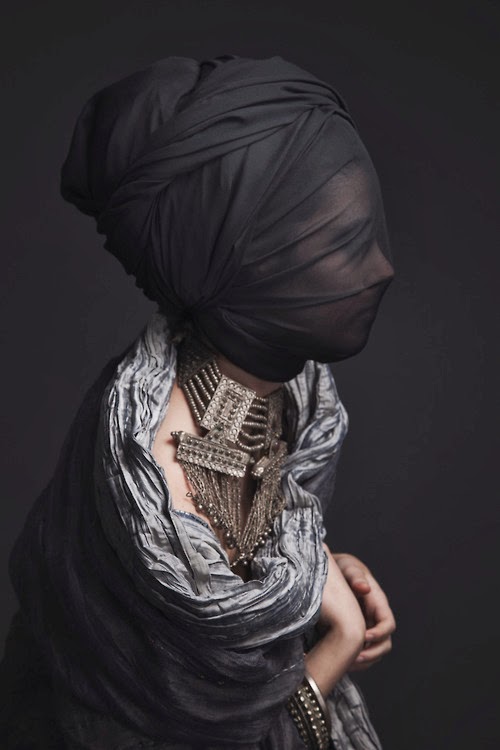 |
Silk Thread Martyrs
photography by Tarek Moukaddem
|
There's a great video of the exhibition opening in London. As always at art exhibition openings, hardly anyone is looking at the costumes. But we certainly were.
 |
|
includes photography by Tarek Moukaddem
© Omarivs Ioseph Filivs Dinæ
|
We were very interested in getting a close to the works as possible. For us, it was all in the detail, whether it was a panel of embroidery or
 |
Silk Thread Martyrs
photography by Tarek Moukaddem
|
the raw edging of a garment
 |
Silk Thread Martyrs
photography by Tarek Moukaddem
|
or a thread under tension
 |
Silk Thread Martyrs
photography by Tarek Moukaddem
|
We were inspired by everything we saw. We weren't at all surprised when we heard later the British Museum had acquired an item from the exhibition. We also weren't surprised when we later discovered Omar Joseph Nasser-Khoury's connection with INAASH in Lebanon. The Archive first began acquiring INAASH products in the mid 1980s. They were always stunning and innovative - at the time we were documenting their use of silk, pastel shades and beading. As their website states:
"From its inception Inaash has pursued a philosophy of excellence and creativity in design ... mindful of the crucial role of traditional needlework in Palestinian heritage [while] recognizing the outstanding aesthetic impact of this high quality craft when fused with contemporary sensibilities".This appealed to Omar Joseph Nasser-Khoury - this quote from an interview with Sue Jones in the issue of "Textile" at the top of this post:
"For the shirts and jackets, I worked with INAASH in Lebanon. I was very keen to work with them ever since I was introduced to their products, so I decided to do my college internship with them in Beirut; this was a year before I actually commenced working on “Silk Thread Martyrs.” I had to make a few phone calls and make use of a few great aunts to get through to the ladies there. I think it was the best educational experience I had during my time at college.
"INAASH is an important center of embroidery—it was started about forty years ago by a group of Lebanese and Palestinian women, who worked diligently on reintroducing embroidery work among the Palestinian refugees in Lebanon. What distinguishes them from almost all the other associations and women’s organizations is their attention to detail, color combinations, quality control, and use of fabrics. The irony is that these particularities were once part of the subconscious of the producers of Palestinian fashion and now they have become an extra advantage.
"The embroidery motifs are original INAASH arrangements that they were already producing on different items. My favorite two were the hjabat (amulets) and mafateeh njoum (star keys), which we had to alter slightly to adapt to my designs ... INAASH are famous for beading their embroidery, so I decided to carry that through in the work, but instead of the glass and plastic beads, I chose some copper, tin, and amber beads for the jackets..."
An INAASH product was very important in OmarJoseph Nasser-Khoury's own journey of discovery. Back to that interview with Sue Jones from "Textile":
"I live in Jerusalem. Growing up, I was usually making things; embroidery, however, was not something that interested or influenced me—neither my mother nor my grandmother embroidered. I did have an interest in making clothes though, simply because that made me feel I could have more control in terms of what I could wear, but it was just that. When a group of British fashion designers came to Palestine to look for potential and inspiration in traditional dress, I wondered why on earth there were no Palestinians with a similar interest. This, coupled with the experience of seeing a shawl embroidered by INAASH1 in Lebanon that my mother had bought on a trip to Beirut, made me decide to pursue an education in art and design. The decisive moment was when I saw the Palestinian costume collection at Birzeit University Museum. The small collection blew my mind—I had never imagined there was anything as profound or variant in terms of color, style, detail, nuance, and skill as I had seen.
In retrospect, I feel my decision was rather reactionary and narrow-minded. A lot of it was based on romance and nostalgia and this urge to “salvage and revive.” All the same, I do not think I would have been able to overcome this nonsense without having followed through my decision. Palestinians in Palestine and the shatat seem to be stuck in this place. I have been working on a project involving fashion design and dress and the participants with whom I was asked to share my experiences were very precious about the embroidery. There is this feeling that they are obliged to represent Palestine and the Cause through embroidery—which in turn has become sacrosanct, like a brand.
OmarJoseph Nasser-Khoury then raises several issues very close to our heart:
"You do still see women wearing embroidered dresses in Palestine. Originally and before the Nakba in 1948 and the Naksa in 1967, the majority of women who embroidered did it for their own personal consumption. Embroidery and dress were markers of wealth and social standing. All the same, as richer women became more globalized—and this is seen in towns like Bethlehem—they turned their attention toward European fashions. Now most of the women who embroider do it for others as a means of generating an income.
"Embroidery charities have been set up throughout Palestine and neighboring countries like Lebanon and Jordan to “empower” refugee women. I personally think this might have been the case forty years ago, but now, in addition to corrupting and bastardizing the art of embroidery, they do little besides maintaining a pathetic status quo.
"Most of what is produced in the charities is bought in sympathy and support for the Palestinians. The same goes for any creative work on that level. There is an inescapable dynamic of condescension at play here. I think there ought to be an informed and ruthless critique when it comes to the notion of cultural heritage and folklore. Especially when this heritage has become separable from our colloquial daily lives. It is problematic that the arena for Palestinian dress has now become the museum, private collections, coffee table books, and incompetent political discourse, rather than the bodies of Palestinians!
When the images taken by Tarek Moukaddem for the collection first became public, my aunt sent my mother an e-mail complaining that she saw little of “our beloved traditional costume” in the work. I cannot remember her true words, but she wrote something to that effect. I was bemused. Besides this, the overwhelming reception was laudatory and positive. What I found disconcerting was the automatic redemption of the work because of its Palestinianism. There was an obvious lack of critique when it came to fashion.
He elaborates on this point in an interview with This Week In Palestine:
"There’s been a very positive reaction to the fact that it’s Palestinian, but not enough fashion feedback, which worries me. To be honest I did project a political stance and people liked that, but my main concern is that the work carry the cause rather than the cause carry the work; therefore, I really concentrated on avoiding clichés so that the collection could be valued for its quality and worthiness of process in terms of thought and production.
 |
Silk Thread Martyrs
photography by Tarek Moukaddem
|
Back to the This Week In Palestine interview:
"With the Nakba in 1948 came the death of many things, so this collection is mourning the martyrdom of everything that Palestine has lost since 1948; humans, heritage, style, freedom, costume, identity, the homeland, etc. The work is a rejection of this reality, it’s a protest that says, “Since we are not allowed to own anything, then we’ll own our death.” It’s basically giving the Occupation the V-sign.
It is also a celebration of Palestinian culture and an attempt at highlighting the breadth, variety, intricacy, and quality of the older Palestinian garments.
This was basically done through the employment of the “traditional” manual techniques of dressmaking, like stitching, embroidering, fabric manipulation, dying, etc. The point, however, was not to differentiate between the older and the contemporary in terms of traditional versus modern, rather to prove that Palestinian fashion is a continuous flow of innovation and reflection of reality.YES!!!! He continues:
"The aim was to create a collection that would initiate a discussion about the expression of identity through fashion. The garments are indeed physically wearable and comfortable, despite being extreme. However, they are garments that have been conceived to push the limits of what is usually perceived as typical Palestinian fashion, and to stimulate that discourse.
I’d like to make Palestinians more aware of the existing fashions we have and to take pride in them. During my internship in 2009 in Beirut with INAASH (Association for the Development of Palestinian Camps), a lady walked into their shop and noticed a detailed photo of a Galilee coat in Shelagh Weir’s book, Palestinian Costume; she assumed it was Indian and didn’t have the slightest clue that it was actually Palestinian. Many people, including Palestinians, don’t realise how rich Palestinian crafts are. The point is rather than sanctify these crafts they ought to be included and enjoyed in daily life. We ought to celebrate this part of our identity as we celebrate our cuisine, our music, and our literature - it’s quite pointless to limit these monumental garments merely to silly wedding celebrations."You can imagine how delighted we were when Omar Joseph Nasser-Khoury began curating exhibitions of Palestinian cultural heritage.
 |
| source |
The first was Beyond Æsthetics (take a detailed look at it's brilliant poster above):
"an exhibition showcasing the Ethnographic and Art Museum’s Palestinian Costume and Tawfiq Canaan Amulet collections, curated on the basis of the visual symbolism and communication as seen in both collections. It aims to elaborate on how the potentials and possible attitudes, when exhibiting and studying ethnographic collections in a visual context, are virtually unlimited. With this approach, the Museum hopes to surpass the stiffness of nostalgia and conservatism which seem too often to confine and limit discourse and imagination when cultural heritage is in question. This exhibition comes as part of the 2011 series of events organized by the Museum aiming to bring the contemporary visual arts program closer to the University’s local community as well as to society as a whole, which in turn stresses on the importance of unconfined artistic practice and interaction."
This one sounds like a lot of fun and we are sorry we didn't see it. Next came Mvsevm: Seat of the Muse:
 |
| source |
Again this was an interactive exhibition about breaking down the usual exhibit / audience / curator barriers, exploring:
“the dialogue between designers and museums and how the processes of inspiration, research, and creation interdependently develop. It aims to break down and deconstruct the traditional barriers that have been set up between the audience and the exhibited, inspiration and production, archive and gallery, by bringing all these elements into play within the exhibition space."Note the word "archive" there along with museum / gallery etc - this was for us like finally meeting someone in the curatorial world that shared our ideas:
"A core team of four individuals - the curator and three assistants - will carry out the project by compiling a body of research based on the manual techniques of construction found in items selected from the Palestinian Costume and Canaan Amulet ethnographic collections. The collated research and information will be used to build a collection of finalized fashion items, which in turn will reflect and investigate contemporaneity and practicality, and the aesthetic potential of these techniques.
"The physical openness of the space, coupled with the engaging setting, aims to actively involve the audience in the design, research, and production processes undertaken by the design team throughout the duration of the exhibition. Visitors will be able to see the team working in the space and interact with them in whatever capacity both see fit.
"Concentration will be on how museums and exhibited items can be used by creative individuals as a source of inspiration and information to generate knowledge. The project will look at the dynamic that develops between the exhibited item / artifact and the participants as viewers and creative individuals who will use the information to design and create a product throughout the period of the project.Next post we'll talk about the rest of the articles in that issue of Textile. Meanwhile, for now we look forward to Omar Joseph Nasser-Khoury's future endeavours with much interest :)
"The research process, design development, product realization, and audience interaction that take place at the museum will create a workshop space that, in turn, becomes and generates the exhibition itself. This means that the process, information, conclusions, and ideas gathered and developed throughout the project by the exhibition team and the audience are approached and exhibited, as one would approach works of art or ethnographic items - almost as an interactive installation. These will be constantly developing throughout the exhibition and changed in such a way that for an individual viewer the space will never look the same on two different visits...."
More info:
- The Mosaic Rooms - Silk Thread Martyrs press release OmarJoseph Nasser-Khoury (OMARIVS IOSEPH FILIVS DINÆ) 18 February – 9 March 2011
- Silk Thread Martyrs film - Neville Rigby
- This Week in Palestine - What a Beautiful Mourning June 2012
- Sue Jones “Silk Thread Martyrs”: Palestinian Embroidery in Textile Volume 11, Issue 2, pages 196-201
- Beyond Æsthetics BZU
Wednesday, August 7, 2013
"Her skin has the memory of trees" - Karl Schembri at the Byron Bay Writers Festival

Palestine Costume Archive Director Jeni reports from the Byron Bay Writers Festival:
It was an honour to meet Karl Schembri at the Byron Bay Writers' Festival, a small but lovely writers festival that's held in the very popular seaside town Byron Bay in northern NSW, Australia. A few years ago my daughter Kadek Purnami, who is part of the Ubud Writers and Readers Festival team, was a guest of the Byron Bay festival. She took me along. Now, much to the amusement of other Palestine Costume Archive staff, I'm addicted to writers festivals :)
It was an honour to meet Karl Schembri at the Byron Bay Writers' Festival, a small but lovely writers festival that's held in the very popular seaside town Byron Bay in northern NSW, Australia. A few years ago my daughter Kadek Purnami, who is part of the Ubud Writers and Readers Festival team, was a guest of the Byron Bay festival. She took me along. Now, much to the amusement of other Palestine Costume Archive staff, I'm addicted to writers festivals :)

I attended Karl's panel "Discomfort zone: how extreme environments affect creativity" on Friday afternoon (his other panels are listed on his blog here).

Karl is a Maltese writer and journalist. His investigative journalism is spot on - see his Wiki entry for details / press awards etc. Being a museum curator / interested in lost cultural heritage I first encountered his name in 2005 when his investigations led to the clampdown on the trading of ancient Mesopotamian artifacts from Iraq on eBay via Malta (see this link). He has had articles in The Sunday Telegraph and Guardian Weekly, amongst many others, and has reported extensively from Libya, Kosovo, Albania, and the Occupied Palestinian Territories. He also works for OXFAM in Gaza.
He has written two novels and is the co-author / co-editor of several poetry anthologies, including an anthology of poems in solidarity with Palestinians published during the 22-day war on Gaza. He has just published another book of poetry "Remember the future" in English, published by Writing Knights Press. In a strange twist of synchronicity in terms of my different worlds coming together, he thanks the Ubud Writers and Readers Festival in his acknowledgements. Perhaps they helped with publishing, I must ask Kadek. I know he attended as a guest last year - Juli from the Juli in Bali blog posted that at last year's Ubud festival "Karl Schembri had the best line, ‘Writers are the only people who can be someone else without needing a psychiatrist’"!.
"Remember the future" was available for sale via the Collins Book stall at the festival, albeit at an appalling price. You can purchase it online for $6, which is much better than the $15 we paid. However we wanted a copy for the Archive's library and wanted to ask Karl to sign it. So the $15 was a bargain, really :)
It was certainly very interesting to hear him speak of life in Gaza, a place which is carved deeply into my heart. Karl described the constant drones - which of course are not part of my Gaza reality - as sounding "like a factory over your head". Dr Jean (Calder at the Palestine Red Cresecent Society) has also discussed the drones. Karl writes evocatively of them in his poem "Gaza":
"Drones watching on usYou can read the rest here.
sending back images
to faraway aliens
capturing our daily dance
rituals of hope and misery
ruins of love and war
donkey-carting joy and sadness
the bitter lemons and the sweetest fried cakes
the olives, the grapes and the limbs
the God-sent births and God-taken martyrs..."

تلك السيدة المسنةشهدت ما يكفي من شروق الشمسليجعد وجه الأرض ..بشرتها تحتفظ بذاكرة الأشجارحينما كانت المزارع مفتوحةً ..كانت تخطو على أرض الوطنبقدميها العاريتين ..توازن برأسها جرار الحليب الطازج ..وترعى الماشية التي كانت حيةًعند حدود الأفق
You'll find the English version here. Here's just a little:

I met up with Karl in the authors' book signing tent after his panel, and we talked a little about Gaza, and about the our own work, while he signed the Archive's library copy of "Remember the future".

I loved that he wrote in the book:
"The old woman has seenDo read the rest. When Karl read this aloud at the festival, I scribbled down that line "her skin has the memory of trees". It just went right through me. He certainly has a wonderful way with words, in any language. I knew exactly what he meant, in regard to older Palestinian women. But for me his words went even deeper and immediately evoked Palestinian cultural memories of how older women once wore the saru (cypress tree) design embroidered on their dresses, and more recently how the olive tree has become a symbol of nationalism, as in the intifada embroidery below, in the Palestine Costume Archive's collection.
enough sunrises to wrinkle the earth
her skin has the memory of trees
her head used to balance
jars of fresh milk
when the fields were still open
when her feet treaded bare
on homely land
and the livestock were still alive
grazing on the horizon..."
I met up with Karl in the authors' book signing tent after his panel, and we talked a little about Gaza, and about the our own work, while he signed the Archive's library copy of "Remember the future".

I loved that he wrote in the book:
"to Jenny,
to keep remembering the future
by curating the past"
I'm sure that will keep all of us at the Palestine Costume Archive inspired. Perhaps we can invite Karl to morning tea so he can read us some more poetry :)


References you might find of interest: