Keeping you informed about Palestinian cultural heritage research, and our work here at the Archive

Keeping you informed about Palestinian cultural heritage research, and our work here at the Archive

Monday, October 17, 2011

Valentina Abu Oqsa’s "Ana Hurra"


We wonder what happened re it's early closing in the US, but are sincerely grateful that Valentina Abu Oqsa’s play Ana Hurra received an in depth and thought provoking review by Jaime Omar Yassin at The Electronic Intifada.

Let's hope more of us get a chance to learn and see more of this play soon.  

(YouTube contains a couple of short clips, although we don't know if these are authorized. Looks pretty powerful to us. Check out here, here and here).

Wednesday, September 14, 2011

Some things never change....


Why does this story / issue seem oh so familiar to everyone at the Palestine Costume Archive lol:
Gaza children’s images of war censored under pressure from US Israel lobby

Nora Barrows-Friedman
The Electronic Intifada
13 September 2011


Pro-Israel organizations pressured an Oakland children’s museum to cancel an upcoming exhibition of drawings made by Palestinian children in the Gaza Strip. Community leaders say the shutting down of the exhibition is the result of a disturbing — and well-funded — campaign to silence Palestinian voices across the US.
On 8 September, just two weeks before the exhibition was set to open to the public, the board of directors of the Museum of Children’s Art (MOCHA) announced that they had canceled “A Child’s View of Gaza.” The board shut down the show due to pressure from “constituents,” according to a statement made by Randolph Bell, the board’s chairman, in the San Francisco Chronicle (“Oakland museum cancels Palestinian kids’ war art,” 9 September 2011).
The show was curated in partnership with the Berkeley-based non-profit group Middle East Children’s Alliance (MECA), which has been working for 23 years to advocate for Palestinian, Iraqi and Lebanese children’s rights. Barbara Lubin, MECA’s executive director, told The Electronic Intifada that it was “upsetting and infuriating” that the show was canceled, but she wasn’t surprised.
“Anybody who knows this issue knows that the Jewish Federations of North America and the Jewish Council for Public Affairs have launched a multi-million dollar project to combat what they call the ‘delegitmization’ of Israel,” Lubin said. “They try and suffocate the boycott, divestment and sanctions movement and censor Palestinian cultural initiatives. What they’re doing is financing the work of silencing and shutting down anyone who wants to talk about what’s really happening to Palestinians.”
The Chronicle also reported that the board of directors at MOCHA vaguely cited the “inappropriate nature” of the content of the children’s drawings in their decision to shut down the exhibit. Some of the Palestinian children’s illustrations show tanks, guns and explosions, but the board’s assertion that these images are “inappropriate” enough to censor is clearly selective.
In years past, MOCHA had successfully exhibited strikingly similar artwork by children in Iraq who drew from their personal experiences of war following the 2003 US-led invasion and subsequent occupation. Another exhibition several years ago showed artwork by children made during the Second World War that “featured images of Hitler, burning airplanes, sinking battleships, empty houses and a sad girl next to a Star of David,” the Chronicle added.
Lubin said that the difference in this context is simple: “The pro-Israel groups are afraid that people will start understanding what’s really going on with Israeli policy through seeing exhibits like the one we put together. They don’t want people to know that Palestinian children are suffering. They’re afraid of us hearing that other side. For 63 years we’ve heard one side in this country and around the world, and it’s time for the other side to be heard.”
Stretching Israel’s siege from Gaza to Oakland
The censored drawings were created through local children’s mental health initiatives in Gaza immediately following Israel’s attacks in the winter of 2008-09, during which approximately 1,400 Palestinians, including more than 300 children, were killed.
Ziad Abbas, associate director of MECA, told The Electronic Intifada that several art-based organizations in the Gaza Strip began working with traumatized children in an effort to help them channel their fears, anger and trauma through artistic expression. Those drawings resulted in the collection of artwork that was to be showcased at the children’s museum.
“The art projects were born out of a necessity to try to reduce the impact and effects of the attacks which killed hundreds of children in Gaza. These drawings came from that kind of therapy to express their feelings,” he said.
Abbas added that the child artists were thrilled that their work had “broken Israel’s siege on Gaza” when the drawings made their way to a museum halfway across the world.
“It was important for these children to know that their voices were going to be heard in Oakland. However, they didn’t expect the siege to stretch all the way from Gaza to California, which is essentially what happened when MOCHA canceled the exhibit due to pressure from these groups,” Abbas said.
Major donors: “Funding was not jeopardized”
Upon investigation, it emerged that those “constituents” who got the ear of MOCHA’s board chair included pro-Israel public relations institutions with extraordinarily large budgets and organized community outreach programs. In the Bay Area, these organizations include the Jewish Community Relations Council (JCRC), a subsidiary branch of the Jewish Council for Public Affairs (JCPA); and the local chapter of the Jewish Community Federation (JCF), which operates under the umbrella of the Jewish Federations of North America (JFNA).
The JCRC and the JCF both receive substantial funding from the Walter & Elise Haas Fund, which has also funded MOCHA.
The fund, based in San Francisco, is a major donor to arts, science, social justice and Jewish organizations around the Bay Area across the political and cultural spectrum. MOCHA received $30,000 in grants from the Haas fund in 2011 (Recent grantmaking: The Arts,” Walter & Elise Haas Fund website, accessed 9 September 2011).
However, a program coordinator with the Walter & Elise Haas Fund told The Electronic Intifada that their staff had talked to the museum about possible public concern with the exhibit, but that the art show “was their decision and their funding was not in any way jeopardized with their doing it.” Pam David, the executive director of the Haas Fund, declined to comment for this article.
John Patchner, communications director for the East Bay Community Foundation — which has awarded tens of thousands of dollars in grants to MOCHA over the years — told The Electronic Intifada that they had “not been contacted by anyone in connection with the cancellation of the exhibit and we’re currently seeking additional information from the Museum of Children’s Art.”
But there are many other foundations that support MOCHA. And in August at least one pro-Israel online campaign encouraged the general public to directly contact MOCHA funders, and published a list of various foundations, in a bid to cancel the children’s art exhibition.

“No fight is too small” for pro-Israel groups
Whether or not MOCHA’s funders were directly intimidated by pro-Israel groups in the Bay Area, it’s certain that top leadership from groups such as the JCRC had a hand in shutting the exhibit down. The JCRC has repeatedly thwarted art and cultural initiatives in the Bay Area which highlight the Palestinian struggle, and has used the guise of “fighting anti-Semitism” to censor alternative voices.
At San Francisco State University in 2006, a proposed mural in honor of the late Palestinian-American intellectual Edward Said was attacked by the JCRC, which helped convince the university administration that the mural sent a “chilling” and threatening message to Jewish students and therefore should be blocked (“SFSU president keeping Jews safe with mural censure,” Jewish Weekly, 6 October 2006).
In 2007, the JCRC also worked hand-in-hand with the Anti-Defamation League (ADL), one of the largest and most influential Israel lobby organizations in the US, to force the San Francisco Arts Commission to exert pressure on a local grantee of theirs, an organization for at-risk youth in San Francisco. A mural, planned and painted by Homies Organizing the Mission to Empower Youth (HOMEY), depicted symbols of Palestinian struggle and resistance, including a Palestinian woman with a kuffiyeh (the traditional checkered headscarf) and a crack in the wall that resembled historic Palestine.
The JCRC and the ADL put pressure on the Arts Commission to make the artists omit or modify some of the images after claiming that the symbols were anti-Semitic and “out of touch with the overwhelming majority of Jews,” as reported in the San Francisco Examiner (“Controversial mural to be altered in S.F.,” 20 September 2007).
The two organizations also worked together to stifle free speech on college campuses in the Bay Area, censoring academic lectures by attempting to conflate criticism of Israeli policy with anti-Semitism. Other pro-Israel groups, backed by the ADL, have pressured faculty boards to deny tenure to university professors who openly criticize Israeli policies.
Following MOCHA’s cancellation of the exhibit, Rabbi Doug Kahn, executive director of the JCRC, admitted to the online blog Muzzlewatch (a project of Jewish Voice for Peace) that he was “working closely with the Jewish Federation of the East Bay [which is part of the JFNA]” and “shared with the leadership of MOCHA our concerns about the inappropriateness of this exhibit given the fact that MOCHA — an important and valued community institution — serves very young children” (“Oakland children’s museum cancels Palestinian children’s art exhibit under pressure from local Jewish groups,” 10 September 2011).
Rabbi Kahn refused to respond directly to The Electronic Intifada’s questions via phone, but emailed a statement from the JCRC on 12 September. Entitled “Jewish Community Applauds Children’s Art Museum’s Decision on Exhibit,” it alleges that the art show “contains violent images that dehumanize an entire ethnic and religious population.”
The JCRC adds that MOCHA’s leadership “recognized the negative effect that this inflammatory exhibit would have on young children, Jewish and non-Jewish alike,” adding that the drawings could “potentially create an unsafe atmosphere for Jewish children.”
However, nowhere in the children’s drawings are there anti-Semitic images or phrases. The only Stars of David that are drawn are the ones that Israel itself has put on its flags, F16 bomber jets, tanks and soldiers’ uniforms — ubiquitous Israeli national symbols that any Palestinian child living under Israeli military occupation would see on a daily basis, especially during times of wanton attacks.
The cancelation of the children’s exhibition was celebrated as a victory by pro-Israel groups. On 7 September, the day before MECA was informed by the museum’s board of directors that the exhibit had been canceled, the Jewish Federation of the East Bay (JFEB) had already received information that the show was shut down — and boasted about the cancellation of the exhibit on its official twitter account.
JFEB (@JFEDeastbay) tweeted: “Great news! The ‘Child’s view from Gaza’ exhibit at MOCHA has been canceled thanks to some great East Bay Jewish community organizing.”
Pro-Israel groups to “pressure civic leaders” in new $6M initiative
The timing of Kahn’s determination to pressure the MOCHA board is significant. Just eleven months ago, the JFNA pledged to invest $6 million in a new, three-year initiative they call the “Israel Action Network.”
Working alongside the JCPA — of which the JCRC, Kahn’s organization, is a subsidiary — the Israel Action Network “is expected to serve as a rapid-response team charged with countering the growing campaign to isolate Israel as a rogue state akin to apartheid-era South Africa — a campaign that the Israeli government and Jewish groups see as an existential threat to the Jewish state … The network will monitor the delegitimization movement worldwide and create a strategic plan to counter it wherever it crops up” (“Federations, JCPA teaming to fight delegitimization of Israel,” Jewish Telegraphic Agency, 25 October 2010).
The JFNA stated that this new campaign would seek to influence “civic leaders,” and said that it would be fully staffed and “up and running” by 1 January 2011.
According to their recent tax forms, the JFNA’s investment of $6 million in this new campaign should not be a financial burden — they listed more than $197 million in total assets between June 2009 and June 2010 (Return of organization exempt from income tax, 2009, 2009-2010 [PDF]).
The fact that these enormous, well-funded Israeli advocacy organizations have turned their attention to a singular, modest children’s art exhibition in Oakland highlights the Israeli lobbies’ tireless efforts to silence Palestinian expression. Deborah Agre of MECA agreed, saying that “no fight is too small” for these groups.
MECA’s Barbara Lubin added that the attack on this children’s art show is just one in a long line of such campaigns.
“But this is particularly saddening to me because these are voices of children,” Lubin said. “And as I said to the head of the board of directors at the museum, MECA loses, MOCHA loses, but more importantly, the children from Gaza lose the most. They’ve always been the ones to lose the most. Not only do they have to live through these bombings and the siege, but then when they try to express their experiences through art, they’re shut down.”
“There’s only one winner in all of this,” Lubin added, “And that is the Zionist lobby who intimidate, harass and do everything they can to make it impossible for people to have these kinds of exhibits.”

The child artists in Gaza are upset that their work has been censored, according to MECA staff.

MOCHA’s board of directors: supporting all children, or just some?
According to its tax documents, accessed from public records, it is clear that MOCHA is a grassroots organization highly dependent on funding from outside grants and foundations. MOCHA listed just over $700,000 in contributions and grants in 2009 — whereas salaries and employee benefits accounted for approximately double that amount. Their fee-based children’s art programs bring in additional revenue of just under $1 million for that year.
If pro-Israel lobbyists indeed placed threatening calls to foundations that support MOCHA, it is understandable that they could feel frightened by the potential loss of money for the next fiscal year and would therefore bend to pressure by these outside groups. But MOCHA may have violated its own mission statement in doing so. On its tax forms, MOCHA states its mission is “to ensure that the arts are a fundamental part of the lives of all children.
Ziad Abbas said that it’s wrong for the board of directors to put conditions on that support. “Do they really support all children, or just certain ones? Certainly, in this situation, the Palestinian children who made this artwork are not being supported at all,” he remarked.
The Electronic Intifada asked whether the children in Gaza had been informed that their exhibition was shut down, and what their reaction was to the news. Abbas explained that he had just received a call from one of the young artists in Gaza who saw MECA’s press release on the Internet that explained that the show was canceled.
“He was extremely disappointed, and the other children were obviously shocked and sad as well,” Abbas replied. “It’s upsetting to them to hear that a children’s art museum across the world decided that their personal [narratives] are offensive, and then silenced their voices and artwork. When you hear about an art museum that has violated its own mission to censor children’s artwork and children’s artistic expression, it’s extremely disappointing.”
Community support is out in force
Following Thursday’s announcement by the MOCHA board of directors, MECA has been flooded with phone calls and emails from supporters not only just across the Bay Area but worldwide who are appalled at the shutting down of the children’s art show. And Lubin said that while outrage at the museum is understandable, the institution is not the enemy.
“MOCHA is very dear to our hearts,” Lubin emphasized. “We love this organization and respect the work they do. It’s an essential institution in the Bay Area. Our anger is not at the people who work at MOCHA; rather, our anger is at the board who do not have the courage to stand up to this kind of intimidation from the pro-Israel groups. We’re asking people to direct their anger at the board and at the Zionist organizations who do this kind of muzzling. But certainly not at the organization itself.”
MECA has started an email action campaign in an effort to counter-pressure the board of directors with support and gratitude for hosting the Palestinian children’s artwork. They are also asking people to come to the gallery on 24 September, on the planned opening day of the exhibition, in a show of support for the show even if it remains canceled.
Meanwhile, Lubin and the MECA staff are busy figuring out alternative venues for the exhibition. “We’re not sure where the show will be yet, but we’ll continue to work on seeing that these voices are heard and that these pictures are shown. People want to do something, and have been offering space in their homes, shops and even in schools,” Abbas said. “They won’t shut down these children’s voices.”
Nora Barrows-Friedman is an award-winning independent journalist, and is a staff writer and editor for The Electronic Intifada. She also writes for Inter Press Service, Al Jazeera, Truthout and other outlets, and regularly reports from Palestine.

Tuesday, December 21, 2010

Al Hanouneh's extraordinary "Guardians of the Memory"

Al Hanouneh troupe members dance
 in traditional Palestinian outfits
 in Amman on Saturday evening
(Reuters photo by Muhammad Hamed)

From the Jordan Times, by Mohammad Ben Hussein

AMMAN - Arab nationalism and Palestinian folk traditions were set to live music in a performance in the capital on Saturday evening.

In a concert held to express solidarity with the Palestinians, Al Hanouneh folk troupe took to the stage at the Royal Cultural Centre and danced to popular tunes such as “Youya” “Alee Narak”.

Band leader Musa Saleh said the performance titled, "Guardians of the Memory", is part of the group’s mission to preserve the recent and historical memory of Palestine and the greater Arab world.

“We have a duty as a band to protect the collective Palestinian memory. Our memory is part of our identity and Israel is doing its best to tarnish that memory to destroy our identity,” Saleh told The Jordan Times after the concert, which marked the anniversary of the partition of Palestine by the UN General Assembly in 1947.

“We see Israel as trying to rob everything from us, not only the land. They dress air hostesses on their planes with Palestinian attire and claim to have invented falafel among other things. We should not allow them steal our tradition and culture,” he added.

This year’s event featured prominent bands and poets from across the region, including Tawfiq Al Halabi, Rayek Kheir, Shadi Mousa, Najeeb Yuakbi, Ahmad Fahmawi, Flayeh Al Jubour, Sana Mousa, Talal Haidar and Ahmad Fahmawi, among others.

Al Hanouneh was established in 1993 in Amman with the goal of protecting and safeguarding the culture and folklore of the area through the selection and classification of Palestinian folklore.

The group comprises over 80 dancers, musicians and singers.

20 December 2010

More photos:  Photos from Emirates247.com


Wednesday, August 18, 2010

Arabesque Festival - Brides of the Arab World, Kennedy Center, Washington D.C


Displays of Palestinian costume are still fairly rare around the world, so here at the Archive we like to document each one as much as we can.

Quite often when we post about Palestinian heritage displays it can be a tough read, as we record stories of organizers - no matter where they are in the world - facing major problems budget wise, politics wise, content wise (when museums / exhibition venues try to control info on labels and wall text, or stop certain photos being used) etc with their display.

Sometimes the problem relates to the quality of the heritage material being displayed. Some times it's hard for exhibition organizers to know how to identify and date Palestinian material, for example how to tell pre1948 costumes and textiles from mid 20th century ones.  Or what garments go together on a mannequin.  Some items proposed for display may need (expensive, time consuming) conservation. Sometimes the information on the labels is wrong. Sometimes the items displayed are not even Palestinian.
It's a challenge. That's what happens when cultural knowledge has been ripped away and must be reclaimed inch by inch. But we'll let you in on a secret. Things are slowly improving on this front.  In fact, the particular exhibition we are posting about today provides a good example of that. This Palestinian costume display was part of a larger exhibition that looked at Middle Eastern costume, which itself was a small but important part of "the largest ever Arab arts festival in the U.S" which was "widely seen as a landmark for the representation of Arab culture in the United States".  Even better, there was no problem about the budget or about the quality of the Palestinian cultural material displayed or the info on the labels.

Which means, if you are out there looking at creating an exhibition of Palestinian costume, then this is an excellent example to use. It may only contain a handful of mannequins devoted to Palestine - and we find the white hands on those mannequins a bit intrusive lol -  but the quality and cultural knowledge being exhibited is the best.


"Brides of the Arab World" was part of the Arabesque Festival  which ran at the Kennedy Center in Washington DC from February 23 to March 15, 2009:
"Unwrap the cultural treasures of the Arab world in this Kennedy Center international festival showcasing the varied cultures of the 22 Arab nations that represent the Arabic-speaking world. From the Arabian Gulf to the Levant to North Africa-this region of the world is the birthplace of human civilization and features extraordinary diversity in geography, traditions, landscape, religion, and contemporary aesthetics. 
"In cooperation with the League of Arab States, the three-week festival brings together artists, many of whom are making their U.S. debut, in performances of music, dance, and theater, as well as exhibitions featuring art installations, fashion, a soundscape, cuisine, a marketplace, and much more. Discover the evolution of art forms born from the cradle of human civilization. Experience an amazing breadth of culture that spans both eons and continents"
Talk about an amazing program of events! Some Archive volunteer staff did attend, and the rest of us were very envious. It was also great to see Arab culture displayed in the US. As Piney Kesting later noted in Art to Heart in Saudi Aramco World:
"The seeds for “Arabesque” were planted more than four years ago. “I believe the arts create peace and provide a window onto understanding people,” says Michael Kaiser, president of the Kennedy Center. He explains that since 2004, the Center has sponsored festivals focused on France, China and Japan; for 2009, he says, he wanted a larger festival focused on regions about which Americans have little cultural knowledge. “In the Arab world, we know only about politics and oil,” Kaiser comments. “We have no knowledge of Arabs as human beings. I felt it was important for us to dispel this ignorance, and also to show the immense beauty that has been created by Arab people throughout the centuries.
"For the festival’s 21 days, visitors found an open passport to the Arab world—no visas required. There were daily performances on several of the Center’s nine stages; discussions of Arab literature with more than 30 authors; Arab films; an exhibition of 40 wedding dresses from all of the 22 Arab nations; contemporary art exhibits; shopping in “The Souk” (“Marketplace”) and learning about the Islamic world’s contributions to science in the “Exploratorium.” 
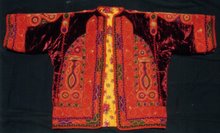
Bedouin costume, Egypt
Costume History is Fun

James Zogby wrote in The Huffington Post:
"Negotiating the logistics and politics necessary to assemble the festival was monumental. Locating the talent, securing visas, transporting sets, costumes and works of art was, itself, a remarkable undertaking, a tribute to the foresight and vision of the Kennedy Center's Director, Michael Kaiser, and the determination and the commitment of his staff to see the project to fruition. 
"Five years in the making, the Director and staff of Washington's prestigious Kennedy Center, traveled across the Arab world to assemble a wide range of artists from all 22 Arab countries. Eight hundred performers, in all, have come to the U.S., from the traditional (Berber singers from Morocco), to the more avant-garde (Marcel Khalife, or Debbie Allen's remarkable "Omani Dancers"). There were musicians, singers and dancers, poets and painters, story-tellers, artists and craftsmen represented in the group. 
"Arabesque" provides Americans and Arabs alike with a profound learning experience. As Secretary General of the Arab League, Amr Moussa, noted, never before have artists from all 22 Arab countries been represented under one roof in one festival. As the festival unfolds over its three-week run, tens of thousands of Americans will see the richness and diversity of Arab culture, in all its many exquisite forms..."
The Palestinian costumes were from the collection of the Palestinian Heritage Foundation, an amazing foundation that does excellent work and has an excellent collection.  The Palestinian Heritage Foundation later wrote in their Newsletter for March 2009:
 “Brides of the Arab World” featur[ed] 48 traditional bridal outfits from all 22 member countries of the Arab League ... a fascinating display of rich textiles, embroidery and intricate jewelry. 
"The Palestinian Heritage Foundation presented five costumes from Palestine representing Bethlehem, Jerusalem, Ramallah, Al-Khalil and Asduud, as well as other costumes from Jordan, Syria, Lebanon and Tunis. The costumes from Lebanon and Tunis come from the collection of the late Dr. Hala Salaam Maksoud, donated by her family to PHF."


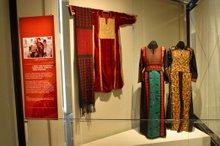
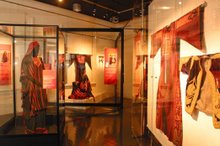
You'll find some excellent photos of the installation on the PHF's newsletter.  Coleen T at the Costume History is Fun blog has several posts with excellent photos of the displays, including Palestine (10 July 2010), we've reproduced several here in fact it was finding these photos that prompted this post. Pierre Radulescu, who posted the You Tube videos above, also posted some photos of his blog here.

The detailed labels accompanying the five Palestinian costumes were very good, combining both the past and present, which as one reviewer noted, is rare:
"The descriptions of the bridal gowns and their history reveal what is usually hidden from American audiences; that the traditions, cultural expressions and heritage of the Palestinian people mingled with adjacent Arab lands and dated back to the time of the Roman Empire. Unfortunately, many of these traditions and cultural aspects from early times have been more recently destroyed"
Brilliantly, Coleen T included label text in her Costume History is Fun posts, so we are going to quote some below:

Source: Courtesy Costume History is Fun
Asdud Dress 
"With its lightweight fabric and V-cut neckline, the Asdud costume was well suited to the warm Mediterranean climate of this coastal town. This particular dress was hand-woven in the 1930s in nearby Mejdel, once famous for its narrow linen edged with red or turqoise stripes. Similar fabric has been excavated from sites dating back to the 2nd century, and the embroidery patterns (cypress trees, combs) are just as ancient. The headdress or saffeh resembles that woen in other coastal areas; decorated with coins, it is wrapped around the bride's braided hair and covered with a large embroidered headscarf.
Source: Courtesy Costume History is Fun
"Since the 1948 war, the former residents of Asdud have lived in refugee camps in nearby Gaza. Asdud is now the Israeli town of Ashdod and its traditional embroidery has almost disappeared, although Palestinian workshops in Lebanon and Jordan do still re-create these classic patterns on shawls, jackets and bags. "
Source: Courtesy Costume History is Fun
El Khalil Dress 
"The El Khalil wedding dress is famous for its winged sleeves and heavy embroidery, with silk cross-stitch covering most of the linen. The bride may also wear a coin-covered vest called a miklab. The headdress, richly decorated with coins and precious stones, sits atop a simple cap. Reserved exclusively for weddings, it is shared by all brides from the same clan. A large embroidered linen scarf called a ghudfeh is draped over the headdress; after the bride is presented wo the wedding guests, the scarf is removed to reveal her complete costume. Embroidery motifs on this dress, made in the 1940's, include "acanthus leaves with cup" khemet-el-pasha (the tent of the pasha) and feathers."
Source: Courtesy Costume History is Fun
Jerusalem Dress
"Made in the 1940s, this wedding dress from the village of Ein Karem reveals the strong influence Bethlehem exerted on the embroidery in villages around Jerusalem in the early 20th century. The primary fabric is imported European velvet, and the chest piece, side panels and sleeves are silk embroidered with couching. Called talhami or tahriri, this needlework was usually done by professional women embroiderers in the towns of Bethlehem, Beit Jala and Beit Sahur. And as in Bethlehem, a short-sleeved embroidered jacket (taqsireh) was worn over the long-sleeved dress, creating a lovely shirred effect. The scarf covering the headdress was trimmed with locally made lace, a feature unique to Jerusalem costumes. 
"This is but one of the eight different Jerusalem styles; each boasts different fabrics and colors, but all feature similar embroidered panels. The former residents of Ein Karem are now refugees (the village has become a popular Israeli tourist destination). but Palestinian embroidery workshops still reproduce the Ein Karem dress as well as the taqsireh which many women now wear as an elegant jacket"
Source: Courtesy Costume History is Fun
Ramallah Dress 
"One of the most famous Palestinian costumes, the Ramallah bridal outfit is said to have originated in the 5th century. This one was made in the 1920s of hand woven linen embroidered with silk thread in a cross stitch pattern. It features the traditional squarechest piece adorned with age-old motifs such as flowers, palm trunks, birds and the S- shaped alak or leeches (used for medicinal purposes, they represent good health and longevity). Its wuqa headdress is decorated with Ottoman coins and cross stitch embroidery. 
"Draped over the headdress is a matching scarf embroidered with crosses, a reminder that Ramallah was a predominantly Christian town in the 1920s. During the 1930s, silk scarves imported form the Far East became popular, but today the traditional costume is worn without a scarf. On special occasions, Palestinian women intent on preserving their heritage wear contemporary versions of the dress made of synthetic fabric embroidered with cotton thread. The headscarves have been re-purposed as wall hangings, tablecloths and cushions. "
Bethlehem Dress 
"A woman would wear this costume for the first time on her wedding day, then on festive occasions thereafter. Distinguish by long, winged sleeves called irdan, these dresses were made from a special linen hand-woven exclusively for that purpose. The fabric was crafted in lengths of about 10 yards; silver brocade at one end was used for the lower back of the dress, a tradition that goes back at least 10 centuries. The shatweh, or headdress, resembles those seen on ivory statues dating from 1200 BC. It was presented to the bride at their wedding and could be worn only by married women. Decorated with Ottoman coins and coral, the shatweh, is covered by a large headscarf. 
"Most of the embroidery on the dress and headdress is metallic and silk couching. The square chest piece features a traditional design with floral rounds in each corner and a central medallion containing a cross (this dress dates from the 1930s when Bethlehem was predominantly Christian). For Muslim brides, flowers replaced the cross. This special linen has not been woven since the 1960s, but Bethlehem dresses made with synthetic fabric and embroidery thread are available to today's brides, who often include one in their weddings along with a modern white gown. On special occasions, today's Palestinian women also wear contemporary jackets and accessories inspired by the traditional couching."
A lot of work went into getting those labels right, in discussing both pre and post 1948 styles, and in tying whole outfits together so you know what goes with what.  We adore statements like "A woman would wear this costume for the first time on her wedding day, then on festive occasions thereafter". This addresses one of our pet hates - the pretty much constant misrepresentation in European and North American exhibitions of traditional Palestinian dresses as bridal gowns in the Western sense, worn once and never again. This was absolutely not the case. The majority of items in a woman's married wardrobe were sewn before her wedding as part of her trousseau, worn on specific days during her wedding celebrations and then afterwards on special occasions.

"Brides of the Arab World's design and installation would have been tricky, because the Hall of Nations / the Hall of States are not the easiest of display areas, being major through ways.  You also need to tie the exhibition in to the rest of the proposed festival.  As Piney Kesting notes in Saudi Aramco World:
"The difficulty with exhibits that involve 22 countries, explains “Arabesque” exhibit designer Adrien Gardère, is finding “a common thread that emphasizes the legacy and the roots that link the artists.” In the case of the Kennedy Center, which is neither a museum nor an exhibition hall, “you want the exhibits to enhance the performing arts and to capture the attention of a public that has come primarily for the performances,” he says. In less than eight months, Gardère produced exhibits that used Islamic architectural elements and proved as fascinating and provocative as the artworks themselves 
"Visitors entering the Kennedy Center were captivated by a row of traditional wedding dresses in the “Brides of the Arab World” exhibit. Upstairs, Egyptian sound engineer Alaa El Kashef ’s “Soundscape: Souk” evoked a busy Cairo street. Nearby, the exhibit of Azza Fahmy’s jewelry, a blend of traditional and modern design, was displayed nestled in stacks of unglazed clay pots. Women’s art from throughout the Middle East appeared in a room constructed of mashrabiyyah windows—the traditional turned-wood screens that allow in exterior light while preserving interior privacy. In the Exploratorium, visitors lay back and watched a 3-D film on the golden age of Islam, projected onto the ceiling."

It was certainly an effective installation. The entire Arabesque festival was widely praised.  "Arabesque: More Significant than Apparent" headlined one review, while James Zogby concluded:
"The experience of "Arabesque" will shatter stereotypes, and put new definition to the meaning of being Arab. For too many Americans, Arabs exist only as one-dimensional political beings, lacking hearts or souls ... During the next three weeks, this caricature of Arabs will be destroyed ...
"There are lessons to be learned from "Arabesque." It should be repeated. The seeds that have been planted by this festival will grow on their own - but how much better if they are nurtured and cultivated? The lesson here is that, not only is the Arab past glorious, but that the present and future are, as well. All of us owe thanks to the Kennedy Center for reminding us of that, and challenging us to do better at remembering it."
More info about the exhibition:

Monday, April 19, 2010

Palestinian / Jordanian costume in the National Folklore Museum in Amman

Jordanian bedu outfit
Jordanian Museum Popular Traditions
1991
(from the Archive's website)

Archive volunteer staff are scattered worldwide, some with no access to museums with Palestinian costumes and cultural material. So we are going to post about museums with Palestinian collections so you can all see where material is held, and get an idea of how much is left and what condition its in.


The Jordan Folklore Museum and Jordanian Museum of Popular Traditions in Amman are amongst our favorite museums.  They are located on each side of the Roman theatre in downtown Amman. Lots of us have visited over the years, and their collections inspired us to try to find out more.


They have good collections, but like many small museums they have limited funds for conservation.  Their display is small, but evocative, and we have the greatest respect for the museum staff who look after everything.


We've provided links below to any installation photos we've found on the web, and we'll keep updating this. If any Archive friends or volunteers in Jordan get a chance to take photos for the Archive's documentation, please do!

  • Noelle from the Little Yellow Duck blog uploaded several wonderfully details posts with photos of Palestinian, Syrian and Jordanian bedu and fellahin costumes in the these museums.   As we can't access our own photos of this collection at the moment (they were pre digital) we thought you might like to see hers.  We'll also drop Noelle a line to help her identify some of the costumes and ask if we can reproduce copies of her photos in this post at some point.Links all published on 12 and 13 April 2006:
  1. Hebron robe and shambar 
  2. Hebron jillayeh  (very rare garment)
  3. Bethlehem
  4. Jerusalem
  5. Nablus
  6. Beer Sheba
  7. No idea (double dresses)
  8. No idea 2 bedu?
  9. Beer Sheba 2
  10. Ramallah
  11. Ramallah 2
Mosaic 1 - Picture of Jordan Museum of Popular Tradition, Amman
This photo of Jordan Museum of Popular Tradition is
 courtesy of TripAdvisor

Pictures of Jordan Museum of Popular Tradition - Attraction Photos
This photo of Jordan Museum of Popular Tradition 
is courtesy of TripAdvisor
Source
Source

More info:
  • Jordan Folklore Museum "the museum presents the traditional Jordanian life, including costumes, home furnishings, musical instruments and handicrafts dating back to the 19th century. Other notable exhibits include a Bedouin goat-hair tent with rug weavings and household equipment, and replicas of traditional domestic interiors" Opening hours: 8.00-16.00 in winter, 8.30-18.30 in summer  Opening Days: daily 
  •  Jordan Museum of Popular Tradition  "Located in the eastern section of the Roman Theater, this museum displays the traditional costumes of Jordanians, including embroidery and antique jewelry, as well as domestic utensils. It also houses a collection of mosaics from some Byzantine churches in Jordan" Opening hours: 8.00-16.00 in winter, 8.00-18.30 in summer  Opening Days: daily except Tuesday