Keeping you informed about Palestinian cultural heritage research, and our work here at the Archive

Keeping you informed about Palestinian cultural heritage research, and our work here at the Archive

Monday, April 19, 2010

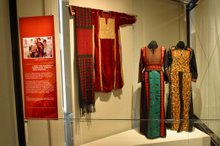
Palestinian / Jordanian costume in the National Folklore Museum in Amman

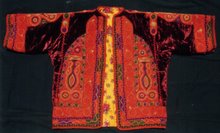
Jordanian bedu outfit
Jordanian Museum Popular Traditions
1991
(from the Archive's website)

Archive volunteer staff are scattered worldwide, some with no access to museums with Palestinian costumes and cultural material. So we are going to post about museums with Palestinian collections so you can all see where material is held, and get an idea of how much is left and what condition its in.


The Jordan Folklore Museum and Jordanian Museum of Popular Traditions in Amman are amongst our favorite museums.  They are located on each side of the Roman theatre in downtown Amman. Lots of us have visited over the years, and their collections inspired us to try to find out more.


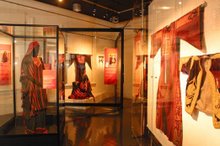
They have good collections, but like many small museums they have limited funds for conservation.  Their display is small, but evocative, and we have the greatest respect for the museum staff who look after everything.


We've provided links below to any installation photos we've found on the web, and we'll keep updating this. If any Archive friends or volunteers in Jordan get a chance to take photos for the Archive's documentation, please do!

  • Noelle from the Little Yellow Duck blog uploaded several wonderfully details posts with photos of Palestinian, Syrian and Jordanian bedu and fellahin costumes in the these museums.   As we can't access our own photos of this collection at the moment (they were pre digital) we thought you might like to see hers.  We'll also drop Noelle a line to help her identify some of the costumes and ask if we can reproduce copies of her photos in this post at some point.Links all published on 12 and 13 April 2006:
  1. Hebron robe and shambar 
  2. Hebron jillayeh  (very rare garment)
  3. Bethlehem
  4. Jerusalem
  5. Nablus
  6. Beer Sheba
  7. No idea (double dresses)
  8. No idea 2 bedu?
  9. Beer Sheba 2
  10. Ramallah
  11. Ramallah 2
Mosaic 1 - Picture of Jordan Museum of Popular Tradition, Amman
This photo of Jordan Museum of Popular Tradition is
 courtesy of TripAdvisor

Pictures of Jordan Museum of Popular Tradition - Attraction Photos
This photo of Jordan Museum of Popular Tradition 
is courtesy of TripAdvisor
Source
Source

More info:
  • Jordan Folklore Museum "the museum presents the traditional Jordanian life, including costumes, home furnishings, musical instruments and handicrafts dating back to the 19th century. Other notable exhibits include a Bedouin goat-hair tent with rug weavings and household equipment, and replicas of traditional domestic interiors" Opening hours: 8.00-16.00 in winter, 8.30-18.30 in summer  Opening Days: daily 
  •  Jordan Museum of Popular Tradition  "Located in the eastern section of the Roman Theater, this museum displays the traditional costumes of Jordanians, including embroidery and antique jewelry, as well as domestic utensils. It also houses a collection of mosaics from some Byzantine churches in Jordan" Opening hours: 8.00-16.00 in winter, 8.00-18.30 in summer  Opening Days: daily except Tuesday

Sunday, November 1, 2009

Palestinian Film Festival, Australia 2009


If you can, do go along to the Palestinian Film Festival now screening in three Australian states. There are some extraordinary movies showing until mid November 2009, and we'd love you to see as many as possible! Archive staff in particular recommend "Heart of Jenin".

Here's the press release for the Festival:

After a hugely successful inaugural season, the Palestinian Film Festival returns for its second year, this time expanding into venues in Sydney, Melbourne and Adelaide. Featuring internationally acclaimed, award-winning films, the festival continues with its mission to reflect the lives, stories and culture of Palestinians beyond the politics that are often focused on by the media.

Opening the festival this year is the 2009 Cannes selected film The Time That Remains, written and directed by celebrated filmmaker Elia Suleiman. Also featured is the stunning Pomegranates and Myrrh, directed by Najwa Najjar, which screened at Sundance earlier this year to critical and popular acclaim, and a special screening of the first Palestinian animation film Fatenah (director: Ahmad Habash). Popular films from the documentary program include the hit Slingshot Hip Hop (director: Jackie Reem Salloum) and the hopeful and tender The Heart of Jenin (directors: Lior Geller, Markus Vetter) which has caused passionate debate around the world.

The 2009 program consists of an exciting and diverse range of features, documentaries, animations and short films, all of which are certain to entertain and enrich audiences from all cultural backgrounds
You'll find more info plus screening times in each city on the Festival's website :).

(logo: courtesy Palestinian Film Festival)

Saturday, June 20, 2009

New acquisition - a donation of a late 20th century embroidered vest


This lovely contemporary vest has just come to our collection. Here's a few cross stitch close ups - some lovely "saru" designs, amongst others :) :


Saturday, August 23, 2008

What website? The Palestine Costume Archive vanishes online yet again....


As long term Palestine Costume Archive friends know, we periodically have website troubles. Sometimes these are easy to fix (when hackers make a mess) but this time we lost our domain name.

We have tried unsuccessfully to contact the people who now own "www.palestinecostumearchive.org". For a couple of months. We have now given up and are in the process of registering another name. We'll be back as soon as possible.

Anyone out there with enquiries about Palestinian costume / culture, please feel free to email us, or contact us via either of the Archive's blogs. We'll provide copies of website info, pix, all the usual things. And again: apologies for the inconvenience.

Friday, July 18, 2008

Balata Film Collective's "Palestinian embroidery under occupation"


 This video was uploaded on YouTube by the Balata Camp Film Collective:
"Film is an important means of both resistance and communication. The Balata Film Collective was initated to enable young Palestinians from Balata to break their isolation, challenge their oppression and and represent their lives to the world. 
"The Balata film production collective films, edits and produces movies in Arabic and English. Until now, the collective has focused on producing shorts which are uploaded to the internet. 
"Please visit http://www.balatacamp.net for further information about balata camp and balata film collective. Please do also visit for further video material on balata camp please visit http://a-films.blogspot.com, the webpage of the anarchist video collective a-films."
We think it's terrific, and look forward to more films :)