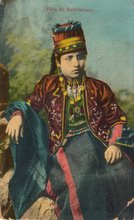
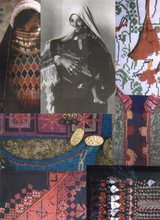
When the Palestine Costume Archive first started, in the early 1980s, if you wanted a Palestinian meal anywhere in the Palestinian diaspora you went to family or friends' homes. But wonderfully these days Palestinian cafes and restaurants are springing up all over the diaspora. Archive friends and volunteers regularly ask about them, so we thought we might review some of our favorites.
Canberra, Australia
This is Sam. Here at the Palestine Costume Archive in Canberra we're very fond of Sam. He's holding our latest favorite food, but you're not going to hear about this particular dish until a later post :)

Remember, we recently posted a review of Tatreez Cafe in London? We've been feeling so jealous of Archive friends and Education Officers based in London because they can hang out at Tatreez. Well we are jealous no more. Because we've got Sam.
Sam is the owner / chef of Zar Bakery and Cafe.

Which has just opened in Canberra. Which means there is now a Palestinian cafe in Canberra. The Archive was set up here over thirty years ago and we've never had a Palestinian cafe in Canberra. But now we do :)

It will make outside seating very pleasant in summer, even if it's a bit brisk right now.

So what can we tell you about Zar Bakery and Cafe. Let's talk about what it looks like first, and then we'll talk about the food.
One of the reasons we enjoyed reviewing Tatreez Cafe was because, apart from being a wonderful place for Palestinian food, it's also interesting for us as a museum dedicated to documenting contemporary Palestinian culture, to look at in terms of it's design construction. We posed the question in that post:
"because Tatreez Cafe is a designed space, specifically created to evoke pre 1948 Palestinian culture and landscape within a 21st century urban environment... does it succeed?"We all agreed it did:
"It mixes the modern industrial world (brick walls, burnished metal panels, metal air ducts, etc) with echoes of older traditions (wooden tables and chairs, handwritten blackboard menu, while components like the form and colour of the huge pizza oven the shape of the vertical decorative wooden panels and the earth coloured tiled floor as well as these cotton table decorations evokes the Palestinian village landscape"In Zar Bakery and Cafe's case, Sam and his team may not have had Relic Interiors London on hand, but they've achieved a very nice look on their own. The cafe and it's signage / logo etc have utilized a (dark and light = earthy / nature / natural) brown, black and white colour scheme which is echoed in it's logo and state of the art business cards:

As with Tatreez there is an interesting juxtaposition between industrial and rustic components, albeit a more subtle one. Zar Cafe's interior is welcoming, the kitchen areas spotless and gleaming,

more like a modern day Ramallah bakery / restaurant kitchen (Sam is from Ramallah). Sam might admire the beautifully styled oven that we love at Tatreez Cafe, but then again he might not - Zar's kitchen is well set out for making Palestinian breads, and Sam has a good working area right near his multiple ovens.

However in some of the public areas Zar has gone for a more rustic look, with one section featuring nicely textured wooden paneled wall, a long wooden bench top

and wooden bar stools with an antique walnut finish topped with woven rush leaves seat:

The cafe's logo has been hand painted on a panel on the wooden wall,

the hand painted element giving the whole panel a lovely texture:

The same logo appears on candles
and the menu, which adds orange to the colour range:

At first glance you could almost be anywhere in the Middle East with this cafe, but when you check out the menu you are definately looking at Palestinian dishes.

And then of course there is Sam himself, who's as Palestinian as they come :)
Sam creates both the classics and new versions of them. Here's Sam making manakeesh with za'atar, a very popular Palestinian breakfast dish, although it can be eaten any time.
In Canberra we've been used to substituting store-bought pita bread for proper Palestinian bread, and that's a terrible thing. If you've ever tasted home made Palestinian bread you'll understand why. Wiki outlines the different traditional types of bread on their Palestinian cuisine page:
"Palestinians bake a variety of different kinds of breads: they include khubz, pita and markook and taboon. Khubz is an everyday bread and is very similar to pita. It often takes the place of utensils; It is torn into bite size pieces and used to scoop various dips such as hummus or ful. Markook bread is a paper-thin unleavened bread and when unfolded it is almost transparent. Taboon receives its name from the ovens used to bake them."But none of this gives you any idea at all of how Palestinian breads taste and smell and feel. Now Sam is here we can finally access real Palestinian bread - even better we can watch him make it.
Here's Sam pressing the dough into a flat bread shape, making little indentations with his fingertips:

As Wiki points out the word manakeesh:
"is the plural of the Arabic word manqūshah (from the root verb naqasha 'to sculpt, carve out'), meaning that after the dough has been rolled flat, it is pressed by the fingertips to create little dips for the topping to lie in."
Wiki continues:
"Traditionally, Levantine women would bake dough in a communal oven in the morning, to provide their family with their daily bread needs, and would prepare smaller portions of dough with different toppings for breakfast at this time. "This (either late 19th or early 20th century) photo from the American Colony Collection shows a woman probably from the Jerusalem region, waiting to pick up her bread from her local village oven taboun:
 |
| source |
Manakeesh followed Palestinians into the diaspora. Back to Wiki:
"Manakish is popular in most Levantine countries as well as Australia, especially in the major urban centres of Melbourne and Sydney where many Lebanese have settled. In these cities, bakeries selling Manakish are common in predominantly Lebanese areas, often called "Lebanese Pizzas".
Well some of us called them Palestinian pizzas, but you get the idea. Their topping can be everything from cheese to meat to herbs. We've ordered it with the most classic: za'atar.

Let's go back to Wiki:
"Za'atar (Arabic: زَعْتَر za‘tar, also romanized zaatar, za'tar, zatar, zatr, zattr, zahatar, zaktar or satar) is a generic name for a family of related Middle Eastern herbs from the genera Origanum (oregano), Calamintha (basil thyme), Thymus (typically Thymus vulgaris, i.e., thyme), and Satureja (savory).
"The name za'atar alone most properly applies to Origanum syriacum. It is also the name for a condiment made from the dried herb(s), mixed with sesame seeds, dried sumac, and often salt, as well as other spices. Used in Arab cuisine, both the herb and spice mixture are popular throughout the Middle East."

"Za'atar has historical significance for Palestinians, some of whom see the presence of za'atar as the signifier of a Palestinian household. For Palestinian refugees, plants and foods such as za'atar also serve as signifiers of the house, village, and region from which they hailed"Za'atar is traditionally dried in the sun and mixed with salt, sesame seeds and sumac. There are several Palestinian fair trade businesses producing wonderful za'atar, we're going to be posting in more detail about these soon.

We often serve za'atar with pita bread - you did the bread into olive oil and then into the za'atar. However Sam is using it in a slightly different form. Wiki says:
"when the dried herb is moistened with olive oil, the spread is known as za'atar-wu-zayt or zeit ou za'atar (zeit or zayt, meaning "oil" in Arabic) ... This mixture spread on a dough base and baked as a bread, produces manakeesh bi zaatar"


The flat bread goes into the oven and is baked until lightly browned and crisp.

They don't take long - here's Sam checking on other items he's just made:

You can either serve them warm right away or else cool them - the za'atar ones are nice at room temperature. In fact Sam's now selling small versions ready packed to take away. Here's Sam serving our flat breads straight out of the oven:

As we said above we are going to make a separate post about the second dish Sam served us. Today let's concentrate on the manakeesh bil zaatar.

It was so good that a week later we are still dreaming of it.

Look at the olive oil and herbs seeping into the lovely chewy bread:

Folding the flat bread over makes a very tasty sandwich:

Zar Bakery and Cafe is of course also a bakery so we are looking forward to their making lots of sweet things. Speaking of sweet, one of the reasons we'd come to Zar Cafe that particular day was that Sam had posted on Facebook on June 25 about making katayef for Ramadan. Katayef is a favorite sweet of ours. It's totally over the top. Wiki observes on their Palestinian cuisine page:
"A common Palestinian dessert reserved only for Ramadan is qatayef, which could be provided by the numerous street vendors in several major Palestinian cities or towns as well as typical Palestinian households.
"Qatayef is the general name of the dessert as a whole, but more specifically, the name of the batter that acts as a base. The result of the batter being poured into a round hot plate appears similar to pancakes, except only one side is cooked, then folded. The pastry is filled with either unsalted goat cheese or ground walnuts and cinnamon. It is then baked and served with a hot sugar-water syrup or sometimes honey"
We especially love the version made with a crushed walnut, cinnamon rose water and ashta cream filling, either fried or baked, then served drenched in hot orange water scented sugar syrup (Claudia Roden's recipe here). See why we say it's over the top?
We'd not had it for a long time. It's really only served at Ramadan and we'd not been in the right place or the right time for it. But today we were lucky. While Sam didn't have any ready to eat, as it was a few days still to Ramadan, he very very generously gave us a few pancakes and some advice for how to put everything together - thank you Sam :)

We were consoled by the other lovely sweet things on offer that day, nicely packed up in amounts you could take away.

These included harissa Palestinian style almond and semolina cakes

which were lovely and moist and not too sweet (you'll find a similar recipe here)

and baklava:

Many people think that baklava is Turkish or Greek in origin. And these countries certainly make the sweet very well. But the name itself gives it away - baklava comes from two Arabic words: baql (nuts) + halawa (sweet). Sam's version was exquisitely spiced with nutmeg and cinnamon and honey, the philo dough was still crunchy and

the bite size pieces were perfect.

Even our dog wanted to try them.

For readers with dogs, this is a very pet friendly cafe - our border collie was welcomed by all the staff. Note Sam is being very professional about not touching her when he's saying hello, while he's working in a kitchen:

On their Palestinian cuisine page Wiki writes:
"Two hot beverages that Palestinians consume is coffee — served in the morning and throughout the day — and tea which is often sipped in the evening. Tea is usually flavored with na'ana (mint) or maramiyyeh (sage). The coffee of choice is usually Turkish or Arabic coffee. Arabic coffee is similar to Turkish coffee, but the former is spiced with cardamom and is usually unsweetened."We can confirm that the coffee served at Zar Bakery and Cafe is perfect:

Sam will also make maramiyyeh tea for those who ask for it. He had some dried sage from Jordan, so we added to his stockpile by leaving him some Al'Ard dried sage as a thank you for our lovely meal:


We also talked with Sam about the possibility of Zar Bakery and Cafe stocking Palestinian fair trade products like Al'Ard and Canaan Fair Trade, and put him in touch with Jennifer from Leichhardt Friends of Hebron, from whom we purchased these products last weekend.

The lunch time trade was picking up and Sam was getting very busy. It was time to head back to the Archive and catalogue and store away the latest gifts and newest acquisitions for the Archive's costume collection and Research Library. Here we are carrying all our lovely sweets away:

We also send a review to Trip Advisor trying to get the cafe listed, although of course we had to say it was a Lebanese cafe as Trip Advisor does not recognize "Palestinian cuisine".

5 stars from us :)
More Info:
- Zar Bakery and Cafe, Mawson shops, ACT
- Zar Bakery and Cafe on Facebook
- Wiki - Palestinian cuisine
- Wiki - manakeesh
- Wiki - zaatar
- Leichhardt Friends of Hebron
- Palestinian fair trade businesses: Al'Ard and Canaan Fair Trade