|
"Symbolic defiance: Palestinian costume and embroidery since 1948"
exhibition title panel installed at WOCMES, Mainz, Germany
(First World Congress of Middle Eastern Studies) |
A couple of months back we mentioned our lost exhibition on our Facebook page in regard to a newsletter article by
The Palestinian Museum about
lost Palestinian art exhibitions. In response to that a few Education Officers have asked for up to date info about the lost exhibition. So, as we are coming up on the 11th anniversary of it's loss, we thought we'd make a post.
"Symbolic defiance: Palestinian costume and embroidery since 1948" was the Palestine Costume Archive's third traveling exhibition. Curated in 2001, it was unique - the first museum quality exhibition of post 1948 Palestinian costume and embroidery, it's display material primarily drawn from the Archive's collection, the Archive being one of a very small handful of museums worldwide to collect and acquire post 1948 Palestinian cultural material.
The Archive began it's traveling exhibition program in 1995 with the extremely successful
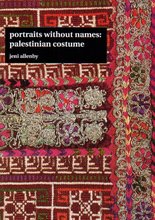
"Portraits without names: Palestinian costume" exhibition,
 |
"Portraits without names: Palestinian costume"
installed at Museum Victoria's Immigration Museum |
which:
"features over 200 years of Palestinian design, and examines how traditional costume and embroidery have long reflected the culture and identity of the Palestinian people. It remains the only exhibition of Palestinian cultural heritage available on the international museum travelling exhibition circuit.
 |
"Portraits without names: Palestinian costume"
installed at Museum Victoria's Immigration Museum |
"Curated originally for display in regions worldwide with Palestinian communities, Portraits without names is designed so that examples of cultural heritage held by the nearest community, or material held in nearly museums, can be incorporated into the display...."
 |
Wedad Boutagy, a member of the Sydney Palestinian community,
stands in front of an exhibition exhibition graphic showing her
in a Jerusalem studio photograph as a young woman,
at the opening night of the Archive's travelling exhibition
"Portraits without names: Palestinian costume" at the
Powerhouse Museum, Sydney, 1996. The story of the Boutagy family
was one of the diaspora stories told in the Sydney installation of the exhibition
(courtesy: Powerhouse Museum). |
With "Portraits" still touring and to counter the anti Muslim / Arab post 9/11 environment the Archive curated "Secret Splendours: women's costume in the Arab world":
 |
"Secret Splendours: women's costume in the Arab world"
installed at Museum Victoria's Immigration Museum |
The exhibition was reviewed in Newsletter - East Asian Art and Archeology Issues 57-70:
"this exhibition of breathtaking costumes and textiles covers a cross section of the arab world, including Morocco, Tunisia, Egypt, Syria, Jordan, UAE, Kuwait, Oman, Yemen and Saudi Arabia. It features historical and contemporary examples of costumes worn by urban, village, oasis and bedouin women. Among the most striking are heavy silk floss embroidered wedding outfits from Siwa Oasis in Egypt, ornate cross stitched bedouin dresses from the Sinai Desrt and lavish, gold sequinned festive over dresses from the gulf region"
 |
"Secret Splendours: women's costume in the Arab world"
installed at Museum Victoria's Immigration Museum |
With our third exhibition we wanted to return to the topic closest to our heart. "Symbolic defiance: Palestinian costume and embroidery since 1948" was curated with several goals in mind:
- it focused specifically on post 1948 costumes and textiles. Until this point museums very rarely acquired or displayed Palestinian costume produced after 1948. Because Palestine had ceased to exist in 1948 it was believed any contemporary cultural material was inferior and not worthy of being preserved in a museum. But we knew that those "inferior" costumes and embroideries had important stories to tell.
 |
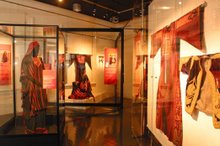
Palestinian political textiles on display in
"Portraits without names: Palestinian costume"
installed at Museum Victoria's Immigration Museum |
- While certainly there was a selection of these important works in our first traveling exhibition this was the first time Palestinian "intifada" political textiles had been displayed in some depth
 |
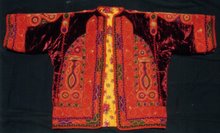
Chest panel of an intifada “flag” dress
Palestine Red Crescent Society's
Al Amal Rehabilitation Centre Embroidery Project, Khan Younis, Gaza Strip
(collection: Palestine Costume Archive, Canberra) |
- The exhibition was also accompanied by a range of embroidered products from the refugee embroidery projects that featured in the exhibition, so acted as both promotion and as a fundraiser for those projects.
 |
Deaf Palestinian refugees embroidering furniture covers
at the Palestine Red Crescent Society's
Al Amal Rehabilitation Centre embroidery project,
Khan Younis, Gaza Strip, 2000
(photo: Jeni Allenby) |
- the exhibition could easily be adapted for low budget display for Palestinian diaspora communities / international academic conferences / political activist organizations venues
The following blurb went up on our
website:
"Symbolic defiance reconstructs the last half century of Palestinian cultural history, bringing to life the almost complete loss of that heritage after the events of 1948, and documenting the extraordinary revival of Palestinian costume and embroidery that occurred in the late 1980s.
"The exhibition examines the establishment of Palestinian refugee camp embroidery projects and the effect of this upon embroidery's traditional role in Palestinian society. It also documents the development of Palestinian village life, including traditional dress and embroidery, as a nationalist symbol, and explores how women’s traditional costume became one of the dominant representations of Palestinian cultural identity.
"The exhibition includes material never before displayed, including examples of traditional dress styles from the 1950s, 1960s, 1970s and 1980s, as well as rare intifada dresses and political embroideries, many on loan from Palestinian refugee camp and village embroidery projects in the West Bank, Gaza Strip, Jordan, Syria and Lebanon...."
 |
Abdel Rahman al-Muzaye
a PLO postcard from the 1970s showing a Palestinian woman
in traditional dress with agricultural implements, symbolically
supporting her (pre 1948) village
(Palestine Costume Archive collection) |
The checklist included:
- examples of embroidered clothing during the decades since 1948
- examples of refugee camp styles
 |
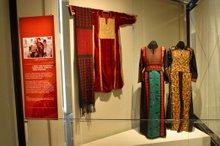
1980s traditional dresses in
"Portraits without names: Palestinian costume"
installed at Museum Victoria's Immigration Museum |
- examples of political garments and embroideries, most especially intifada dresses and embroideries
 |
Detail from "The Martyr" embroidered panel,
designed by the ANAT Workshop, Yarmouk Refugee Camp, Syria
(Palestine Costume Archive collection)
(photo: Jeni Allenby)
 |
Detail from "The Martyr" embroidered panel,
designed by the ANAT Workshop, Yarmouk Refugee Camp, Syria,
featuring allegorical figures holding symbols of lost Palestine
(Palestine Costume Archive collection)
(photo: Jeni Allenby) |
|
- Palestinian refugee camp embroidery project products
 |
Jordan River Designs dolls wearing traditional dress
from the Archive's collection in
"Symbolic defiance: Palestinian costume and embroidery since 1948"
|
- Examples of contemporary embroidery from Palestinian diaspora communities
- Examples of contemporary fine art/cultural expression from Palestinian diaspora communities inspired by Palestinian embroidery and costume
 |
Detail of the chest panel of a 1991 intifada "flag" dress
showing embroidered Palestinian boys with slingshots,
in the colours of the Palestinian flag,
designed by the Anat Workshop, Syria
(photo: Jeni Allenby). |
- original works on paper including 19th and 20th century postcards and photos showing traditional dress plus around thirty posters featuring costume and embroidery motifs
 |
| PLO postcard in the Archive's collection |
The Archive originally had around fifty posters in it's collection. A selection of thirty were chosen for this exhibition. We've specifically listed the ones below because there are also copies of these in the
Palestine Poster Project Archive so you can follow the link to see a photo of them:
- Palestine Red Crescent Society / Palestinian Heritage House series: calendar and posters featuring series of paintings by artist Abd al aal Hassan based on photos from other sources. Some examples: Al Souk and The Wedding (original source is a film still published in Shelagh Weir's "Palestinian Costume" British Museum)
- UNRWA - series of postcards and posters of traditional Palestinian dress from Widad Kawar's collection in Amman - one example here:
 |
UNRWA -Ramallah dress poster
from poster and postcard series of traditional
Palestinian dress from Widad Kawar's collection in Amman
source |
As you can imagine, with this wonderful checklist "Symbolic defiance: Palestinian costume and embroidery since 1948" was a stunning looking - and very informative - exhibition, and very quickly we received requests to display it.
The exhibition's first international installation was at the first
World Congress of Middle Eastern Studies in Mainz, Germany.
 |
"Symbolic Defiance: Palestinian costume and embroidery since 1948"
installed at WOCMES, Mainz, Germany
(First World Congress of Middle Eastern Studies) |
We met fellow Australian academic Vicky Mason there (who at the time was Research Associate International Relations and Global Security Curtin University of Technology Perth Western Australia).
Vicky later sent us this review:
"One of the highlights of attending the September 2002 World Congress for Middle Eastern Studies (WOCMES) conference in Mainz, Germany, was attending the outstanding Exhibition of "Symbolic Defiance: Palestinian Costume and Embroidery Since 1948" organised by the Palestine Costume Archive in Canberra, Australia.
"I felt honoured to have been able to see first-hand such a world-class collection of this priceless nature. In the course of my research I have read much about the key role costume and embroidery have played for Palestinian people, and to see such first-rate and unique examples of this work – such as with the Intifada Flag Dresses - was a truly amazing experience for me.
 |
"Symbolic Defiance: Palestinian costume and embroidery since 1948"
installed at WOCMES, Mainz, Germany
(First World Congress of Middle Eastern Studies) |
"I also have to say that the exhibition was a particular success because of the professionalism of the organiser of the exhibition – Jeni Allenby. In particular her paper "Re-inventing Cultural Heritage: Palestinian Traditional Costume and Embroidery Since 1948" gave a wealth of information enabling the true value of the exhibition to be appreciated.
"Moreover, I was not the only one who felt this way about the
exhibition and Ms Allenby’s paper. Many other scholars attending the conference that I spoke to personally also expressed their appreciation of the exhibition, a notable example being the Palestinian singer and musicologist Reem Kelani. I hope that the Archive continues their wonderful work taking this amazing collection to new audiences across the globe".
 |
"Symbolic Defiance: Palestinian costume and embroidery since 1948"
installed at WOCMES, Mainz, Germany
(First World Congress of Middle Eastern Studies) |
We tried! After WOCMES we were contacted by several venues and in 2003 an American tour was organized. As we later advised
Electronic Intifada the exhibition:
"was to have been displayed in the United States at the MESA 2003 (Middle East Studies Association annual conference) in Anchorage and the Arab Festival in Seattle...
"However on 1 November 2003 the exhibition (which was being couriered over to MESA 2003 by the Archive’s director) was taken for a security check/ x-ray at Los Angeles airport’s Terminal 4 and has not been seen since. All attempts by the Palestine Costume Archive, Qantas, Alaskan Airlines and MESA to locate the exhibition over the last three weeks have totally failed and the search has now been abandoned.
"The “loss” of this exhibition under such circumstances raises major concerns for all museums and curators worldwide currently proposing to tour Middle Eastern exhibitions to the United States and is a matter that should be further investigated before other such “losses” of Arab or Islamic cultural material occur.
"For the non-profit, volunteer-run Palestine Costume Archive - the only museum to make exhibitions of Palestinian cultural material available on the international museum traveling exhibition circuit - the loss is devastating and certainly puts in doubt the proposed 2005 tour to the United States and Canada of another popular Archive exhibition, Portraits without names: Palestinian costume, which contains a great many rare and irreplaceable 19th and early 20th century Palestinian costumes on loan from international museums and private collections...."
The "Portraits without names: Palestinian costume" was indeed cancelled.
As we posted on this blog's FAQ page (after discovering during a tour of our storage areas the two exhibition title stick-on wall labels for "Symbolic Defiance: Palestinian costume and embroidery since 1948" for the two venues where the exhibition was to be displayed after the MESA conference):
 |
"Symbolic Defiance: Palestinian costume and embroidery since 1948"
exhibition stick on wall labels for the two venues the exhibit never reached |
"It was terribly disheartening when it happened. I'm just very glad I was the courier. I would have hated anyone else from the Archive to bear the responsibility. Luckily the loans for the exhibitions were in my hand luggage so at least those were not lost, but everything else was..."
So what happened to our exhibition? We won't elaborate here other than to say we've been unofficially told that Israeli airport security experts were advising at LAX a lot sooner after 9/11
than the media reports. And ours was hardly the only Palestinian cultural exhibition that's disappeared over the years, as
The Palestinian Museum's newsletter article ("simply an initial step towards drawing attention to an issue deserving of far deeper investigation") about
17 lost Palestinian art exhibitions reconfirms:
"Over the past few years, Palestinian artists have participated in a number of exhibitions outside Palestine. Unfortunately, a significant number of these exhibitions are now effectively lost, and the paintings they contained remain unaccounted for.
"Speculation about the fate of these important works of art abounds; so too do the fingers of blame pointed at various groups and individuals. In interviews recently conducted by the Palestinian Museum, artists have agreed that the loss of many of the works was largely due to a combination of bad organisation and opportunistic misappropriation. If we add this to the shows confiscated or irrevocably damaged by the Israeli authorities, we find ourselves facing a situation that urgently needs to be rectified: these lost works represent an important part of the Palestinian visual history, and it is an enormous shame that they remain inaccessible to the Palestinian public."
We agree. The Archive very nearly didn't survive the loss of our own exhibition. While we were very very grateful for the response we received after it's loss (as we
wrote in our Press Release update of 10 Dec 03
"the Palestine Costume Archive would like to take this opportunity to thank everyone who has contacted us regarding our missing exhibition. We greatly appreciate your concern and support. The Archive would also like to thank MESA staff and other conference delegates for their wonderful support and tireless suggestions during the MESA 2003 conference in Anchorage (where the exhibition was to be displayed)")
you can imagine the enormous resulting expenses related to trying to locate it from Australia / legal fees etc, plus it was a priority for us to immediately cover the loss of all the embroidered products various refugee embroidery projects had provided for both display and sale. And of course all this occurred at a time when getting funding was almost impossible, in the post 9/11 environment.
Aware the exhibition was unlikely to be found, we
put the call out:
"the Archive has two aims in any further promotion of this matter. The first is to raise international awareness of the exhibition's loss to avoid such a thing happening again. The second is to raise public awareness of our museum’s need for emergency funds to replace both lost cultural material and expensive exhibition support material (such as enlarged graphics, museum banners, wall texts etc)."
And so began the long road to re-curating the exhibition, something that was very important to us and that gave us a reason for not giving up. We began reacquiring embroidered products from refugee embroidery programs, put the call out to Palestinians worldwide for help with replacing posters and political ephemera, early postcard etc and also asked that friends worldwide keep an eye out for interesting Palestinian political textiles.
But we then discovered we'd lost our nerve, in terms of touring internationally. Our lives are dedicated to preserving and documenting Palestinian heritage and we'd caused precious heritage to be lost, no matter how good our intentions. How could we tour and put more cultural heritage at risk? So for a while, as we noted
this blog's FAQ page:
"we cut down our traveling exhibition program and started advising people wanting an exhibition to think about creating their own, perhaps working with an Archive Education Officer."
And that worked well for a few years, while the Archive recovered from this experience - it's not easy as a museum to have experienced such a loss, and to live with it. Especially in the light of recent events in Gaza, a place that remains close to our hearts. We drew great comfort from reading
Omar Al-Qattan's "In the face of possible genocide, what use is a museum? On Gaza" which came as part of The Palestinian Museum's recent newsletters, and which we'd like to quote in detail here, because it's so important to us as a Palestinian museum ourselves, albeit on a much smaller scale:
"As the world watched in horror the vicious destruction visited upon the people of Gaza over the last weeks ... [at] the Palestinian Museum ... we were left feeling numb and powerless in the face of this carnage... In fact, the Museum team was inevitably left asking itself what a museum could possibly do in the face of such events, and what its role should now be.
We've gone through the same thing, these last dreadful months.
"The Palestinian Museum endeavours to narrate Palestinian history as a means of preserving part of our national collective memory, while reflecting upon, and hopefully learning valuable lessons from, that process. Unfortunately, the Palestinian narrative is one in which examples of attempted social and cultural genocide against our people abound, particularly during the last sixty five years: the Nakba of 1948, in which Israeli forces expelled over three quarters of a million Palestinians from their country and destroyed their villages and towns; the occupation of East Jerusalem, the West Bank and the Gaza Strip and the expulsion of a further 250,000 Palestinians in 1967; the 1982 war in Lebanon that killed thousands of Lebanese and Palestinians civilians and ended with the Sabra and Shatila massacre, in which Israel colluded in the murdering of between 800 and three thousand civilians by its Phalangist allies; the brutal suppression of two popular uprisings; confiscation of Palestinian land and water resources; the relentless building of illegal settlements, walls and checkpoints across our land and, last but not least, three military onslaughts on the Gaza Strip since 2008. But is the study and preservation of these historical crimes a guarantor that they will never occur again? And if not, then why build a museum to mark them?
"One possible answer lies in the notion of sumud, or steadfastness, which has profoundly influenced Palestinian cultural and political discourse and is essential to the thinking behind the Palestinian Museum.
Sumud has also been a foundation stone of the Archive.
"The logic of this notion is that we as Palestinians must continue to build our lives and our institutions in the face of Israeli military might: it is the simplest and most vital form of resistance, a way of asserting our physical presence and cultural vitality on our land, in a situation where the political balance of power is overwhelmingly against us. Part of that process is the preservation of the past, particularly the injustices perpetrated against our people."
"Yet we have seen in recent weeks that what this quiet defiance cannot do is eliminate the possibility that genocide and ethnic cleansing will be contemplated again - in a dark corner, perhaps, of the Zionist movement, faced as it is with its signal failure to rid historic Palestine of its Arab inhabitants and yet still staunchly refusing to recognize their rights within the framework of a just and equitable peace. One can even see the war on the people of Gaza, and the open calls by senior Israeli politicians for the expulsion and even extermination of Gaza’s Palestinians in recent weeks as a brief, if brutal, dress rehearsal for such a scenario. And of course, this is not something a museum can do very much to avert. All it can attempt is to raise awareness among both Palestinians and the world at large that what happened in 1948 can happen again, only this time on a much more cataclysmic scale. It can hope, too, that such awareness might just act as a deterrent to further horrors.
"The Palestinian Museum must also, surely, provide a platform for Palestinians to reflect upon our own responsibility for the events of the past and present. After all, how history unfolded in the way that it did, and what we might or should have done to change it, are questions that every museum of culture and history would surely like its visitors to ask themselves. Such questions are profoundly empowering: they remind us that we are not merely victims of history, but also, potentially, its agents. And so museums also, in this sense, end by offering hope. In our case, that the Palestinian people are still here, that at home and in exile we continue to make our voices heard and to gain support and solidarity, that our culture is celebrated the world over when a few decades ago it was denigrated and dismissed - surely all this means that the future belongs to us, not to those who seem determined to eliminate us...
Please read the rest
here. To conclude we'd just like to re-quote that last paragraph, because it inspires us so much:
"museums also, in this sense, end by offering hope. In our case, that the Palestinian people are still here, that at home and in exile we continue to make our voices heard and to gain support and solidarity, that our culture is celebrated the world over when a few decades ago it was denigrated and dismissed - surely all this means that the future belongs to us, not to those who seem determined to eliminate us..."
And who know, insha'allah, if we keep steadfast and strong, one day our lost exhibition may come home :)
 |
Detail of "Orange Tree" embroidery panel,
designed by the ANAT Workshop, Yarmouk Refugee Camp, Syria,
featuring allegorical figures holding symbols of lost Palestine
(Palestine Costume Archive collection)
(Jeni Allenby) |
More Info: